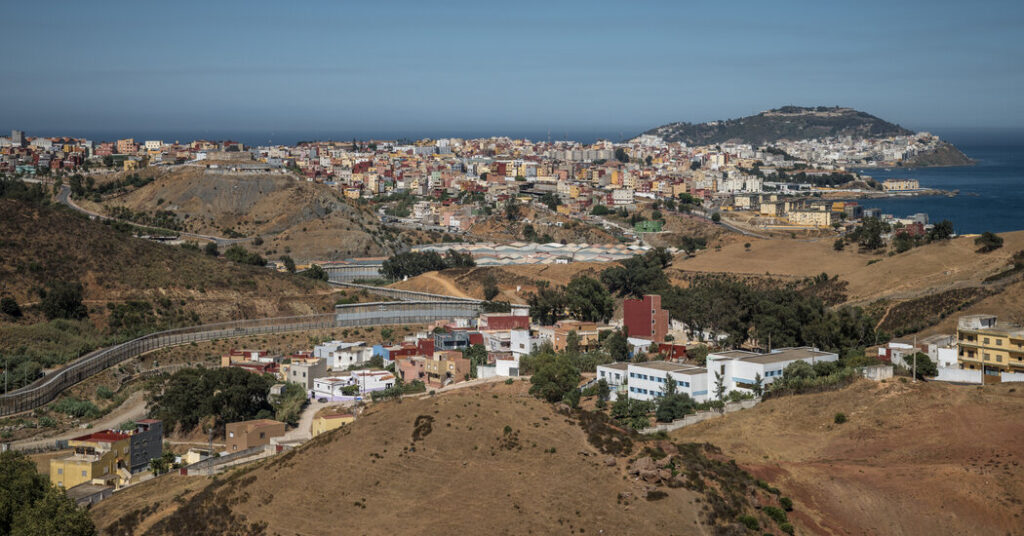
The two North African towns are only a mile apart, but vast differences separate them.
Ceuta sits near the northernmost tip of Morocco and juts into the Mediterranean Sea like an elephant’s trunk. It is a territory of Spain whose people enjoy the benefits of membership in the European Union. Compared with Fnideq, which is just south along the coast, it is wealthy. Fnideq is in Morocco, where economic prospects for many young people are bleak.
In recent days, the divide between these communities collapsed as tens of thousands of migrants from Morocco and sub-Saharan Africa pushed from around Fnideq into Ceuta. The upheaval captured global attention, including that of President Trump.
It was just the latest chapter in the tangled history between the two cities, whose people have been mixing and trading for generations even as their governments’ policies and disputes have hardened the border between them.
The latest crisis illustrated, in condensed form, the perennial reality that has bedeviled governments across the globe that try to control illegal migration: that economic disparity will motivate strivers across borders, often at great risk to themselves, to seek better lives.
In more than a dozen recent interviews in Fnideq and Ceuta, no one said they expected migrants to stop attempting the trip.
“If they opened the border, half of Morocco would leave,” said Abdullah Yusufi, 61, who was selling boogie boards, foam noodles and inflatable inner tubes near the beach in Fnediq. Ceuta was clearly visible, just across the bay.
Asked if he had sold gear to migrants trying to make the crossing, he shrugged.
“I don’t ask people what they are going to use them for,” he said.
The Moroccan government considers Ceuta occupied Moroccan territory and has at times restricted the border to put pressure on Spain.
Ceuta has been under Spanish control for hundreds of years, and its 84,000 residents are Spanish citizens, many of them from the mainland. Many others have roots in Morocco, stay in touch with relatives there, speak Moroccan Arabic and are Muslim.
For many years, Moroccans who lived nearby could enter Ceuta without a visa. Some would attend summer carnivals there. Many others came to bring back duty-free goods to resell, a type of permitted contraband that was good for business in Ceuta and key to the economy of Fnideq and the surrounding area.
“The amount of money that was coming into this part of the country was astounding,” said George Bajalia, who teaches anthropology at Wesleyan University and has studied the border.
But after Morocco built a giant port complex nearby, it restricted the illicit trade from Ceuta, he said. During the pandemic, Morocco closed the border with Ceuta, and it did not allow that trade to resume when the border reopened, hurting the economies on both sides.
That exacerbated the wealth gap that has propelled people from Fnideq and other Moroccan towns toward Ceuta.
“For decades, people built an economy around that trade, and now it was gone,” Mr. Bajalia said. “All these people, the thousands and thousands who made a living out of that border, haven’t had their jobs replaced.”
To enter Ceuta now, Moroccans need visas, which many cannot obtain. At the border crossing, Spanish and Moroccan officials monitor traffic and stamp passports.
In his fabric stall at a Fnideq market, Alami El Makrini, 60, said he used to go to Ceuta a few times per week to get merchandise. Now he can’t.
“When the state decided to close the border, they hurt the shopkeepers and didn’t give us any compensation,” he said.
Some have racked up debt, he said, and market workers were among those who fled their jobs to sneak into Ceuta last week.
“They can’t even make what they need for their daily survival anymore,” he said.
Global attention zoomed in on Ceuta last Thursday. Some 72,000 migrants drawn by social media posts falsely claiming that the border was open stormed into the territory. Over the weekend, most of them, short of food and water, returned to Morocco or were sent back by the Spanish security forces.
At least 75 migrants died while trying to cross, the Spanish authorities said. Most of them drowned in the bay.
The dramatic images of such a large, swift influx set off debates across Europe and elsewhere, with right-wing politicians pointing to Ceuta as a worse-case situation.
Mr. Trump said what happened in Ceuta looked like “the invasion of a country” and used the issue to attack his Democratic opponents before this year’s midterm elections.
“The same thing is going to happen to us if the Republicans don’t get elected, except worse,” Mr. Trump said during a cabinet meeting on Friday.
In Ceuta this week, life edged back toward normality. Residents strolled through the tidy plazas and broad avenues of its city center, past bars, restaurants and shops selling swimwear and lingerie.
But tension persisted. In a matter of hours, we witnessed a fistfight that appeared to be about migration and saw people at a grocery store call the police on a migrant who had come to buy food.
Khadija Saghero, 17, was one of the migrants who crossed last week, with her sister, Widad, 16. In an interview in Ceuta, she said it was her fourth attempt to reach the territory.
“I just wanted to leave,” said the elder Ms. Saghero, a recent high school graduate.
“We saw the stairs to happiness,” said her sister.
Nighttime fog and the presence of so many other swimmers helped the sisters avoid being caught, she said. Once in Ceuta, they got new clothes and had their hair done, hoping to blend in.
Now, they plan to lie low to avoid being detained. Then, somehow, they will head for Europe, she said.
“We want to go to the mainland,” she said.
In the Muslim-majority El Principe neighborhood, young men carrying plastic bags with scant possessions walked down narrow lanes wearing mismatched sandals, suggesting they were new arrivals. Many would probably soon learn that reaching Ceuta did not mean they could stay and that there was no easy way to cross the sea to continental Europe.
In an interview, Juan Jesús Vivas, the mayor-president of the territory, appeared as shaken and baffled as other residents by the recent events.
“People in Ceuta are in a state of sadness — a mix of grief, indignation, helplessness, fear, concern and anxiety,” he said. “People are asking themselves, ‘Could this happen again?’”
He estimated that 3,000 to 5,000 of the migrants who entered last week were still there.
The city was also caring for about 1,200 unaccompanied minors, who exceeded Ceuta’s shelter capacity by about 2,500 percent, he said.
“What has happened has laid bare just how vulnerable Ceuta’s border is,” he said.
Enrique Avila, a retired political science professor who served in the Spanish military for more than three decades, including in Ceuta and Melilla, another small Spanish territory farther east, said Ceuta’s mentality had been shaped by its long history of being attacked by its neighbors.
“This is a city laden with emotion because throughout its history it has been threatened and has felt alone,” he said.
He dismissed the idea that Spain’s North African territories were anachronistic, saying physical contiguity was not necessary for nations. If it were, he said, Northern Ireland would not be part of Britain and Alaska would belong to Canada.
“Hawaii is very far from the United States,” he noted.
The post Two Cities With a Tangled History appeared first on New York Times.