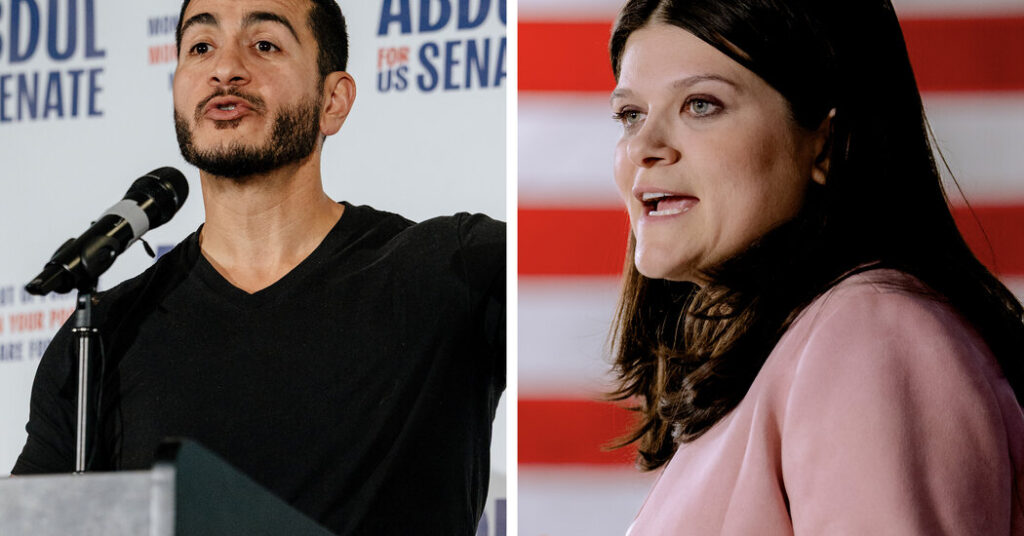
Recent polls of Michigan’s Democratic Senate primary have shown a comfortable lead for Dr. Abdul El-Sayed, a progressive former public health official, over Representative Haley Stevens, a moderate four-term congresswoman. However, some uncertainty remains, given how difficult it is to predict who will turn out for primaries, an issue that has sometimes led to surprising outcomes.
The race for the Democratic nomination sharpened in early July when Mallory McMorrow, a state senator, dropped out (her name will still appear on the ballot). Since Ms. McMorrow’s exit, Dr. El-Sayed has clear leads of more than 10 percentage points in seven of the nine polls fielded.
Ms. Stevens’s only leads in that stretch came from a Glengariff Group survey fielded shortly after Ms. McMorrow’s exit — where Ms. Stevens led by seven percentage points — and a Tavern Research poll from that same week. The Tavern poll showed her ahead by one percentage point head-to-head, but also had Dr. El-Sayed ahead by three percentage points when Ms. McMorrow was included in the question.
Even when Ms. McMorrow was still in the race, Dr. El-Sayed led in most polls, though his leads at that point were mostly in the single digits. As the field has narrowed and undecided voters have broken, his margins have grown.
Age Could Be a Key Factor
Poll results among demographic subgroups should be interpreted with caution, as they are based on relatively small subsamples that are not necessarily designed to be representative. But some meaningful takeaways can emerge when multiple surveys point in the same direction. Polls in this race have consistently showed Dr. El-Sayed performing well among voters under 30 years old — a persistent trend among recent progressive candidates — and have him maintaining an overall advantage with voters under 50 years old.
Ms. Stevens, by contrast, draws her strongest support from older voters. That could play a key role in how the race plays out, as that demographic has historically made up a significant share of primary electorates.
Questions of Electability Cut Both Ways
Some concerns have been voiced that Dr. El-Sayed’s progressive views could make him a riskier general-election candidate. A recent SoCal Strategies poll — sponsored by Red Eagle Politics, a conservative personality — offered some support for that concern. In that poll, only 57 percent of Ms. Stevens’s primary supporters said they would back Dr. El-Sayed in the general if he won the nomination, and 12 percent said they would instead vote for former Representative Mike Rogers, the presumptive Republican nominee, who lost to Senator Elissa Slotkin in the 2024 general election.
An EPIC-MRA poll showed Ms. Stevens leading Mr. Rogers by two percentage points, while Dr. El-Sayed lagged behind Mr. Rogers by three percentage points. A Glengariff Group poll from late July told a similar story, with Ms. Stevens in the lead by one percentage point (Dr. El-Sayed again trailed, this time by 10 percentage points).
On the opposite side of the Democratic spectrum, concerns have been raised that Ms. Stevens’s support for Israel could alienate other portions of the Democratic base. A late June Quantus survey found both Ms. Stevens and Dr. El-Sayed leading Mr. Rogers by one percentage point, while a Wedgewood poll from around the same time showed Dr. El-Sayed ahead of Mr. Rogers by five percentage points, and Ms. Stevens tied. More recently, a Mitchell poll conducted in late July found Dr. El-Sayed tied with Mr. Rogers, while Ms. Stevens lagged by three percentage points.
The post Polls Show El-Sayed With a Significant Edge in Michigan Senate Primary appeared first on New York Times.