Michael O’Hanlon is a defense and strategy analyst at the Brookings Institution and the author of “To Dare Mighty Things: U.S. Defense Strategy Since the Revolution.”
Despite the heady moment in Philadelphia with the Declaration of Independence’s approval in early July, 1776, that summer was a tough one for the nation’s founders, George Washington in particular. The rest of that year — until Washington crossed the Delaware River and won the Battle of Trenton on Dec. 26 — would go down as the worst period of the Revolutionary War.
Throughout those unhappy months, the outcome of the war was very much in doubt. Trouble was brewing even before the founders adopted the Declaration in Philadelphia. On July 2, British forces under Gen. William Howe occupied Staten Island and sought to establish control of New York Harbor. Over the ensuing weeks, they relocated to Long Island and prepared a major assault on Washington’s forces.
Washington and his army had established elements of a defensive position on the island. But they were unprepared for the attack that came. Outnumbered, outmaneuvered and outthought, Washington’s forces were defeated at the Battle of Long Island on Aug. 27 and had to escape across the East River to Manhattan.
This evacuation provided only a temporary reprieve. British forces pursued Washington and his beleaguered army northward, forcing a battle at Harlem Heights near the current location of Columbia University on Sept. 16. There, led by “Knowlton’s Rangers,” the Continentals held their own at first — but soon had to flee north once more. The British again caught up to the Continental Army and achieved another decisive victory at the Battle of White Plains on Oct. 28.
Washington then directed the Continental Army to return to Manhattan and defend Fort Washington. But on Nov. 16, the army suffered another major defeat as thousands of troops were captured. What was left of Washington’s ragtag army fled through New Jersey to Pennsylvania, hoping to outrun the British and perhaps pick up reinforcements from patriotic colonists along the way.
Though reinforcements were generally not forthcoming, rebel and Colonial forces managed to stay one step ahead of the pursuing redcoats. As the belligerents moved closer, the Continental Congress took precautions and evacuated indefensible Philadelphia. Fortunately, Washington’s troops arrived at the Delaware River as winter set in — allowing them to commandeer local shipping and cross the river themselves, creating a defensive barrier against the British that promised to hold at least until the river froze.
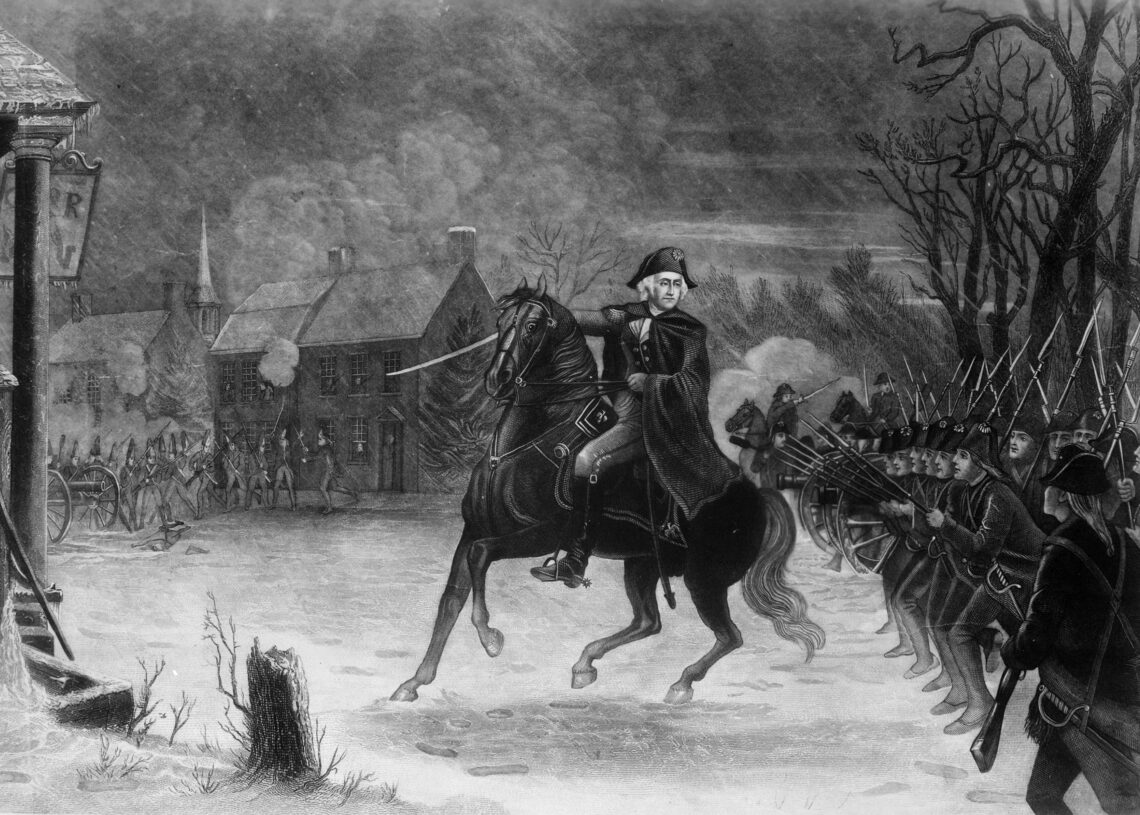
That crossing of the Delaware westward bought the Continental Army time to rest and recover — and for Washington to regain his footing. As John Adams wryly put it, reflecting on the events of the previous months, “in general, our Generals were out generalled.” But on Christmas night, Washington would cross back over the Delaware to strike unsuspecting and dispersed Hessian and British forces at the Battle of Trenton. He would surprise the British again a week later at the Battle of Princeton.
Thus began a counterpunch strategy that Washington would employ in one form or another throughout the war. He generally eschewed open-field battles except when conditions were favorable — as happened at Saratoga in 1777 and Yorktown in 1781 — and instead relied on surprise and deception.
Washington was arguably the only American military commander in history to fix his own flawed strategy during a major war. In other conflicts where the U.S. struggled initially but later turned things around, a new military leader was needed to develop and implement a new strategy, as happened when Gen. Ulysses S. Grant turned the tide of the Civil War and when Gen. Matthew B. Ridgway replaced Gen. Douglas MacArthur in the Korean War.
Before turning things around, Washington needed to ride out some tough experiences — and get a few lucky breaks along the way. The Fourth of July in 1776 was a short-lived party. Celebrations over the signing of the Declaration looked like a premature taunt of King George III until the Continental Army’s fortunes improved. Washington’s perseverance might be the most important lesson from 1776 — and one Americans can still absorb today.
The post After July 1776, the party ended quickly for George Washington appeared first on Washington Post.