Before we get to news about the stinky seaweed that’s plaguing beaches, and some good news for conservation, let’s get caught up:
Documents undercut Trump’s claims about Utah national monument: When he announced that he was shrinking the protected Bears Ears National Moment in Utah last month, President Trump claimed that recreation was virtually impossible there. “You can’t go hunting, you can’t go fishing, you can’t do anything, you can virtually not even walk on it,” he said. But recreation has been allowed in Bears Ears since 2016. And government documents reviewed by The Times show that Trump administration officials were briefed on recreational opportunities inside the monument.
Oceans
Mexico’s war on stinky seaweed
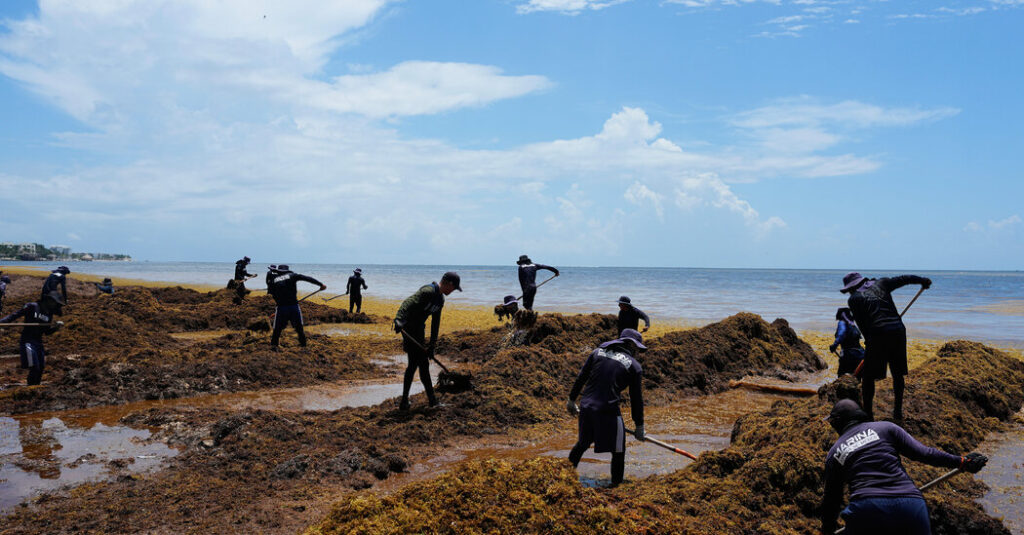
Mexico’s beaches are contending with a record-breaking influx of noxious seaweed as up to 9,000 tons per day wash onto their pristine shores along its Caribbean coast, home to tourist destinations like Cancún.
Sargassum, a type of floating macroalgae that emits a rotten-egg smell as it decomposes, can threaten the health of cleanup workers and send tourists back indoors.
President Claudia Sheinbaum of Mexico last week announced a $115 million plan to clean up the coastline, David Shortell reported. Mexico will deploy two large ships to capture the seaweed before it reaches the beach and the country’s navy will install 30 miles of containment barriers to trap the sargassum at sea. Hundreds of workers will wait on the sand to shovel up the rest.
“The effort so far has been titanic, but we have to do more to prevent sargassum from reaching the beaches,” Sheinbaum said.
Sargassum has threatened tourism in Mexico, Florida and the Caribbean in recent years. The heaps of it that wash up on beaches come from a larger, thousands-miles-wide mass in the Atlantic Ocean that weighs some 30 million tons and that has been expanding seasonally for more than a decade.
At sea, sargassum patches are important habitats for turtles, crabs and fish. But when the seaweed washes ashore, it quickly begins decomposing, releasing unpleasant odors and a harmful gas, hydrogen sulfide.
Though sargassum volumes fluctuate, the overall trend line is clear: Warming oceans, along with nutrient runoff from farming, are making the stinky seaweed more prevalent and extending its growth season.
A very big blob
Twenty years ago, scientists had never detected sargassum blobs in the Caribbean Sea.
“Starting in 2011, everything changed,” said Chuanmin Hu, a professor of physical oceanography at the University of South Florida, who has monitored sargassum by satellite for two decades.
A shifting climate, nutrient pollution and other factors pushed the seaweed into tropical Caribbean waters, where it thrived. Tropical temperatures, abundant sunshine and plentiful nutrients were “like heaven to this plant,” Dr. Hu said.
In 2023, sargassum landings struck Florida, blanketing the coast for months on end. Two years later, the patch was even larger, surpassing its previous record by 40 percent.
This year, March and April broke monthly records for the amount of sargassum in the tropical Atlantic, Dr. Hu said.
Health issues for frontline workers
It’s not easy to get rid of washed-up sargassum, which can coat miles of shoreline and replenishes itself with every return of the tide.
In the Mexican state of Quintana Roo, home to Cancún and Tulum, beachfront businesses have hired workers to rake sargassum by hand each morning during the peak season.
It’s a dangerous job. A recent study that enlisted sargassum cleanup workers to wear hydrogen sulfide sensors found that nearly half the measurements exceeded Mexico’s legal exposure limit over the course of an eight-hour workday. Almost half the workers reported skin irritation and headaches, and a quarter of them reported nausea and dizziness. Some who stood in the water for hours reported losing hair and nails.
“These people earn very little money, sometimes only 500 pesos a day,” roughly equivalent to $29, said Rosa Rodríguez-Martínez, a researcher at the National Autonomous University of Mexico who worked on the study. “They don’t have any medical support because it’s a temporary job,” she added.
“It’s very unequal. It’s violating their human rights, basically.”
Health problems are not confined to Mexican beaches. In 2018, doctors in Guadeloupe and Martinique recorded 11,000 cases of acute sargassum exposure.
Cleanup efforts scale up
In Miami-Dade County, Florida, 19 specialized tractors comb the beaches twice a day during the peak sargassum landing season, mixing most of it into the sand and sending some to a landfill at a combined cost of $9 million a year, according to CBS News Miami.
In Mexico, the special-purpose sargassum ships are expected to remove up to three tons per minute from the ocean. The 30 miles of barriers are also expected to prevent some from reaching the store.
Shortell reports that at Oasis Hotels & Resorts, a collection of all-inclusive properties in Cancún’s popular hotel zone, it takes nearly 200 people working round-the-clock shifts to remove the sargassum from the beaches.
Conservation
100 animals and plants just got some much-needed help
A new fund called the Phoenix Species Project said Tuesday that it would pump $200 million into efforts to pull imperiled animals and plants back from the brink of extinction and even restore them in the wild.
It’s among the largest philanthropic funds focused entirely on species recovery, and it stands out for both the scope and specificity of the wildlife included. The project is a collaboration between Re:wild, a nonprofit group co-founded by the actor Leonardo DiCaprio, and the Bezos Earth Fund, a private foundation created by Jeff Bezos, the billionaire behind Amazon.
The move comes amid alarming declines in global biodiversity. The hundred species were chosen because they were near extinction, had local organizations already working to save them and represent a diversity of habitats, countries and types of species. They include:
-
The Hickory Nut Gorge green salamander in North Carolina, whose already dwindling habitat was largely leveled by mudslides from the remnants of Hurricane Helene in 2024.
-
The fuzzy belly button, a South African plant, whose sudden popularity as houseplants, particularly in East Asia, has driven it to near-extinction in the wild.
-
The bowmouth guitarfish in the Indo-Pacific, which looks like a cross between a ray and a shark and is killed for its prized fins. — Catrin Einhorn
Number of the day
A 33 percent increase in profit
Lisa Friedman reports that Saudi Aramco, the world’s largest oil company, on Tuesday reported a 33 percent increase in profit despite severe disruptions to its supply routes caused by the war in the Middle East.
Oil companies have reported multibillion-dollar windfalls for the second quarter of 2026 because the war has driven energy prices higher, Friedman writes.
After the United States and Israel launched military strikes against Iran in February, Saudi Arabia shifted much of its oil out of the Strait of Hormuz, a vital waterway for oil and gas that has been paralyzed during the conflict.
Related: Insiders at leading oil and gas companies have made millions from stocks since the Iran war began.
In case you missed it
A federal plan would impose drastic water cuts on Arizona, California and Nevada: Communities and farms across three states face potentially serious cuts in the water they can use from the Colorado River over the next decade under a plan the Trump administration published on Friday.
The Trump Administration is undoing plans to increase workplace heat protections: The administration is moving to rewrite Biden-era proposals that would mandate breaks and access to water and shade for workers, in a step businesses lauded but that labor groups said could weaken already-limited federal protections. Congress is considering legislation that would go a step further.
More climate news from around the web:
-
A record drought has forced Romania and Hungary to shut down nuclear plants, The Guardian reports. Both countries rely on the Danube River for cooling water. “Romanian naval forces carried out a controlled explosion to help redirect vital cooling water from the drought-hit Danube to the country’s last working nuclear reactor,” it writes, while Hungary “said it may be able to eke out two more days of power from its only atomic plant.”
-
Solar power will soon surpass coal as China’s biggest source of energy capacity, Bloomberg writes.
-
According to Reuters, Colombia recorded its lowest deforestation levels in two decades between 2022 and 2025.
Read past editions of the newsletter here.
If you’re enjoying what you’re reading, please consider recommending it to others. They can sign up here.
Follow The New York Times on Instagram, Threads, Facebook and TikTok at @nytimes.
Reach us at [email protected]. We read every message, and reply to many!
The post Mexico Declares War on Stinky Seaweed appeared first on New York Times.