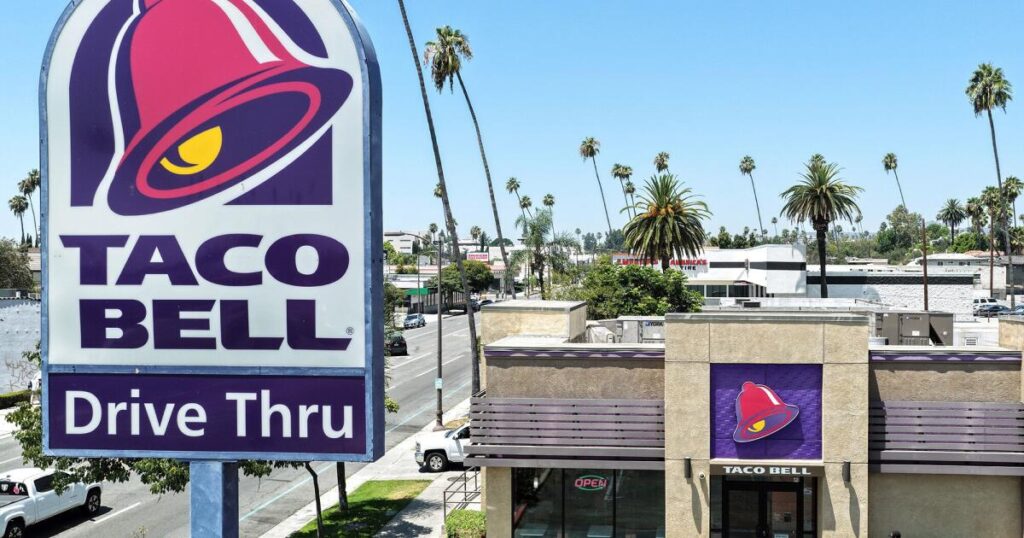
Michigan health authorities were in touch with Taco Bell’s parent company, Yum! Brands Inc., about a parasitic outbreak in early July, weeks before the company officially alerted consumers.
The Michigan Department of Health and Human Services held a call with Yum on July 2 to discuss cyclospora, according to documents obtained by Bloomberg News through a public records request. In a follow-up email, officials asked to connect with the company’s supply chain quality assurance and communications teams “for a discussion about any intervention or notification that could be taken this week to aid in reducing the number of cases in the future.”
At the time, Taco Bell had received a media inquiry about some Michigan locations, according to an email sent to the company by a public health official.
“Although it was reassuring to hear that you had not received complaints and your staff were not reporting illness, we have a strong signal from our epidemiologic interviews that we need to continue to work with Taco Bell,” wrote Sarah Lyon-Callo, Michigan’s state epidemiologist.
It’s unclear exactly how the outbreak came to light and when the discussions began. While the early days of any public health investigation raise substantial questions, the cyclospora situation was unique because of its size and the speed with which it spread.
Michigan advised businesses and commercial kitchens that handle raw produce to take extra precautions with lettuce, leafy greens and other produce on July 4. Two days later, a state rapid response team reiterated an earlier request to Taco Bell for documents, saying the pace and number of people affected meant information was needed “in a timely manner to preserve public health.”
Taco Bell became the public face of the outbreak after a July 7 news report showed signs purportedly affixed to some of its restaurants in Michigan warning of an ingredient recall. At the time, no recall had been announced by the US Centers for Disease Control and Prevention, the Michigan Health Department or Taco Bell.
Yum shares fell 2.9% on Monday. Taco Bell said it acted quickly based on Michigan’s guidance.
“Out of an abundance of caution we moved swiftly to voluntarily remove potentially impacted ingredients from select stores, in line with Michigan guidance,” the company said in a statement Monday.
The Mexican-style chain didn’t publicly confirm the move until July 14, when it said it had removed “limited ingredients” at select restaurants as a precautionary measure due to the outbreak. Taco Bell said at the time that authorities hadn’t confirmed a link to Taco Bell, an ingredient or a supplier.
The cyclospora outbreak has infected more than 6,707 people across 45 states, according to the CDC. While Michigan appears to be the epicenter, and two people with serious underlying medical conditions have died there, US officials are investigating multiple outbreaks with a variety of potential sources.
Federal health authorities didn’t publicly link Taco Bell to the outbreak until July 17, when it advised customers to avoid shredded lettuce at locations across five states. The Food and Drug Administration tied the illnesses to iceberg lettuce supplied by produce giant Taylor Farms, which recalled products sent to 27 states. Taco Bell pulled the affected Taylor Farms lettuce from its restaurants.
The Michigan health department said Monday that “information pointed to lettuce, tomatoes and onions as potential sources for this outbreak, although other food items could not be ruled out. Eating at Taco Bell restaurants was also commonly, although not exclusively, identified,” it said in a statement.
The department shared the information, which was based on detailed food diaries, with Yum officials, the CDC and FDA, according to the statement.
Visits to Taco Bell restaurants took a hit from the outbreak, though Yum executives said last week that the sales declines have “moderated materially” thanks to promotions such as a $1 burrito drenched in enchilada sauce and a “Mexican pizza” for the same price.
Yum shares declined about 4% in July. Stocks of other restaurants that serve lettuce, including Sweetgreen Inc., Cava Group Inc. and Chipotle Mexican Grill Inc. have also fallen, even though they haven’t been linked to the outbreak.
The infection is caused by ingesting the microscopic cyclospora parasite, typically from contaminated food. It is typically found on leafy greens like lettuce or herbs and raspberries. It’s notoriously difficult to trace cyclospora because the parasite cannot be replicated in a lab and the produce has often been consumed by the time symptoms start to show.
Epidemiologists have to rely on patient interviews to determine a source of the contamination. By July 10, Michigan had conducted more than 700 interviews, according to the documents.
Federal infection numbers lag state health departments due to case reporting delays. Michigan – the epicenter of the Midwest cluster that is now tied to nine states – reported more than 11,200 infections and two deaths on Monday. While cases increase during the warm summer months, there are normally fewer than 100 people diagnosed in the US each year.
Michigan’s health department said the two people who died had underlying health conditions that were likely impacted by cyclosporiasis and dehydration. Symptoms of the infection include nausea, fatigue, and severe, watery diarrhea that can last as long as two months. It is treated with common antibiotics and supportive care including fluids.
Sirtori writes for Bloomberg.
The post Taco Bell knew of parasite outbreak weeks before nationwide lettuce warning appeared first on Los Angeles Times.