THE EGO TRIP: Psychedelic Toads, a Trail of Deaths, and the Guru Who Peddled Transcendence, by Kimon de Greef
If you were to power-rank psychedelic experiences, the effects of the dried secretions of a drab toad would top the list — a trip that careens you into infinity in less time than it takes to make a sandwich.
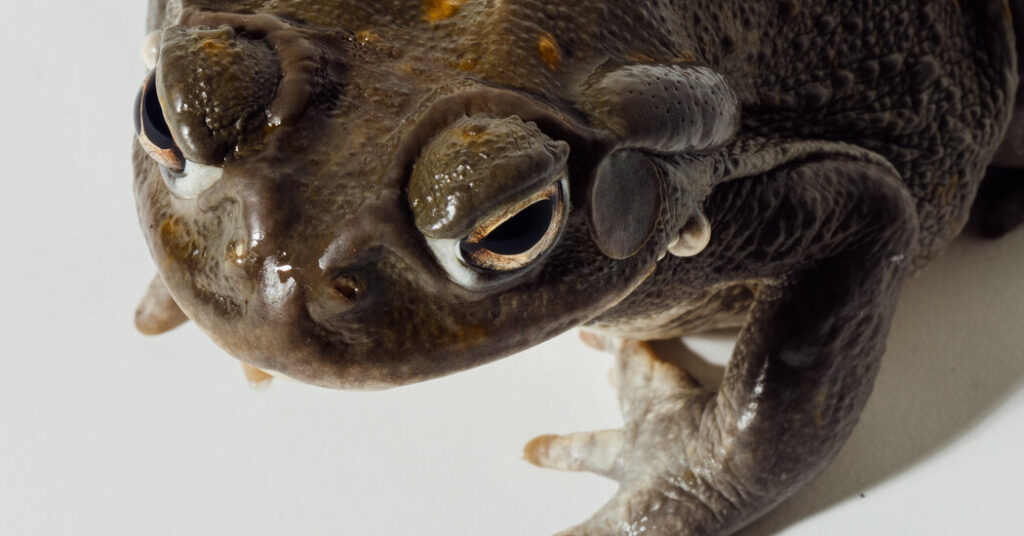
The milky poison that the Sonoran Desert toad releases contains the psychoactive compound 5-MeO-DMT, revered by adherents as “the God molecule.” When it’s dried and vaporized, one inhalation can induce overwhelming mystical feelings and ego-obliterating loss of self.
For some, the experience elicits feelings of gratitude and healing. For others, it’s the stuff of nightmares and breakdowns. For an experience this intense, a wise guide is key — or so you’d think.
“The Ego Trip,” an enthralling and galling travelogue into the deeply weird underbelly of the psychedelic renaissance, shows that not all guides are created equal. And some, including the book’s central character, are downright psychopathic.
The South African writer Kimon de Greef is a journalist to the bone, and his straight take on the strange goings-on around him and keen eye for detail help to anchor the surrealist drama — toad glands that pop “like pimples,” people with names like Tofu Deb, psychedelic seekers vomiting in unison.
The book emerged from a profile de Greef wrote for The New Yorker of Octavio Rettig Hinojosa, a Mexican doctor turned crack addict turned toad proselytizer. In some circles, the name Octavio is synonymous with the drug. He became a psychedelic celebrity, writes de Greef, “like a god” to other toad facilitators (yes, that’s a job description) who had revived a lost Indigenous practice.
For a while, Rettig was everywhere, endorsed by the United Nations Association of Venezuela and featured in a Vice documentary, leading ceremonies at Burning Man and headlining psychedelic conferences. To this day, he maintains a small but loyal legion of toad-smoking followers.
Rettig did not, in fact, discover the practice. In the 1960s, an Italian chemist found the compound 5-MeO-DMT in the Sonoran Desert toad, the only animal known to produce it, though it is naturally occurring in some plants and has been used in ceremonial snuffs for thousands of years.
Synthesized 5-MeO-DMT is particularly attractive to pharmaceutical companies owing to its short onset and duration (it hits fast and tops off around 30 minutes). Several clinical trials of a synthetic form are ongoing, including ones intended for the treatment of postpartum depression and bipolar II disorder.
But a subset of psychonauts believes that the synthetics are no match for the healing power of the Toad deity. And, accordingly, a market emerged in their sole habitat, the Sonoran Desert — which sits in the cross hairs of the Mexican drug wars.
Rettig’s legitimacy arose in part from his connection to a tribe called the Seri, who, as “the last custodians of a sacred practice,” de Greef writes, had trained him. The Seri, who were nearly colonized out of existence and now work primarily in the fishing trade, had been badly affected by the epidemic of drug addiction owing to their proximity to cartels’ smuggling routes. In fact, Rettig introduced toad smoking as a treatment — only to turn around and claim that his patients were the true originators of the practice.
It was a compelling story. And a financially profitable one. With the backing of a small faction of Seri elders, Rettig took to donning their traditional garb and chanting their songs, traveling the world, selling mostly Western audiences on his discovery of a suppressed Indigenous practice.
De Greef follows this claim through the historical record and finds it lacking — though he stops short of deeming it a fraud. (A 2026 journal was more decisive, terming the practice “a fabricated ancestrality.”)
If you’re familiar with the guru playbook, you know where this is going. Rettig engaged in reckless practices. He bragged about the number of clients he had bedded. A child as young as 5 took the “medicine” to treat his A.D.H.D.
In 2016, footage emerged of Rettigkicking and slapping a terrified man on a Venezuelan beach, forcing him to take more hits of toad. Rettig even admitted to using taser-like devices on his clients.
Then came the deaths. A girlfriend mysteriously died in an underwater cave. Then another woman stopped breathing during a ceremony and died; the charges were later dropped and Rettig settled a civil case out of court.
“We see the fallout,” a fellow toad practitioner admitted to de Greef. “It’s terrifying.”
But the terror doesn’t begin or end with Rettig. There are many other toad facilitators, some just as predatory, who are still working today. And the same recklessness extends to the aboveground research, as big pharmaceutical companies compete to bring 5-MeO-DMT to market. Though there are some promising results, especially related to the treatment of addiction and depression, some of the research leaves much to be desired in the way of safety and sense.
After The New Yorker published the damning profile, de Greef had a tense run-in with his subject in Mexico during a celebration of the Seri new year. There, Rettig offered de Greef a draft of an unknown “essential oil.”
To my absolute befuddlement, de Greef took it.
“I had no reason to trust him, yet in that moment I chose to, perhaps because the offer felt sincere, even conciliatory,” he writes.
The concoction is laced with an extract of morning glory seed, chemically related to LSD. “My eyeballs felt twice their usual size,” he writes. “I floated in the water and watched the sky.”
The mind reels. How could our steadfast, buttoned-up guide fall into such an obvious trap? And herein lies the fascinating but unexplored center of it all: If de Greef can be so easily ensnared by a man like Rettig, what chance do any of us have?
THE EGO TRIP: Psychedelic Toads, a Trail of Deaths, and the Guru Who Peddled Transcendence | By Kimon de Greef | White Rabbit | 315 pp. | $35
The post Toad-Laced Psychopathy Is One Hell of a Drug appeared first on New York Times.