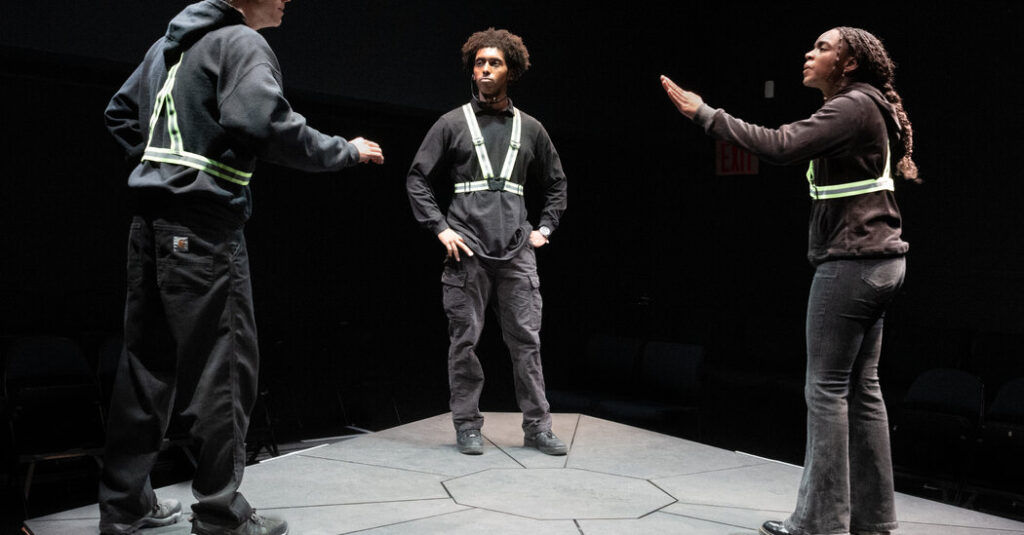
Up on a platform well above ground level, three colleagues keep an eye out. For what, they aren’t exactly sure. A look, maybe, or a certain discomfort that sets one visitor apart from the crowd, flagging them as troubled, possibly on a mission of self-harm.
That isn’t the usual task of an employee at a tourist attraction, but Brendan George’s new play, “The Vessel,” is set at the climbable, 150-foot-tall latticework structure of the same name, which opened at the Hudson Yards luxury development on the West Side of Manhattan in 2019.
While the story George tells about the “Vessel” is fictional, it is inspired by the mammoth metal honeycomb’s grisly history as a site of suicides: four between February 2020 and July 2021. The youngest to die there was 14, the oldest, 24.
Respect for the dead, and for the people who lost them, is an element that “The Vessel,” at 59E59 Theaters, gets very right. Directed by Peter Charney, this play is not looking to exploit tragedy or to depict suicide. Rather, it is interested in the devastation to witnesses and bystanders when preventable deaths occur in public spaces.
For Drake (Sofonyas), Missy (Anastasia Locke) and Viggo (Will Ingram), 20-somethings all, their workplace is the “Vessel.” Their official title is “parks ambassador,” though they don’t actually work at a park. Answering tourists’ questions is part of the $15-an-hour gig. But as Drake says, “We’re hired to prevent distress. Or to intervene. Ultimately, we’re security guards.”
They pass the time mainly by talking among themselves; the contemplative Drake and the upbeat Missy are already tight when Viggo, a wide-eyed naïf from Utah, joins the crew. The collective trauma of a visitor’s suicide on Viggo’s first day bonds the three of them, and they add to their duties of vigilance a self-appointed charge: looking out for one another, becoming their own cordon of safety and well-being.
Sofonyas, especially, is interesting to watch, and the simple geometric set, by Tony DiBernardo, does well at suggesting a single cell of the gargantuan “Vessel.” Yet the production’s tone is erratic, sometimes too overblown for the tiny space that is 59E59’s Theater C, and the staging has a subtlety verging on opacity. It would be helpful for the audience to know, for example, that each of the play’s three scenes occurs on a day that a visitor, in real life, died at the “Vessel.”
People jump on those days in the play, too. Because of the script’s sensitive elisions, though, we are basically expected to catch on only afterward that a suicide has occurred. Viggo’s agitated right-to-die monologue at the top of Scene 2 takes place three weeks after someone jumped, but we don’t know that. Consequently, his anguished eruption comes across as merely manic — and, being quite loud, as unlikely on-the-clock behavior.
What is clear throughout is the weight of the suicides on the three workers: the responsibility they feel, and the guilt — whether or not they witnessed an individual death or might have been able to prevent it. Those feelings are particularly deep-rooted in Drake, a smart guy who came to the “Vessel” from a job as a security guard at an elementary school where a tragedy occurred. His experience at the “Vessel” layers trauma upon trauma.
The entire play takes place before the three-year shutdown of the structure that followed the fourth suicide. It is horrifying to consider — as “The Vessel” absolutely wants us to — how very long it took, after the first death, to make the attraction safer.
The “Code of Conduct” displayed outside the entrance to the “Vessel” these days notes at the very bottom that some levels of the structure “have mesh” — floor-to-ceiling steel netting, a feature put in place in 2024. In small bold capital letters, the sign adds: “Please respect the mesh.”
The Vessel
Through Aug. 23 at 59E59 Theaters, Manhattan; 59e59.org. Running time: 1 hour 30 minutes.
If you are having thoughts of suicide, call or text 988 to reach the 988 Suicide and Crisis Lifeline or go to SpeakingOfSuicide.com/resources for a list of additional resources. Here’s what you can do when a loved one is severely depressed.
The post ‘The Vessel’ Review: Suicide Intervention Squad appeared first on New York Times.