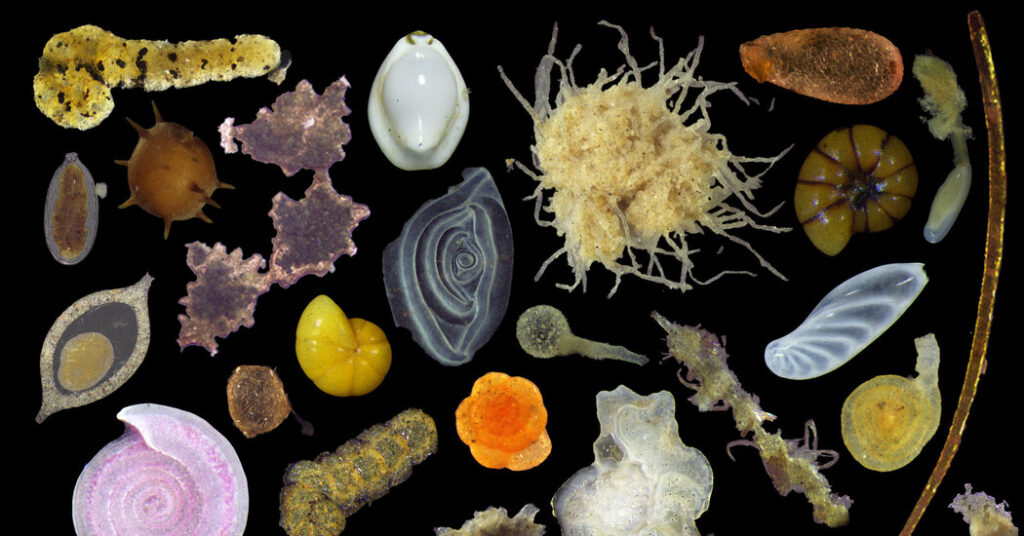
Industrial mining of the seabed could reduce the abundance and diversity of tiny animals living in the depths of the Pacific Ocean, a new study found.
The study, published Friday in the journal Nature Ecology and Evolution, was funded by The Metals Company, which is vying to become the first company to conduct commercial mining on the ocean floor.
Researchers from the Natural History Museum in London analyzed samples from the seafloor before and after a mining test and found that the number of worms, minute crustaceans and other small animals in the path of the mining vehicle fell 37 percent. The variety of the creatures also declined by 32 percent.
The data came from the Clarion-Clipperton Zone, an area in the Pacific Ocean between Hawaii and Mexico that is targeted for seabed mining because it is rich with potato-sized nodules that contain nickel, cobalt, copper and manganese. The metals are used in renewable-energy technologies and also have military applications.
The Metals Company has spent some $250 million studying the environmental effects of seabed mining. The dozens of researchers involved had contracts that allowed them to independently analyze and publish their results. This emerging collection of work represents one of the largest and most comprehensive research efforts conducted in the Clarion-Clipper Zone to date.
More than a dozen countries, through state-owned entities or sponsored companies, hold United Nations permits to explore more than one million square kilometers of deep sea floor around the world. The agency’s International Seabed Authority has not yet approved commercial mining.
This past April, President Trump took a major step that would allow mining to begin by issuing an executive order to fast track commercial seabed mining. It instructed the U.S. government to issue mining permits in national and international waters. The actions drew criticisms for circumventing the U.N. process.
The National Oceanic and Atmospheric Administration is reportedly reviewing The Metals Company’s permit application. A spokeswoman for NOAA declined to comment on the permitting process.
The Trump Administration has also recently proposed expanding the area open to mining around American Samoa from 18 million acres to 33 million acres, despite a moratorium from the territory’s Polynesian leadership.
Critics say not enough is known about the potential damage to the marine environment to allow industrial seabed mining. Nearly 40 countries have called for a moratorium or ban on seabed mining
Scientists once assumed that there was hardly any life in the deep sea, believing that the environment was too extreme and devoid of nutrients. But research from the past few decades has increasingly shown that life on the deep sea is surprisingly abundant and diverse.
The new study described 788 species of macrofauna, one subset animals that live in the Clarion-Clipperton Zone. “We’ve actually only sampled such a tiny proportion of the deep sea,” said Eva Stewart, a doctoral student and lead author of the new study. There could be thousands of species waiting to be discovered, she said. “We just haven’t seen them yet.”
Other research examining a 44-year-old deep sea mining test site found that the biodiversity losses from seabed mining can linger for decades.
Around 30 percent of the small animals that live on the seabed are directly attached to the mineral-laden nodules that the mining operations would collect. Those creatures were not included in the new study, which surveyed macrofauna in the sediment around the nodules.
The Metals Company’s mining vehicles leave about 10 percent of nodules behind, according to Michael Clarke, the company’s environmental manager. He said the 37 percent reduction found in the study was not concerning because it was lower than expected and the company expects these populations to recover over time.
Other research groups funded by the company have examined mining pollution, risks to marine food webs, and other longstanding questions about the nascent industry’s potential to harm ocean ecosystems.
“We used to think of deep sea ecology as a really stable system,” said Bryan O’Malley, a research scientist at the Eckerd College who is working on several studies funded by The Metals Company. Last week, he was lead author of one in Nature Communications that detailed a new method to monitor sediment plumes from commercial mining. “What we found was actually that it’s quite dynamic.”
Understanding the natural variation of marine life in the Clarion-Clipperton Zone is one of the biggest challenges to studying potential effects of mining. Several research groups that have examined animal life in the Clarion-Clipperton Zone discovered that the ecosystem undergoes large changes year-to-year, even without any influence from mining.
It’s one of the most important findings from the expeditions, said Annemiek Vink, a marine geobiologist at Germany’s Federal Institute for Geosciences and Natural Resources who has seen preliminary results for several of the studies and was not involved with the research.
Animal communities on the seafloor can also differ over distances as short as 100 kilometers, while life in the water column also fluctuates more than expected. Without more data about background conditions, scientists won’t be able to properly evaluate the risks from mining, said Jeffrey Drazen, a professor of oceanography at the University of Hawaii, who has published studies on seabed mining funded by The Metals Company.
Seabed mining involves reaching deep into the ocean with an autonomous vehicle to harvest nodules from the seabed floor and pump them up to a ship on the surface for processing. During a mining test that scientists studied in 2022, The Metals Company brought up 3,000 tons of nodules from the seafloor, a fraction of the 1.5 million tons it plans to collect during its first year of commercial operation.
The process creates two kinds of plumes of sediment that can alter the ecosystem. One plume comes from disposing the excess sediment carried to the surface with the mineral nodules as they are transported up to a mining ship. The other involves the clouds kicked up on the seafloor as the vehicle rolls across the soft sediment.
During their test, The Metals Company released the excess sediment 1,200 meters under the waves. Scientists from the University Hawaii funded by The Metals Company found that releasing the sediment at this level dilutes the food supply of the zooplankton and small squid.
This could “potentially starve the food web,” said Michael Dowd, a doctoral student at the University of Hawaii who led the study, which was published last month in Nature Communications. “These animals also serve as a food source for deep diving top predators that are important in commercial fisheries, such as tuna.”
After receiving this data, Mr. Clarke of The Metals Company said the company changed its commercial operating plans to release the unused material 800 meters deeper to avoid the zones where zooplankton are most abundant. The company also plans to expel less waste than it did during the test, because it discovered the slurry contains recoverable nodule fragments, he said.
More than a half-dozen researchers who participated in the research expeditions said in interviews that the scientific opportunity provided by the company was rare. Several said they accepted the funding for the research project because they retained independent ownership of their data and were free to publish their own analysis.
The company gets to see and use the results of the research, “but they don’t have any say in what we publish,” said Adrian Glover, a deep sea biologist at the Natural History Museum and the latest paper’s senior author.
The Metals Company had to rely on independent scientists because it needs data for an eventual environmental impact statement (which regulators require before commercial mining can begin) but Mr. Clarke said there are few commercial contractors with the expertise necessary for studying deep sea ecosystems. The company will continue to fund research while scaling up any commercial operations, he said.
“There’s some papers out there that are based on work that we funded that are not necessarily very useful or complementary to us,” he said. “But that’s because we had this agreement with the academics to get them on board.”
Max Bearak contributed reporting.
Sachi Kitajima Mulkey covers climate and the environment for The Times.
The post What Scientists Found When a Deep Sea Mining Company Invited Them In appeared first on New York Times.