Hein Htet Oo knows the inquisition well.
A simple catch-up call with his parents — who met in their 20s — might turn into a rapid-fire interrogation: “You’re almost 30. Why are you not dating? When are we going to have grandkids?”
For Mr. Oo, turning 27 soon in New York City, it all feels so far away. He filled his free time in graduate school working, desperate for cash to afford groceries and housing. He spent $7,000 on legal help for an asylum application after arriving from Myanmar.
And he’s still searching for financial and job stability in his own life; it’s hard to imagine supporting someone else’s, too.
“Sometimes I wonder, ‘Am I doing the right thing? Am I really living my life?’” Mr. Oo said. “But dating, starting a family — those things can’t even be on my list with all of the other things I have to solve.”
Ask any relationship expert and they’ll tell you: Young people are in a romance recession. They’re dating far less than their parents and grandparents did back in their 20s and early 30s, according to poll after poll, inspiring all kinds of theories and concerns.
But for a generation beginning their adult lives, one simple dilemma is ever more apparent: It’s hard to hit the dating scene amid a crushing economy, sluggish job market and escalating costs.
More than half of unmarried young adults — ages 22 to 35 — say not having enough money is their biggest barrier to dating, according to a national research project from Brigham Young University’s Wheatley Institute and the Institute for Family Studies.
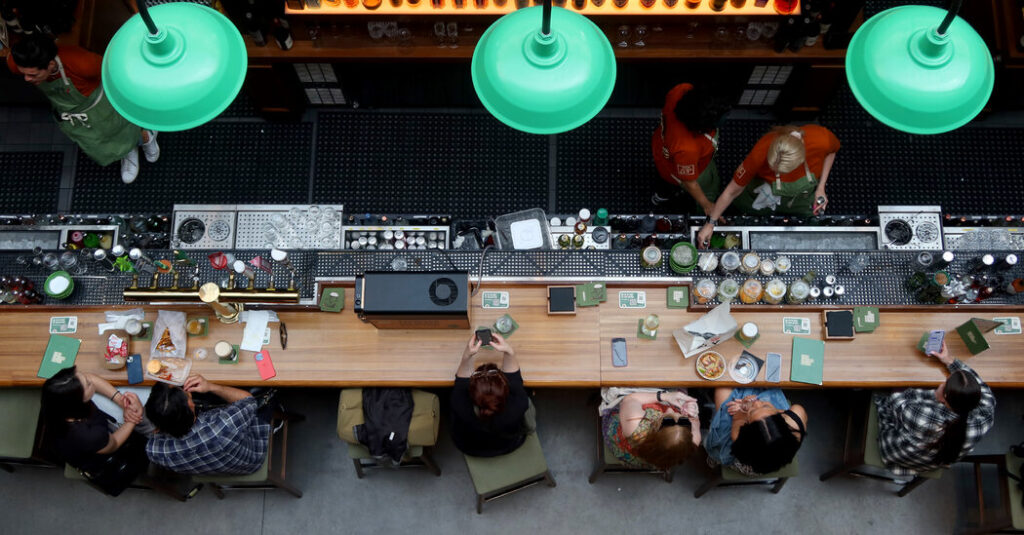
That pressure can feel especially acute in New York. When you can barely afford your rent and energy bills, $130 dinner dates, $20 cocktails or $28 tickets to see “The Odyssey” quickly add up.
“How can New Yorkers be expected to find love right now?” Jillian Hardeman-Webb, a host and producer at the media company Complex, asked Mayor Zohran Mamdani during a video interview this summer.
“You’re just finding out the person is annoying — and you’ve already spent all this money. Now, you’re broke,” she said.
“It’s so expensive to live in this city,” said Mr. Mamdani, 34, who is married. “It’s even more expensive to love in this city.”
‘Dating Here Is Just Terrible’
It has never been easy to date when you’re strapped for cash.
But today’s economy is emerging as another pain point for a generation already struggling to build relationships. Many are fatigued from endless swiping on the apps, frustrated with dead-end situationships and fractured from widespread social disconnection.
It’s not necessarily that young people aren’t interested in relationships, surveys show. But for some, dating less often has become one of the trade-offs of living in an expensive city.
“I definitely do want to get married and have kids,” said Grace Sakellariou, 27, who is single and was born in Queens. “But that just feels so unattainable. I can’t even think about affording a wedding.”
Ms. Sakellariou and her twin sister, who live together in Astoria, have noticed that more men seem to be asking to split the bill — even on second or third dates. “It’s discouraging,” she said. “I think it’s stunted our growth that everything’s so expensive.”
New York would seem like an ideal sandbox for cheap plans — with dozens of free museums, hundreds of green spaces and heaps of low-cost events every weekend that are just a $3 fare away on the 24-hour subway. And lately, some young people have begun opting for park picnics over pricey experiences.
But in interviews, others described feeling full-force pressure from social media in a city that is home to many young professionals with six-figure salaries. TikTok influencers debate whether coffee dates signal low effort. On Instagram, a male creator recently warned his 1.3 million followers that no man with a net worth under $100,000 should be allowed to date.
The average date night spending for Gen Z Americans is more than $200, including transportation and getting ready, according to a survey from BMO Financial Group.
Brian J. Willoughby, a Brigham Young University professor who studies dating, said that it can be tough for other generations — who often met through family networks, religious spaces or bars — to appreciate how much more complicated the dating dance of today is.
“It’s like: ‘How much time did I spend scrolling to find this person? I’m worried about the dinner, but I also have my $30 Hinge subscription, the clothing, all these other things,’” he said.
One underemployed 24-year-old software engineering graduate in Long Island City admitted in an interview that he felt undesirable while earning barely above minimum wage.
An 18-year-old incoming college freshman in Astoria complained about the cost of connection even as a teenager. The ticket to attend her public high school’s senior prom with her date was $375 — and that was before the dress.
And a 27-year-old on the Upper East Side recounted a recent evening when her date said he’d forgotten his wallet, but swore to pay her back.
She never heard from him again.
“Dating here is just terrible,” the woman, Shannon O’Neil, said. “God awful.”
The Singles Tax
For some young adults, a big budget conundrum is in store: Many desperately need a partner to beat the economy. But they struggle with the upfront financial investment it takes to find one.
Take Manhattan, the most expensive borough. New Yorkers who share a one-bedroom apartment can save more than $25,000 on rent a year when living with a partner, the biggest difference in the country, according to a recent analysis from StreetEasy based on median asking rents.
And if the rent is split, it’s much easier to pay off student debt, save up to buy a home or take that big career risk — changing jobs, starting a business or attending graduate school.
It’s why Benjamin Goldman, a labor and public economist at Cornell University, wonders: What if declining dating and marriage rates help explain at least some of the economic angst that so many people in their 20s and 30s feel in New York and other cities?
“It’s one piece of this that’s been under-discussed,” Dr. Goldman said.
Still, this generation’s dating difficulties stretch far beyond economics.
Young people often aren’t confident when it comes to asking someone out or other basic relationship skills. Many agree that dating itself has gotten harder. And in interviews, some traced their hardships back to March 2020, when their social lives in college — where their parents might have met — were upended by the coronavirus pandemic.
“There’s a lot of problems that are both in and out of our generation’s control,” said Josh Timmins, a 25-year-old who plans to start law school next year and is moving to Brooklyn from upstate. He has been slammed with work, gone out less often because a few drinks can cost $40 and feels like the dating apps “are a bit soulless.”
“It’s hard to find actual connection,” he said.
And even people in long-term relationships still feel the burden of rising prices.
Daniel Rosen, 27, lives in West Harlem with his partner and earns good money as a software engineer. But they’re still going out far less than when they arrived from Seattle two years ago.
The prospect of a tab of $150 or more for two entrees, two drinks, an appetizer and tip eventually became “too expensive to justify when I could cook at home.”
These days, he said, “the nice date nights are not even once a month anymore.”
The post Gen Z Can’t Afford a First Date appeared first on New York Times.