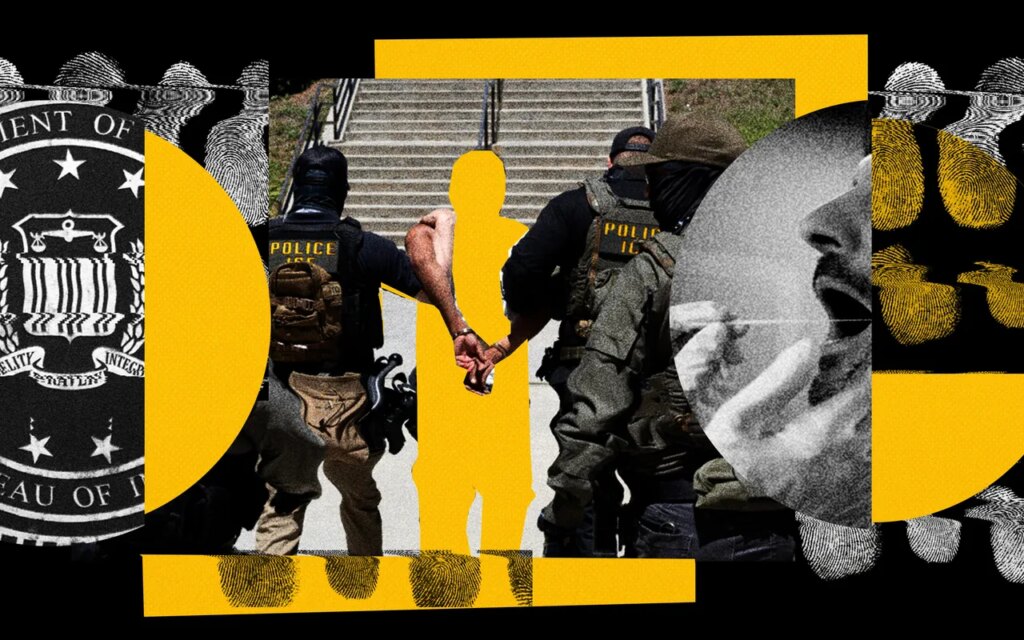
On March 13, 2025, Hugo Moreno-Mendez arrived at the McLennan County Probation Department in Waco, Texas, expecting a routine probation check-in. Instead, Immigration and Customs Enforcement officers were waiting to arrest him.
According to a criminal complaint reviewed by WIRED, officers drove Moreno-Mendez to a nearby ICE field office. There, one deportation officer after another approached him with the same demand.
Open your mouth.
One officer tried to take his fingerprints and swab the inside of his cheek for DNA. He refused. Then another tried. Then a third. Each time, Moreno-Mendez refused.
Four days later, Moreno-Mendez was charged with failing to register as a noncitizen and refusing to provide DNA while in federal custody—the latter a misdemeanor that, as of 2021, ICE itself said it was unaware had ever been accepted for prosecution.
WIRED has made this article free for all to read because it is primarily based on reporting from Freedom of Information Act requests. Please consider subscribing to support our journalism.
Moreno-Mendez took both counts to trial. On August 18, 2025, a magistrate judge in Waco found him guilty of each and sentenced him to time served.
Moreno-Mendez’s case is part of a sweeping expansion of DNA collection from people held for civil immigration violations—a federal campaign that, backed by the threat of prosecution, funnels the genetic profiles of nearly everyone in ICE custody into an FBI database built for criminal investigations. New research from Georgetown Law’s Center on Privacy and Technology estimates that the Department of Homeland Security has become the largest single source of new genetic profiles in the nation’s criminal DNA system, with ICE alone potentially adding as many as roughly 920,000 profiles in 2025.
The vast majority of people in ICE custody have no criminal conviction, and residing in the US undocumented is typically a civil, not criminal, offense. Yet once the DNA profiles of detained people enter the FBI’s Combined DNA Index System, or CODIS, law enforcement agencies across the country can compare them against evidence from unsolved crimes—and against crime-scene DNA collected years or even decades from now. The physical sample, which holds a person’s entire genome, sits in a federal laboratory indefinitely.
The expansion of DNA collection has extended to families held in immigration detention, sparked lawsuits over the collection of DNA from protesters and others who allege they should never have been subjected to the program, and drawn congressional scrutiny after lawmakers learned that children were being swabbed at a family detention center in Dilley, Texas.
“None of the families at Dilley have been convicted of a crime,” US representatives Joaquin Castro, Greg Stanton, and Nanette Barragán said in a joint statement to WIRED. “They do not belong in a database meant for violent criminals, especially children.”
In response to questions from WIRED, a DHS spokesperson defended DNA collection as a border-security and identification measure, saying CBP takes samples from people arrested on federal charges and from detained noncitizens who are subject to fingerprinting and not otherwise exempt. Asked about children whose profiles were submitted to CODIS, DHS pointed to a separate DNA-testing program used to verify family relationships. That program is distinct from the collection at the center of WIRED’s reporting. DHS did not address Georgetown’s estimate that ICE may have added hundreds of thousands of profiles to CODIS in 2025.
For most of the program’s history, migrant DNA collection played out at the border, where Customs and Border Protection swabbed people it took into custody. ICE’s own contribution was marginal. Internal training slides obtained by Georgetown through the Freedom of Information Act (FOIA) show ICE collected 3,609 DNA samples in fiscal year 2020 and 16,392 more through mid-May of fiscal 2021—roughly 20,000 in all. CBP was operating on a different scale entirely: Agency spreadsheets Georgetown obtained and analyzed show it sent the FBI the DNA of at least 1.36 million people between October 2020 and the end of 2024, more than a dozen times ICE’s rate during the same time period.
Georgetown’s new report suggests the program entered an entirely different phase in 2025. FBI records show the “detainee” index of CODIS—the sub-index where DHS-collected profiles are stored—reached 3,345,692 profiles by December 2025, growing by roughly 995,000 that year alone. That is more than 2,700 people a day, every day, for a year.
The FBI does not explicitly disclose which agency submitted which DNA profile. To estimate the split, Georgetown compared the total against CBP records showing the agency sent the DNA of approximately 75,215 people to the FBI in 2025. ICE has refused to release comparable data, rebuffing repeated public records requests. Based on the gap, Georgetown estimates that ICE may be responsible for as many as 919,908 new profiles in a single year.
The change tracks a broader shift. According to Transactional Records Access Clearinghouse data cited by Georgetown, CBP once accounted for the majority of immigration detentions. ICE now accounts for roughly 85 percent, CBP for 15. As of July 11 of this year, ICE was holding 65,765 people, up from 60,311 in early April, while arrests climbed toward 1,500 a day, according to Austin Kocher, a research assistant professor at Syracuse University. The largest single group in detention had no criminal history at all.
“Fun Facts”
US law enforcement’s increased DNA collection traces to a legal and regulatory shift that began more than two decades ago. Congress in 2005 authorized federal agencies to collect DNA from people arrested, charged, convicted, or detained under federal authority. For years, however, Justice Department regulations allowed DHS to exempt many people held in immigration custody when collecting samples would create resource burdens.
In 2020, the DOJ eliminated the exemption. That December, ICE issued Directive 10092.1, requiring officers to collect DNA from nearly everyone in its custody.
Internal 2021 training materials obtained by Georgetown show just how broadly officers were instructed to interpret the policy. One slide, from a May 2021 refresher course for Enforcement and Removal Operations (ERO) officers, tells them that asylum seekers and refugees who have not adjusted their immigration status are not exempt—“therefore, their DNA must be sampled.” Another instructs officers, in capital letters, to ensure DNA is largely collected after “ANY arrest.”
Under a heading reading “FUN FACTS,” a May 2021 ICE presentation counts 69 confirmed CODIS hits from samples that ERO submitted in roughly the preceding six months, matching evidence in cases involving “Sexual Offences, Homicide, Missing Person, Burglary, Larceny, Crimes of Public Order, Property Crimes, Assault and Battery, Stalking/Domestic Violence and a stolen Pinto.” The slide’s author appended a note: “Editor’s note: you’d care if that was YOUR Pinto!”
Before the 2020 rule change, profiles from people detained under federal authority were a negligible share of the CODIS index that police search against crime-scene evidence. Georgetown estimates they accounted for about 9 percent by 2024. If DHS and the rest of the criminal legal system keep collecting at these rates, the center projects, DHS will have supplied more than a third of that index by 2030—a milestone it had previously estimated wouldn’t arrive until 2034.
Primary Purpose
When the Justice Department changed its regulations in 2020, it defended the collection of DNA from immigration detainees in part as an administrative identification measure—akin to taking fingerprints during booking. That distinction mattered. In Maryland v. King, the US Supreme Court upheld warrantless DNA collection from people arrested for serious crimes in part because the state said the swabs were used to establish the identity and criminal history of people in custody, not simply to investigate crimes they were not suspected of committing.
Georgetown has long argued that rationale made little sense in the immigration context. The samples are not merely used to confirm who someone is; they are sent to CODIS, where police can search them against evidence from unrelated crimes for years into the future.
In late March 2025, a deputy official at ICE asked for a legal opinion on “DNA testing for family units.” An attorney within ICE’s Office of the Principal Legal Advisor offered their take, writing that the “primary purpose” of the government’s DNA-collection authority is to build “a national DNA database for solving crimes,” not to establish family relationships.
Stevie Glaberson, research director at Georgetown Law’s Center on Privacy and Technology and a coauthor of the report, says the email strips away the identification rationale the government relied on to defend the program. “The Fourth Amendment categorically prohibits the government from compelling you, without suspicion, to hand over your sensitive information on the speculation that it might be helpful for crime-solving in the future,” Glaberson says. “But what this email shows is that that’s exactly what this program is for.”
Asked whether it agreed with the ICE attorney’s statement that the program’s “primary purpose” is building a national database for solving crimes, DHS did not respond.
ICE training materials instruct officers to warn people that refusing to provide a sample is a federal crime and to refer refusal cases to prosecutors. A 2021 training presentation obtained by Georgetown stated, however, that the agency was then unaware of a single such case accepted for prosecution.
That is no longer true. WIRED identified two prosecutions filed in 2025 against people in immigration custody for refusing DNA collection. One was Moreno-Mendez’s. In the other, CBP enforcement officers at the airport in Carolina, Puerto Rico, asked a man named Ronald Genao-Diaz for a sample on at least five separate occasions, according to court records. He refused each time, covering his mouth with a disposable mask to prevent officers from taking the sample. Prosecutors charged him under the same refusal statute as Moreno-Mendez, and with document fraud. After a judge found probable cause on both counts in May 2025, he pleaded guilty, provided a DNA sample while being processed by the Bureau of Prisons, and was sentenced to time served and a fine.
Kids, Tested
During a May 2026 inspection of the Dilley Immigration Processing Center in South Texas, members of Congress tell WIRED, ICE officials told them the agency had been collecting DNA from detained families for the previous three months. Immigration officials offered conflicting explanations for why the samples were being taken, where they were sent, and how long they would be retained, according to the lawmakers, who later demanded answers from DHS.
In correspondence sent last month and obtained by WIRED, DHS told US representatives Joaquin Castro, Greg Stanton, and Nanette Barragán that ICE may collect DNA from children as young as 14. The department also confirmed that samples collected under the program are sent to the FBI for analysis and entry into CODIS.
Federal immigration agencies have not always followed even that age limit. Newly released CBP records analyzed by Georgetown and independently reviewed by WIRED identify 492 children under 14 whose DNA the agency sent to the FBI between January 2025 and January 2026—including 33 7-year-olds, 32 6-year-olds, and 21 5-year-olds.
One 4-year-old Mexican child was processed in El Paso on January 7, 2026. The record shows the child withdrew an application for admission to the US in lieu of expedited removal—the outcome for a traveler turned around at a port of entry—and was returned to Mexico.
Leecia Welch, chief legal counsel at Children’s Rights and a member of the legal team enforcing the so-called Flores settlement—the long-standing court agreement governing the detention, treatment, and release of children in federal immigration custody—has visited Dilley 12 times since the family detention center reopened. Flores counsel are permitted to inspect detention facilities, interview children and families, and raise potential violations with the government and the court. Welch says the legal team has “regularly” heard from families at Dilley that they were subjected to DNA testing.
“People are very confused about why their DNA is being tested,” Welch says. “I do not think they’re being told what the purpose is. And I do think it creates a lot of stress, especially for children.”
Sworn declarations filed as part of a brief related to the Flores settlement agreement show the testing occurring across several years and settings. In 2026, one mother said Border Patrol took mouth swabs from her and her 5-year-old son but “did not tell us anything about it.” Another mother said officers fingerprinted her and “ran DNA tests on both of us”; her declaration does not identify any explanation. In 2021, a 17-year-old girl traveling alone from El Salvador said an official swabbed her cheek while she was held with roughly 85 other children, though her declaration does not say whether officials explained why. A 12-year-old detained with their family at Dilley in 2026 said officials told them the testing was for “security reasons” and to prove that the child’s father was really the father—an account more consistent with familial verification than CODIS collection.
Welch says Flores settlement–related counsel cannot yet determine how often families are tested, what criteria ICE uses, or which of the government’s separate DNA programs is involved in any particular case. “I honestly don’t know why they’re taking the DNA,” she says. Families interviewed by the legal team often never learn the results, she adds. “It’s just left hanging.”
DHS did not explain why CBP records show DNA submissions involving 492 children under 14. The department also did not address Flores settlement-related counsel’s account that families are often left confused about why DNA was taken or what happened to it.
In May 2026, four US citizens sued federal agencies and officials, alleging that agents took their DNA after detaining them at protests outside the ICE detention center in Broadview, Illinois. The arrests occurred during Operation Midway Blitz, the Chicago enforcement surge led by then Border Patrol chief Gregory Bovino. The suit, Briggs v. Mullin, argues that DHS’s collection program violates both the Fourth Amendment and the First, and seeks the destruction of the plaintiffs’ samples and the expungement of their profiles. “Being arrested and having my DNA taken for peacefully protesting was unsettling and deeply un-American,” lead plaintiff Dana Briggs said in a statement quoted in Georgetown’s report. “My charges were thrown out, but my private biological information is sitting in a lab somewhere. My family members never even went to a protest, but their biological profile is now government property too.”
Asked by Georgetown about those allegations, DHS defended DNA collection from people arrested for federal crimes. “Federal law requires law enforcement to collect DNA samples from individuals arrested for federal crimes under 28 CFR 28.12(b), including rioters arrested for assaulting or obstructing law enforcement,” the department said. The response did not address whether all of the plaintiffs had been charged with such crimes, whether their profiles were entered into CODIS, or the report’s broader findings about DNA collection from immigration detainees and children.
A separate lawsuit involves George Retes Jr., an Army veteran who was employed by a security firm and working as a guard at a California cannabis farm when, he says, federal agents unlawfully detained him following a raid and took a cheek swab. His attorney, Marie Miller of the Institute for Justice, tells WIRED that no one explained why the DNA was being collected or what would happen to it.
Questions about the program’s oversight have grown alongside its rapid expansion. At a congressional hearing in July 2025, DHS inspector general Joseph Cuffari told Representative Ayanna Pressley that his office had “just got done writing” a report related to the question of collection of DNA from children.
When Georgetown later requested the report under FOIA, the inspector general’s office produced two unrelated documents. It identified no completed report, no draft, and no other records showing that the office had examined the DNA-collection program.
Months after ICE began collecting DNA from families at Dilley, members of Congress asked whether the agency had ever examined the privacy or civil-rights consequences of the practice.
ICE said it was unaware of any such assessment.
The post ICE Collected Nearly 1 Million People’s DNA Last Year—Including Young Children appeared first on Wired.