Last January, when Reagan-appointed Judge John Coughenour became the first federal judge to block President Donald Trump’s attack on birthright citizenship, he did not mince words. “I’ve been on the bench for over four decades,” Coughenour said. “I can’t remember another case where the question presented is as clear as this one is.”
Coughenour was the first judge to reach this conclusion, but he was hardly the last. In the last 11 months, numerous judges have reached the only conclusion that the Constitution’s text permits: Donald Trump does not have the power to strip Americans who are born in this country of their citizenship.
The Supreme Court took its sweet time before deciding to take up this issue, but, on Friday, the Court finally announced that it would hear Trump v. Barbara, a case asking whether the Constitution permits Trump to unilaterally denationalize Americans born in the United States. If the justices are capable of behaving in a nonpartisan manner, Trump will lose this case 9-0.
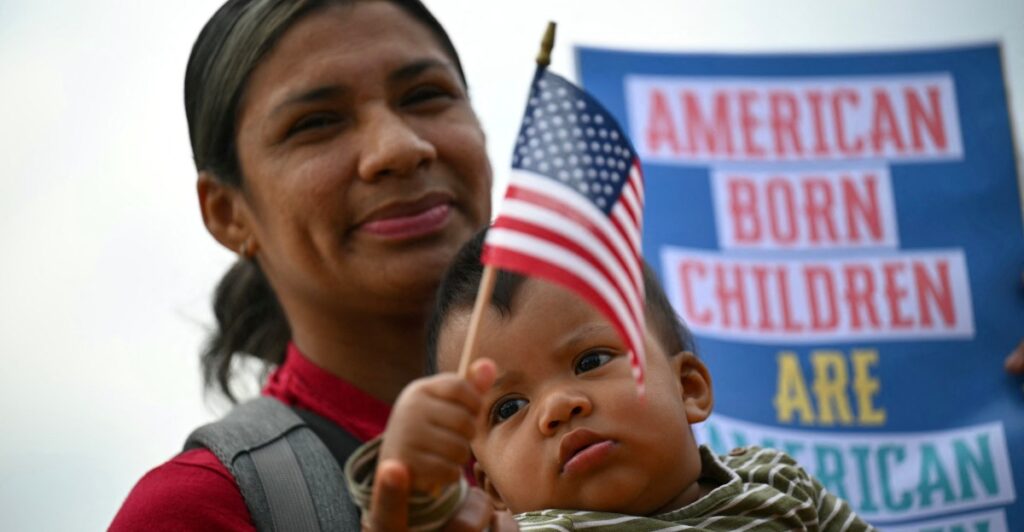
On the first day of his second term, Trump issued an executive order purporting to strip citizenship from some newborn Americans. The order, entitled “Protecting the Meaning and Value of American Citizenship,” claimed to remove citizenship from two classes of Americans. The first is children born to undocumented mothers whose fathers are not citizens or lawful permanent residents of the United States. The second is children with fathers who have similar immigration status and whose mothers were lawfully but temporarily present in the US at the time of birth.
There are few questions in US law that are more settled than the question of whether babies born in the United States are citizens of this country. In the immediate aftermath of the Civil War, the nation ratified the Fourteenth Amendment. Its first line is, “All persons born or naturalized in the United States, and subject to the jurisdiction thereof, are citizens of the United States and of the State wherein they reside.”
“All persons” means all persons. That includes people with undocumented mothers or whose parents otherwise have an immigration status that Donald Trump does not like.
The “subject to the jurisdiction” exception, explained
The Fourteenth Amendment’s text contains one exception to this general rule: Only people “subject to the jurisdiction” of the United States at the time of their birth may claim birthright citizenship. Someone is subject to US jurisdiction if they are bound by US law. So, if the Supreme Court were to conclude that Trump’s disfavored Americans are not subject to US jurisdiction, that would mean that he would be unable to deport them, because they are immune from federal immigration law.
Which isn’t to say that this “subject to the jurisdiction” exception is completely empty. As the Supreme Court explained more than a century ago in United States v. Wong Kim Ark (1898), it is a narrow-but-real exception that applies to limited groups of people.
When the Fourteenth Amendment was ratified in 1868, the most significant group that was excluded from citizenship was “children of members of the Indian tribes owing direct allegiance to their several tribes.” At the time, US relations with indigenous tribal nations were often tense and even resulted in military conflict; the Battle of Little Bighorn took place eight years after the amendment was ratified.
So, it made sense not to give citizenship to people who may be hostile to the US in 1868, although the United States changed its policy on tribal citizens more than 100 years ago. The Indian Citizenship Act of 1924 bestowed citizenship on “all noncitizen Indians born within the territorial limits of the United States.”
Additionally, Wong Kim Ark identified a few other groups of children born in the United States who are not subject to its laws: “children of foreign sovereigns or their ministers, or born on foreign public ships, or of enemies within and during a hostile occupation of part of our territory.” The first of these exemptions is still occasionally relevant today. Last August, for example, a federal appeals court concluded that a man born in New York City, whose father was a Nicaraguan diplomat with diplomatic immunity from US law at the time, is not a citizen of the United States.
But, the Constitution’s text is clear that everyone born in the US who is not immune from its laws is a citizen. And Trump’s lawyers can only get around this fact by pretending that the Fourteenth Amendment says something else. In their petition asking the justices to hear the birthright citizenship cases, for example, Trump’s legal team claims that the Fourteenth Amendment only “extends to children who are ‘completely subject’ to the ‘political jurisdiction’ of the United States, meaning that they owe ‘direct and immediate allegiance’ to the Nation and may claim its protection.”
This might be a plausible argument if the words “completely” and “political” actually appeared in the Fourteenth Amendment’s text. But, they do not. Trump’s argument literally rests on an attempt to add nonexistent words to the Constitution.
If the justices have any integrity at all, or any loyalty to the rule of law, they will reject this frivolous argument.
The post The Supreme Court takes up the most unconstitutional thing Trump has done appeared first on Vox.