The most celebrated architect of his age, a wry, pugnacious, singular genius, Frank Gehry, who died Friday at 96, redefined American architecture and became so famous that he was even a character on “The Simpsons.” In Bilbao and Berlin, New York and, especially, Los Angeles — where the Canadian-born Gehry settled and became inseparable from the city — he left behind playful, polarizing, materially and technologically stunning buildings. They emerged from an artistic evolution that tracks the larger arc of American postwar culture. Some of Gehry’s best, less famous buildings came early, in small, experimental projects with tight budgets, and also late, in imaginary plans he cooked up for L.A. and in designs for concert halls that tapped into his love for music. What follows is a small selection.
Danziger House, Los Angeles (1964-65)
Tucked among the noisy bars along Melrose Avenue, Gehry’s minimalist, two-story Danziger house and studio, from 1965, put the architect on L.A.’s architectural map. Recessed from the avenue, the project offsets a pair of gray stucco cubes, blank facades on the street, enclosing an interior courtyard. Gehry added large windows and skylights, letting sun carve shadows inside the cubes. Already he is making art of necessity: Exposed conduits and ventilation systems nod to SoHo lofts, and the stucco is the same stuff highway crews in L.A. spray on underpasses.
Ron Davis House, Malibu, Calif. (1968-72)
Ron Davis, a Southern California hard-edge abstractionist known for his shaped canvases, commissioned Gehry to design a house and studio in Malibu. Davis’s house would be Gehry’s first building featured in a national magazine. A trapezoid of distinctly sharp angles, nodding to Davis’s art, the house is built from plywood and corrugated metal, extending Gehry’s experiments with geometries and what he affectionately called “cheapskate” materials. Sold by Davis in 2003, the house burned down in 2018.
Frank and Berta Gehry Residence, Santa Monica, Calif. (1977-92)
An eyesore to stuffy neighbors, now a shrine to architects and architecture buffs, the Santa Monica house that Gehry and his wife, Berta, bought during the 1970s started out as an ordinary, pink, 1920s-era Dutch Colonial bungalow. It became a glorious petri dish, earning Gehry his first dose of international fame. Various Rube Goldbergian interventions, extensions and other experiments with chain link and raw plywood reinvented domestic architecture for the late 20th century, borrowing inspiration from artists like Duchamp and Gordon Matta-Clark.
Vitra Museum and Factory, Weil am Rhein, Germany (completed in 1989)
Gehry’s first completed building in Europe, the museum and warehouse he designed for Vitra, the pioneering Swiss furniture company, represented a creative pivot point. The design alludes to Frank Lloyd Wright’s Guggenheim in New York and perhaps Le Corbusier’s chapel in Ronchamp, France. Composed of swooping, swirling, jutting forms, the museum’s sculptural exterior expressed a complex of specific functions inside. The project came to be associated with Deconstructivism, a new architectural movement whose computer-aided explosions of lines and volumes were custom-made for an emerging universe of photo-based media.
Fred and Ginger, Prague (1992-96)
On a long-vacant site in Prague, bombed during the Second World War, Gehry conceived a pair of office towers that look like canoodling dancers. Fred and Ginger, as the project became known, mixed comic elements of Hollywood pizazz with nods to Prague’s traditional 19th-century architecture. It spoke to a fresh optimism in Central Europe after the fall of the Berlin Wall — and to architecture’s allusive poetry and power. Fred and Ginger, leaning and swaying, emerge from their staid architectural neighbors on this corner of the Czech capital, just as the city was emerging from the Soviet era.
Guggenheim Museum, Bilbao, Spain (1991-97)
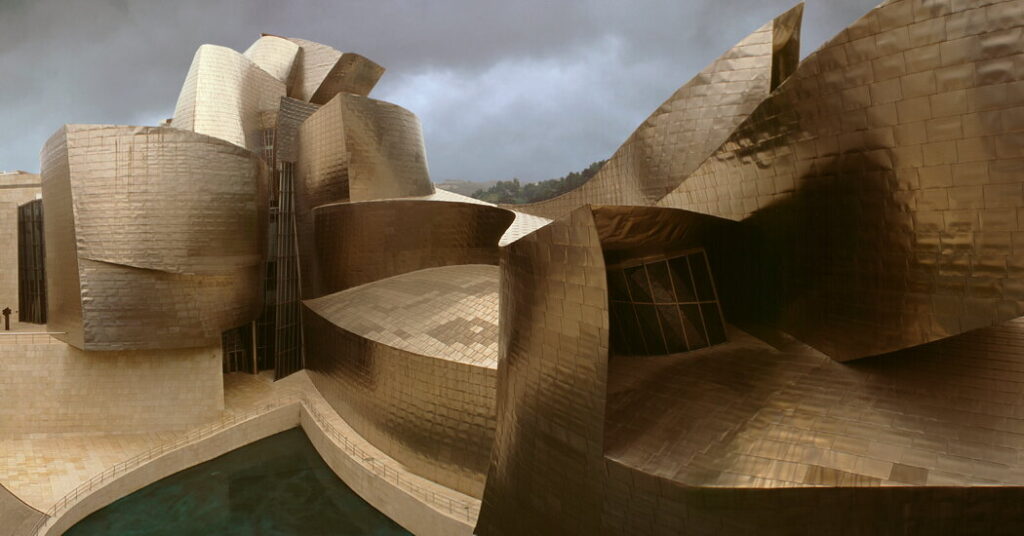
Bilbao had already been getting an architectural makeover when Gehry’s game-changing, unforgettable, fish-shaped art museum landed on its riverfront. The museum instantly made the former industrial city an alternative to Rome and Paris for highbrow art-and-architecture tourism. The project provided Gehry with that rarest of clients who allowed him to test out methods and concepts he had been evolving for decades. The architect Philip Johnson compared what resulted to Chartres Cathedral, no less. It may not last 800 years, but it is the building that will forever define Gehry — and architecture at the turn of the 21st century.
Disney Hall, Los Angeles (1988-2003)
With its warm, wood-lined interior and acoustics, Disney Hall is, first and foremost, a terrific place to hear music. But it is also a spectacle on the skyline, its riot of shimmering steel panels opening up like the petals of a giant flower under the Southern California sun. What the Chrysler Building and Eiffel Tower are to New York and Paris, Disney became to downtown Los Angeles. Begun before Bilbao and finished after it, the concert hall helped germinate Gehry’s ideas for the museum and, among his achievements, ranks right up there alongside it.
DZ Bank, Berlin (completed in 2001)
Inside a mixed-use development near Berlin’s Brandenburg Gate, Gehry inserted a conference space whose fantastical, undulating, totally unexpected shape looks a little like a whale floating in midair. The building’s dull exterior acts almost like a straight man for Gehry’s playful punchline. It’s an architectural tour de force not unlike what the architect Norman Foster, to greater symbolic and theatrical effect, did with the inside of Berlin’s Reichstag, a few blocks away.
8 Spruce, New York City (completed in 2011)
Gehry’s first skyscraper, 8 Spruce Street rises 76 stories over Lower Manhattan, its facade clad in more than 10,000 differently shaped stainless steel panels whose arrangement suggests draped fabric. The tower nods, across a century, toward the neo-Gothic filigree and reflective terra-cotta tiling on the nearby Woolworth Building. Pleats in the “fabric” make room for bay windows inside high-end apartments that jut like prows into the skyline. The building’s metal exterior “breathes” over the course of a day, its metallic skin turning a shade of pink in the early morning sun, umber as the sun sets.
Louis Vuitton Foundation, Paris (completed in 2014)
With the Louis Vuitton Foundation, Gehry swapped steel panels for billowing glass to devise one of his most graceful extravaganzas. The foundation sits at the edge of the Bois de Boulogne, the Paris park. It takes inspiration from earlier glass buildings in Paris like the belle epoque Grand Palais. Its composition can conjure up a sailboat, shards of an iceberg or the facets of a Cubist collage. As at Bilbao, exhibition rooms mix conventional, rectilinear spaces with highly sculptured ones. “The sterilized model of making art galleries has been misunderstood as neutral,” Gehry insisted, “when in fact its quasi perfection is” as much a “confrontation to the art as anything else.”
Pierre Boulez Saal, Berlin (completed in 2017)
In his later years, Gehry devoted increasing amounts of time and thought to music, an abiding passion. Boulez Saal, a gem, can put a listener in mind of a cello. Wooden ellipses of tiered seats surround the stage, creating a warm bowl inside an old masonry building. Dedicated to the great French modernist composer Pierre Boulez, devised in concert with the conductor and pianist Daniel Barenboim, the 683-seat hall reveals a side of Gehry that is not the fabulist but the intimist — an architect who could create practical and humane spaces that yielded the spotlight and lifted the soul.
Los Angeles River Proposal (unbuilt)
Gehry, the transplanted Canadian, remained, on a deep level, a local architect, tethered to Los Angeles, where he spent his long career. To the end, Gehry’s office labored on diverse projects for the city, which sometimes provided a counterpoint to his more spectacular buildings, including a housing development for formerly homeless veterans and a remaking of a derelict stretch of the Los Angeles River. That multibillion-dollar river proposal dreamed of a roughly mile-long platform erected over the concretized waterway, adding parkland and other open spaces as well as a cultural center to serve some of the poorest communities in the city.
Michael Kimmelman is The Times’s architecture critic and the founder and editor-at-large of Headway, a team of journalists focused on large global challenges and paths to progress. He has reported from more than 40 countries and was previously chief art critic.
The post Frank Gehry: 12 Essential, Stunning Projects appeared first on New York Times.