
President Donald Trump announced a new round of retaliatory tariffs on July 20 against Canada, invoking the Depression-era Smoot-Hawley Tariff Act in a game of tit for tat that can have no winner.
The administration argues that the new tariffs are necessary to address Canada’s harmful discrimination against the United States auto industry, and are justified by Section 338 of Smoot-Hawley. But Section 338 has never been used to impose tariffs before this year. Section 338 was designed to deter foreign retaliation by allowing the President to increase tariffs against a country that had discriminatory tariffs or trade restrictions on American goods.
While there can be no doubt that Canada’s 25% tariffs on U.S. autos are discriminatory because they target American goods without putting similar burdens on goods from other countries, the administration’s evidence supporting the tariffs is weak at best.
In its Proclamation announcing the new tariffs, the administration claimed that Canada’s 25% tariff on U.S. autos and auto parts—enacted days after Trump’s April 2, 2025 “Liberation Day” Executive Order announcing new U.S. tariffs on Canada and virtually every other country in the world—unfairly discriminates against the American auto industry, thus “disadvantaging the commerce of the United States compared to the commerce of other countries.”
In support of this view, the administration claims that Canadian imports of U.S. autos “fell precipitously” by more than $5 billion, or “approximately 22%,” while Canada’s imports from Mexico, Japan, Korea, and Germany increased by nearly $3 billion.
A closer look at actual trade flows tells a different story, however. As the chart below shows, Canadian imports of U.S. autos historically have far exceeded those from the other listed countries. Since April 2025, Canada’s auto imports from the other countries have increased slightly or stayed the same, while Canada’s imports of U.S. autos have bounced around, falling sharply late last year, rebounding sharply during the first quarter of this year, then trending downward again—ending up, most recently, around the level they were in April ’25.
Moreover, it’s not clear that the tariffs are the cause of the modest decline in American auto exports to Canada. A more likely explanation is that Canadians, like Americans, are holding on to their existing cars longer, resulting in fewer new car purchases overall, which would affect both U.S. and foreign imports.
Indeed, a recent survey for Toyota Canada indicated that 56% of Canadians were delaying major purchases, including auto purchases, because of “affordability concerns.” Mid-year data from the Automotive News Research and Data Center, showing a modest 1% decline in overall new car sales in Canada—with General Motors “once again” leading “all manufacturers in Canadian sales,” and Ford ranked second—would seem to support this.
In short, despite the discriminatory tariffs in both directions, Canada continues to support the U.S. auto industry. Although American auto exports to Canada may have declined slightly in the past year, the United States is still Canada’s primary source of imported cars.
Interestingly, while the administration noted that Canada’s 25% tariff also applies to American auto parts, it avoided any claim about economic harm. That may have been because trends in Canada’s auto parts imports also undermine the administration’s argument.
As shown in the second chart below, over the past year Canadian imports of U.S. auto parts have stayed at or above their historical range. And, similar to autos, auto parts imports also surged in the first quarter of 2026, reaching their peak in March of this year. Auto parts exports have not been trivial either; they have historically been close to the value of auto exports and in the past year have exceeded the value of auto exports. Canadian tariffs have had no clear negative effect on American auto parts exports.
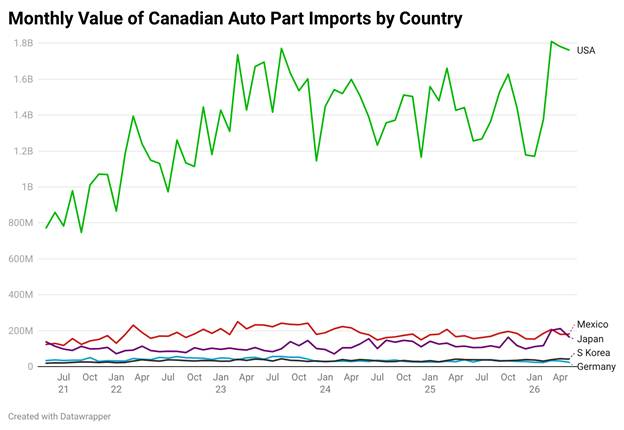
Canada’s tariffs may harm the Canadian economy, but they’re not harming America’s—at least not the auto sector, which is the focus of the administration’s Section 338 retaliatory action.
The announced new U.S. tariffs on Canada are responding to a problem that American tariffs started. Trying to get back at Canada with new tariffs because Canada is trying to get back at America for the tariffs we unilaterally imposed is a fool’s errand. A tariff war with Canada is another potential U.S. war with no winner and no end. But there are likely losers: U.S. and Canadian consumers and the U.S. and Canadian economies.
The opinions expressed in Fortune.com commentary pieces are solely the views of their authors and do not necessarily reflect the opinions and beliefs of Fortune.
Caleb Petitt is a research fellow at the Independent Institute, Oakland, Calif.
The post Trump just invoked a 1930 tariff law no president has ever used — against Canada appeared first on Fortune.