In 2018, after several years of practicing conventional psychotherapy in Philadelphia, Nicole LePera began a new venture, the Holistic Psychologist, an online self-help platform that reflected her growing skepticism toward traditional methods of treating anxiety, depression and other mental afflictions.
At first, it wasn’t much more than an Instagram page with a few hundred followers. Within two years, there were 1.5 million. A 2020 profile in Forbes described LePera as “radically changing the business of mental health.” The Holistic Psychologist had expanded to include a website and a paid membership service, all of it available to meet the emotional unraveling of the pandemic. Lucrative book deals followed. LePera’s main message — that we are all capable of healing ourselves — was finding an even more pervasive reception.
Her chief partner in the enterprise was her wife, Lauren Galvin (known as Lolly), who helped shape the company’s identity. Early on, they were joined by a third person, Jenna Weakland, who engaged with the online community and appeared alongside LePera in videos and on podcast episodes. Like Galvin, Weakland had no formal psychological training. At one point, LePera announced on Instagram that she, Galvin and Weakland were in a romantic relationship together.
Last summer there was a troubling disruption. In August, a startling accusation appeared on the Holistic Psychologist’s Instagram page: “Dr. Nicole LePera has never written an Instagram, TikTok or You Tube she’s spoken since the inception of her career,” someone posted anonymously. “She is the face of a brand she did not voice.” Soon after the post appeared, the Instagram account went dark for a time, and its followers speculated about what had happened. Many wondered about Weakland, who had vanished from the Holistic Psychologist community about four months earlier.
Traditional therapy demands a certain anonymity on the part of the clinician. But “media therapists,” as the psychiatrist and author M. Scott Peck long ago described this segment of the guru class, build their images on self-revelation. Given that LePera had shared so much about her own life online and in her popular self-help books, it was logical that her followers would be curious about what had changed.
The story became clearer earlier this year, when Weakland sued LePera and Galvin, arguing that her role in the Holistic Psychologist was foundational and that she deserved significantly more compensation than she had received. LePera and Galvin then filed a lawsuit against Weakland, accusing her of misusing company funds.
The civil cases, which include allegations of assault, were soon accompanied by police reports. All of it suggested that LePera’s life was marked less by an acquired serenity than by instability and crisis. LePera had landed in uncomfortable contrast to her own advice — to “choose people” who bring “peace and contentment instead of chaos and suffering.”
‘Rock Bottom’
In her writings, LePera describes growing up in a household overlaid with anxiety. If her parents were late to meet her, she assumed the worst: that they had died.
As she tells it, LePera often found her needs subjugated to those of a much older sister, who suffered from chronic illness. Their parents met problems in a spirit of agitation, whether they were one ingredient short for dinner or in the throes of a domestic emergency. Catastrophizing was the family’s default mental state.
Wishing to hold their attention, LePera worked hard at everything, efforts that led her to Cornell University and a doctoral program in clinical psychology at the New School of Social Research in New York. She was drawn to attachment theory, which posits that the bonds we develop with parental figures in infancy and early childhood determine our relationship styles in adult life.
Meeting Galvin was a turning point. She “felt right,” as LePera put it in her book “How to Do the Work.” Galvin challenged LePera in ways that “excited” her, she wrote. Together they built a life in Philadelphia, where LePera had grown up and now ran her practice.
Her clients were rich people and poor people — stressed-out professionals and the formerly incarcerated. No matter who they were, they felt stuck, she observed, wanting change but failing to enact it. More and more, she felt the same way.
The issue crystallized — becoming her “rock bottom,” she would write — about 13 years ago, shortly after her 30th birthday. On vacation with Galvin, she suffered an acute bout of despair. She began connecting her physical ailments — stomach trouble, fainting, panic attacks — to the childhood tensions that conventional therapy had failed to resolve.
With Galvin’s help, LePera undertook the slow and steady work of repairing her body and mind. The couple began every morning with meditation. They studied nutrition and lifted weights. They married and imagined the new professional path that led to the creation of the Holistic Psychologist. Eventually, she started talking about nervous system “dysregulation,” rather than mental illness, a designation she had come to question.
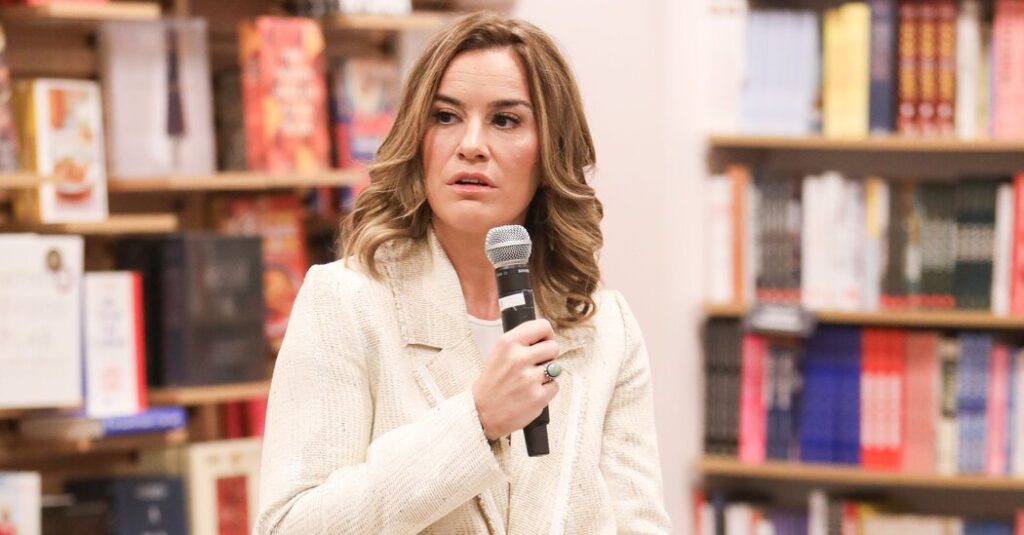
Weakland’s lawsuit against the couple surfaced as a matter of online conversation a few months after it was filed. So it did little to interfere with the launch of LePera’s latest book, “Reparenting the Inner Child,” which arrived in March as an immediate best seller, with an effusive endorsement from Mel Robbins. LePera’s book tour included appearances at the Royal Geographic Society in London and the 92nd Street Y, Manhattan’s epicenter of bourgeois cultural exchange.
Onstage in New York before a sold-out crowd, LePera was interviewed by Ellen Vora, a Columbia-trained psychiatrist, who called her “a guiding light for the culture.” That night, as she had in the past, LePera presented herself as someone who, although still at work on herself, had overcome.
“I would see someone that hurt me and I would immediately understand why they did it, from their childhood, the wounding” she said, explaining an unhealthy tendency she had to empathize in excess.
LePera, 43, talked about “re-parenting” herself. She had taken an extended break from her family to explore who she was. It was hard, she said, but here, too, she seemed to prevail. Her father was seated in the audience, and she pointed affectionately toward him.
What was re-parenting exactly? Vora asked. It was “showing up in a different way for ourselves,” LePera answered, “being the supportive, caring attuned caregiver that very few of us had in childhood.” Derived from the pop psychology of the 1970s, the idea was hardly original to her, but she had revived it for a new generation.
The Guided Meditation
LePera’s first experience of celebrity occurred in the summer of 2019, when she decided to conduct an “inner child meditation,” oceanside, in Los Angeles. The turnout astonished her.
Weakland, a frequent poster on the Holistic Psychologist’s Instagram account, was among those on the beach in Venice that August morning. At 32, she was a recent transplant to Los Angeles from Colorado, where she had worked as a nurse’s aide in a pediatric oncology unit. Although she arrived too late for the session, Weakland met LePera and gave her a deck of oracle cards.
Soon they began messaging each other — or at least that is what Weakland assumed. Later, she came to believe that she had been communicating with Galvin, she told me. (LePera and Galvin declined interview requests sent to them through their lawyers, as well as LePera’s literary agent and book publicists. When asked by phone about specific allegations, one of those lawyers said she had no comment and hung up.)
The Holistic Psychologist took shape as a website, with LePera as the face of a start-up devoted to mental fitness. With Galvin, she expanded the franchise to include the Self-Healer’s Circle. At $20 a month, the cost (now $26) was roughly equal to what four or five minutes of individual therapy would set you back in TriBeCa or West Hollywood. Beyond monthly Q. and A.’s with LePera, the Circle offered members a range of online events, lectures and somatic practices.
When the site went live, so many people tried to enroll that the external server crashed. Weakland sent a message offering to help and was immediately hired. Telegenic and open in her affect, Weakland started appearing on camera, heading some of the Circle’s “Content Teachings,” in which she shared her own story as a child of parents immersed in poverty and addiction. With LePera, she co-hosted SelfHealers Soundboard, a podcast that ran for two years.
Not long after starting her job, Weakland received an invitation from LePera and Galvin to spend part of the holiday season with them. Landing in Philadelphia after Christmas, Weakland made her way to the Four Seasons. In a single room with two beds, the couple laid out gifts for her, Weakland said. Later, they decamped to an Airbnb in the Poconos where, on New Year’s Eve, Weakland recalled, they drank, smoked weed and kissed.
Weakland quickly fell for both women. With them, she said, she felt “chosen.”
By July 2021, they had moved into a rented stucco house in Scottsdale, Ariz., where they bought a bed large enough for three. LePera announced the new configuration on Instagram. “I am in a throuple,” the post began. “A 3 person committed relationship.” She had been reluctant to share this, she said, but she and her partners had promised “to be transparent, authentic, and candid about who we are.”
A few months into the arrangement, Weakland grew close to a next-door neighbor, Jennifer Kolesar. From the beginning, Kolesar said in an interview, she overheard arguments coming from the backyard, some of which frightened her daughter.
“Jenna once asked, ‘Can you hear us? What can you hear?’” Kolesar told me. “And I told her I heard a lot of accusations.” Kolesar told Weakland that she was particularly struck by her partners’ habit of “constantly telling her that she was the problem.”
Still, Weakland’s role in the company was growing. In 2023, she signed an agreement with LePera and Galvin, giving her a one-third ownership stake in Juniortine, the parent company of the Holistic Psychologist.
The audience for the Instagram account grew to 9 million followers, delivering a constant churn of aphorism along the way. Some of the posts were philosophical, sharp, even poetic: Grieving the death of a parent who is still alive means realizing the person you needed never existed. Others were confounding: Not knowing that you are hungry is a core sign of unresolved trauma.
LePera’s popularity was also fed by online videos in which she used role-play to illustrate her insights. In vignettes on maternal narcissism, LePera typically portrayed both the stunted mother and the yearning child now grown up. But for a while, it was Weakland cast as the young daughter victimized by an oblivious mother.
In a standard scenario, Weakland is on the floor, hair in pigtails, clutching a stuffed penguin. In one clip, her character explains that she feels loved only for her accomplishments. “That won’t matter when you’re at Harvard,” LePera responds, demonstrating the worst possible parental reaction.
Other videos had Weakland acting as the patient to LePera’s therapist. “Given the underlying power imbalance of our actual relationship,” Weakland said, “those just made me feel sick.”
She struggled to leave. “For so long I’d try on everything Lolly and Nicole told about me about myself, all the criticism, the opinions, the diagnoses,” Weakland said. In March 2025, she moved out.
The Lawsuit
Late that spring, Weakland flew east to stay with friends in Gettysburg, Pa. She didn’t want LePera and Galvin to know where she had gone but suspected she was being tracked.
Hoping to throw them off, she sent a delivery of cat food to one of her previous short-term rental addresses in Scottsdale and asked her friend Kolesar to pick it up. When Kolesar arrived, she told me, she saw LePera and Galvin in a car outside the building. When Kolesar returned later, she said, the couple was still there. (Weakland’s host in Gettysburg, an epidemiologist, said that Weakland had told her about the incident right after it happened.)
“It just blows your mind that these are the people who are presenting themselves as self help,” Kolesar said.
Despite the conflict, LePera joined Weakland in Gettysburg in July. They stayed with Weakland’s friend, who described LePera as relaxed and happy during her visit. Weakland and LePera had never spent so much time alone together and grew closer.
Later that summer, Weakland and LePera were back in Scottsdale. It was against this backdrop that the anonymously written Instagram post claiming that LePera was “the face of a brand she did not voice” appeared. In fact, Galvin had written it, as she and LePera later admitted in their legal filings.
This was not Galvin’s first expression of volatility. In 2012, according to New Jersey public records, an order of protection was taken out against her in a domestic violence case. Several years later, Galvin came under the scrutiny of Pennsylvania regulators, who fined her $3,000 for diverting money from a Go Fund Me she had ostensibly set up to help the homeless into her own bank account.
LePera and Galvin were now living together again. Weakland saw the couple for the last time in October 2025, she said. They talked about the company. The conversation got tense — so tense that Weakland ripped LePera’s glasses off her head, something she regrets. (In their suit, LePera and Galvin said the incident had left LePera “legally blind.”) In retaliation, Weakland maintains in her own suit, LePera pushed her down a flight of stairs. LePera and Galvin have denied this.
That evening, Weakland went to an urgent care facility to be treated for a bruised and swollen ankle. A week later, on Oct. 14, still bruised, she visited a naturopathic doctor, Sabrina Solt. In an interview, Solt said that Weakland had shared her claim that LePera had pushed her down the stairs. Solt said she had prescribed peptides to increase blood flow to the joint.
On a few occasions when we spoke, Weakland teared up when talking about how much she had loved her former partners and how she could look at them, still, and see the troubled girls they had been.
Weakland remained on the payroll until January of this year, when she was fired. In February, she filed her suit against the couple in Arizona Superior Court for breach of contract. She argued that her role in the company entitled her to at least $3.5 million, an amount she said she based partly on the 2023 partnership agreement.
In a reply to Weakland’s lawsuit in March, LePera and Galvin claimed the figure was outrageous, adding that Weakland had “often failed to deliver materials on schedule” and that her role had been merely “administrative,” a position complicated by Weakland’s appearance in the company’s content.
In May, LePera and Galvin filed a lawsuit against Weakland that lists Juniortine as the plaintiff. The suit paints Weakland as angry, lazy and manipulative. LePera described her differently in her 2023 book, “How to Be the Love You Seek”: “Jenna quickly established herself as an essential member of our team,” she wrote, “bringing communication and leadership that complemented the strengths Lolly and I had.”
Among Weakland’s claims is that she helped brainstorm the books and should receive some profit. But in their response to Weakland’s suit, LePera and Galvin stated, “All books were written solely by LePera.” (A spokeswoman for Flatiron Books, which published “Reparenting the Inner Child,” said the book was written “with a ghostwriter.”)
Taken as a whole, the documents provide a view of unhinged behavior among the women, who seemed fixated on arguing and surveilling one another. Weakland acknowledged that all three had frequently recorded their fights.
In her suit, Weakland maintains that Galvin threatened to release “private recordings” of her, including nude videos, and that LePera “did nothing to stop Galvin’s extortionist threats.” The couple, in response, claimed that Galvin had not threatened to send nude images, but rather videos of Weakland being “physically abusive.” Weakland went on to file a complaint regarding the matter with the Scottsdale Police Department.
LePera has filed her own report with the police, maintaining that Weakland improperly used her credit card last year to make thousands of dollars’ worth of purchases on Amazon and elsewhere. Weakland denied that claim. In their lawsuit, LePera and Galvin further alleged that Weakland had misappropriated a total of more than $1 million of corporate funds for her own use. Weakland denied this, too, saying in an email that the expenditures were all business-related.
Those issues have yet to be resolved. But in court in February, Weakland won a protective order against Galvin, effective for two years. The petition included her contention that Galvin had entered her backyard, peered into her windows and sent her images of her trespass. In legal filings, Galvin and LePera denied Weakland’s interpretation.
LePera’s continuing influence invites the question of how much it ought to matter if your therapist — either someone you see in person, or a public figure you have come to rely on — lives a life very different from the one he or she is trying to help you achieve. If the treatment is succeeding, should it be of any consequence?
Central to the field of medical humanities is the Jungian idea of the “wounded healer,” a figure whose own pain becomes a vital instrument in curing others’. But what if the healer’s own pain seems insurmountable? Or corrosive?
At the end of LePera’s talk at the 92nd Y, audience members were given a chance to ask questions. One woman got up to say she had done everything — all the journaling, all the self-interrogation — and was still not where she wanted to be.
LePera smiled in commiseration. “The saying that many of us love to hate is that healing isn’t linear,” she said. “And that is real.”
The post A Self-Help Influencer With Troubles of Her Own appeared first on New York Times.