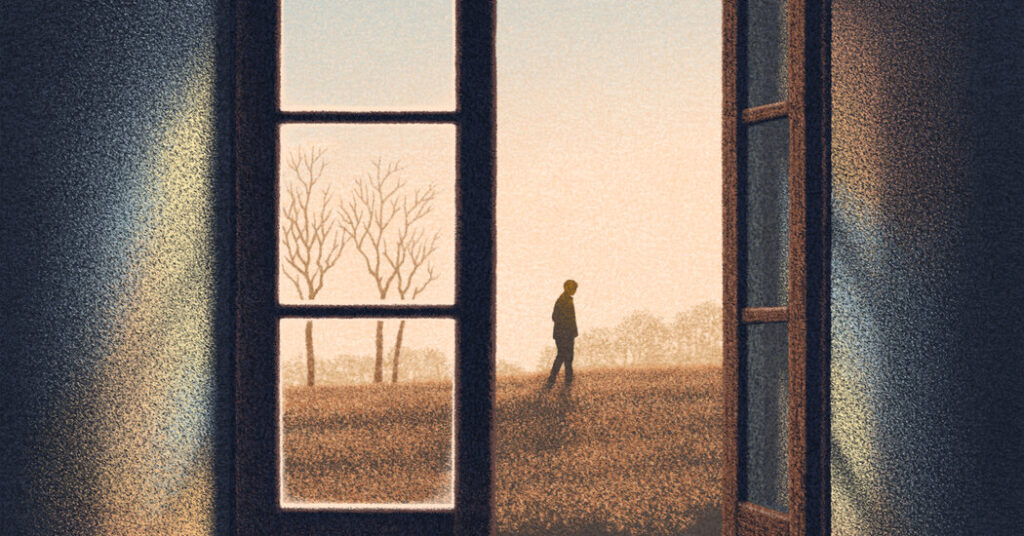
As happens for many people, my 30s were a decade of belated culminations: marriage, children, professional achievement (for me, the publication of novels and a teaching job). However, it all refused to settle into place. My wife and I struggled to get along. Parenthood was sometimes “all joy and no fun.” The novels received critical praise but sold modestly, and the teaching job was 1,500 miles from where my wife wanted, and continued, to live.
I didn’t know what would help, but I knew what wouldn’t: talking about it.
I had spent two decades in and out of therapy, to some insight but little transformation. Ditto for the couples therapy my wife and I had undertaken. I also felt like I’d been talking nonstop since immigrating as a child from the Soviet Union. In America, English became a dangerous tool to persuade elite institutions to give me the things that my elders had said mattered: approval, access, funding, employment. My Soviet-child shyness turned into garrulousness, then logorrhea. I chattered, people clapped, the doors to opportunity opened. I rarely felt at home on the inside but I enjoyed a superficial sense of arrival.
Then there was the noise of just being American. (There was virtually no commercial advertising in the Soviet Union. Think about that for a minute.) Social media exists to terrify us of quiet and solitude. My phone had become a postmodern crack pipe: I knew it was killing me, yet I couldn’t put it down. I felt ill from talking and noise. But that’s all I knew how to do.
So when, two years ago, an acquaintance mentioned to me an annual visit she made to a silent retreat, I cautiously probed for details. Was it a wellness-type thing? Was there yoga? It was the antithesis of luxury, she said: an ecumenical contemplative Christian community in the middle of Georgia, with monastic quarters, silent meals and daily prayer, for $60 a night. It didn’t even have a website.
I’m not a Christian, but I was desperate. I wrote to Oliver Ferrari, a monastic brother in the community, and we settled on several days that December. As the date approached, my thrill at the prospect of unspecified liberation turned to terror. I had never been alone with myself for that long.
The retreat had been started in 1987 by two friends: Fay Key, a civil-rights advocate who longed to enact Jesus’ command to “come away to a lonely place and pray,” and Steve Bullington, a Methodist pastor. I arrived to find a chapel and several modest residences bordered by fields for soybeans and hay. It’s the kind of place where the shower doesn’t shoot straight and the communal jar of almond butter has marks from every spoon that has used it, a sanctuary as plain as its setting. “No majestic mountains, no roaring sea,” as Fay once wrote in a memoir. “I sometimes say there is nothing here but God.”
I was placed in a one-room cottage flanked by a statue of St. Francis and a lowland of sweet gums and broomsedge. It had a twin bed, a wall-mounted propane heater and a compost toilet. The only sound came from pecans thumping the roof. I handed over my laptop and phone and, suddenly, there was nothing to do. I decided to go outside and, Georgia weather being generous even in winter, walk the soybean field. After I circled it, I kept going. I wanted to feel more of the soil and the sun, so I took off my shoes and shirt. Perhaps because I had finally stopped talking, I heard the call of birds. At one point, I stood on an oak uprooted by Hurricane Helene, its bark like the scales of a prehistoric animal, and just surveyed existence.
I was rediscovering the physical world — so this is what all those people meant by being present. No object was too humble to convey the glory of its existence. Passing an ancient Toyota Corolla, I thought, “That steering wheel is solid and true.” The last time I thought such a thing, I was a very stoned undergraduate — that is, more open to the essence of things. I remembered why I was always telling my students that concreteness was sacred in fiction. That week, I sat with myself, in silence, far longer than I imagined I could. “The law of growth is rest,” as the British ecclesiastical artist Caryll Houselander once wrote.
Out in the world, I was always focused on the next move. Here, so little was necessary to feel not only content but ecstatic: simple meals that concluded with prayer and readings; fields to walk in the quiet and warmth; sincerity in the way I was asked after; acceptance when I dared to answer honestly. (At the retreat, meals are largely silent — quiet is the default — but communication isn’t forbidden.) Between the sometimes transactional nature of my professional life and how busy we all seem to be, it had been a long time since anyone had looked me directly in the eyes, as Fay, Steve and Oliver did.
In the desert of the self created by monastic silence, electronic detachment, and genuine fellowship, it suddenly seemed very clear that the main purpose of existence was love. I wanted to rush home to show love to my children, to my wife, to the parents who gave me everything except what they couldn’t. No matter how many places of worship I’ve visited, that’s the only definition of God that’s ever made sense to me.
I came home with ecstatic intentions of renewal. But I couldn’t make the retreat’s lessons work outside the retreat, where I was again overwhelmed by technology, parental duty and marital discord. My relationship deteriorated. A new novel, which I considered my best, failed, even critically. It was, like all my novels, about the irreconcilability of the multiple identities some of us carry within us. The retreat had shown me that these identities might be reconcilable, after all; perhaps the reading public was waiting for me to catch up to the lesson. Either way, I felt as if my speaking superpower had left me. The imaginary judges I’d long strained to dazzle were no longer impressed, if they’d ever been.
I attended the retreat for a second time last December. I was grateful for the respite even if the effect wasn’t as psychedelic. One afternoon, Oliver and I took a walk around the soybean field. It was a colder winter, the sunlight harsher. Again, I was there during Advent, “a season of waiting,” as Steve had put it. After a day of silence, speaking felt like communicating through the voice of another.
“You know, they’re not fancy, the people in there,” Oliver said, seemingly out of nowhere, gesturing toward the 1920s tenant farmhouse where everyone on retreat took their meals. “But they’re good people.” He meant that very few of the people who came on retreat were in pursuit of public acclaim. They were hardly free of struggles and questions. But they were gifted people, often in ways few others were, and sought to make a better world.
When I returned to my cottage, I reread parts of a memoir that Oliver had written, lines about “the relief of not having to be anybody special” and instruction “in the art of being myself.” The question had bewildered me from the moment I had encountered, as an immigrant child, the very non-Soviet maxim “Be yourself.” How can you be yourself when this country was made for reinvention and reaching, and people you cared about seemed to want you only if you became someone different?
The answer has taken time — things happen instantaneously only in the make-believe world of tech — but it began to take shape that afternoon. I had to find the courage to give up on an immigrant’s false dream of belonging. No one should have to work that hard to find community. I was so good at faking the fellowship that it took me a long time to realize it was fake. I would never belong among most of the people I’d been trying to impress all these years. My adopted home was elsewhere, even if I had yet to find out where.
I returned from the retreat with knit hats for the kids, a gift from Fay. When they are older, I will read to them from her book: “The soul-sized task of every small monastic community is to stand in the rubble and dream.” If they ever feel lost, I hope I am around to tell them that it may take time, but if their hearts are good, and their companions true, it might mean they are finally on their way to finding their way. They just need to fall silent, so they can hear themselves better.
Boris Fishman is the author, most recently, of the novel “The Unwanted.” He teaches at the University of Austin.
The Times is committed to publishing a diversity of letters to the editor. We’d like to hear what you think about this or any of our articles. Here are some tips. And here’s our email: [email protected].
Follow the New York Times Opinion section on Facebook, Instagram, TikTok, Bluesky, WhatsApp and Threads.
The post Want to Find Inner Peace? Be Quiet. appeared first on New York Times.