Frank O. Gehry, one of the most formidable and original talents in the history of American architecture, died today at his home in Santa Monica, Calif. He was 96.
Meaghan Lloyd, his chief of staff, confirmed the death, following a brief respiratory illness.
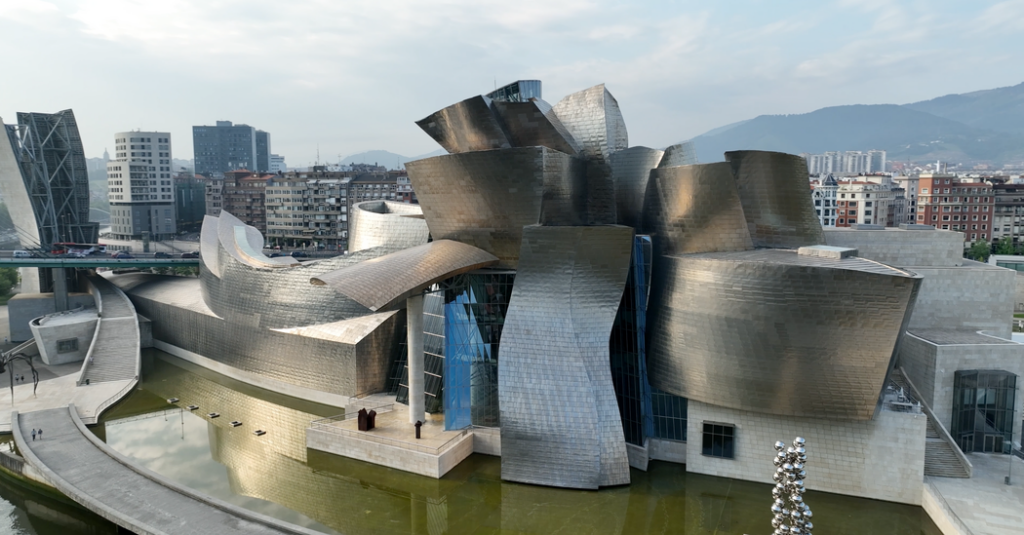
Mr. Gehry’s greatest popular success, and the building he will be most remembered for, is the Guggenheim Museum Bilbao. Set in what had been a dying industrial city on the northern coast of Spain, this wildly exuberant, titanium-clad museum was an international sensation when it opened in 1997, helping to revivify the city and making Mr. Gehry the most recognizable American architect since Frank Lloyd Wright. Its joyful appearance — a composition of glittering, silvery forms that looked as if they had burst out of the ground — seemed to signal the arrival of a new, emotionally charged architecture.
Mr. Gehry, one of the first architects to grasp the liberating potential of computer design, went on to create a host of other celebrated buildings — many of them widely regarded as masterpieces — that in their sculptural bravura and visceral power matched or even surpassed the Baroque architecture of the 17th century.
These included the Walt Disney Concert Hall in Los Angeles, with its cocoonlike interior, completed in 2003; New World Center (2011), a concert hall in Miami stuffed with cylindrical rehearsal halls; and the Fondation Louis Vuitton (2014), a museum in Paris so ethereal that it looked as if it were made of blown glass.
But Mr. Gehry, who won the prestigious Pritzker Architecture Prize in 1989, had made his name long before then. He burst into the consciousness of the architectural world in 1978 with the completion of a Santa Monica, Calif., house that he designed and lived in for four decades — a cheap, wood-frame Cape Cod bungalow that he ripped apart and enveloped in a new skin of plywood, corrugated metal and chain link.
The crude, even violent collision of forms seemed to capture the political and generational rifts that had been straining American society, and the American family in particular, since the 1960s, and it established Mr. Gehry as a force in architecture.
Over the next few years, he produced several more houses whose raw compositions evoked structures in midconstruction. Philip Johnson, architecture’s elder statesman, tried to describe the feeling of being inside one of those houses: “It’s not beauty or ugliness,” he told The New York Times Magazine in 1982, “but a disturbing kind of satisfaction that you don’t get in anyone else’s spaces.”
“I was rebelling against everything,” Mr. Gehry said in an interview with The Times in 2012, explaining his antipathy toward the dominant architectural movements of the time, as exemplified by the Farnsworth House on the Illinois prairie, a stark, flat, steel-and-glass Modernist pavilion by Mies van der Rohe.
“I couldn’t live in a house like that,” he said. “I’d have to come home, clean up my clothes, hang them properly. I thought it was snotty and effete. It just didn’t feel like it fit into life.”
Mr. Gehry later expanded his repertory with increasingly sculptural designs. They included the contorted white stucco forms of the Vitra Design Museum (1989), in Weil am Rhein, Germany, and two cylindrical towers joined in a wild, balletic embrace in Prague — a 1996 building called the Dancing House, or Ginger and Fred, after the dancing duo Ginger Rogers and Fred Astaire.
For some, his work was more sculpture than architecture. Others saw it as emblematic of a global culture that reduced architecture to a form of branding. Mr. Gehry, whose name was recognized around the world, was sometimes derided as a “star-chitect.”
But his work’s emotional ferocity could feel empowering, as if architecture had rediscovered a part of itself that had been lost after decades of dreary functionalism and postmodernist clichés. And the widespread focus on his buildings’ dazzling exteriors could distract from Mr. Gehry’s deeper goals: to create an architecture that was not just affecting but democratic in spirit and evocative of the messiness of human life.
He was born Frank Owen Goldberg on Feb. 28, 1929, in a working-class section of Toronto to Irving and Sadie (Caplan) Goldberg. His father held a series of jobs, including managing a grocery store and selling pinball and slot machines. Frank and his sister, Doreen, lived with their parents in a two-family house clad in brick and tar-paper shingles (a material he would use in some of his designs).
As a boy, he worked part time in his maternal grandfather’s hardware store, stocking the shelves with tools, screws and bolts, an experience, he said, that spawned his love of everyday materials.
Once a week, his maternal grandmother would come home from the market with a live carp, another formative experience, which would inspire the fish imagery that later appeared in his work. “We’d put it in the bathtub,” Mr. Gehry recalled, “and I’d play with this fish for a day until she killed it and made gefilte fish.”
A Move to the U.S.
Frank’s world abruptly fell apart in the mid-1940s, when his father, a heavy drinker, had a heart attack as the two were arguing on the front lawn, a memory that Mr. Gehry said haunted him for decades. His father never fully recovered. After a doctor warned that he would not survive another Toronto winter, the family moved to Los Angeles, renting a cramped $50-a-month apartment in a run-down neighborhood just west of downtown. Culture, Mr. Gehry said, was how they maintained their dignity. Some nights, they would listen to classical music on the radio; others, his sister would practice the violin.
As an architect, Mr. Gehry was a late bloomer. After a brief stint in the Army, he married Anita Snyder, who helped pay his way through the University of Southern California, where he initially studied ceramics. He shifted to architecture after a teacher introduced him to Raphael Soriano, a pillar of postwar Modernism in Southern California. (It was around this time, too, that he adopted Gehry as his surname, a somewhat random choice inspired, he said, by the desire to avoid antisemitism.)
Mr. Gehry spent several years toiling as a midlevel designer and project manager at Gruen Associates, a firm known for its shopping malls. After he opened his own office in 1962, much of his early work was for mainstream developers. He designed a sprawling headquarters for the Rouse Company in Columbia, Md., and two unremarkable department stores for Joseph Magnin in California.
But he was an outsider by nature, and he began looking beyond the work of other architects for inspiration. Like many Angelenos, he was drawn to the laid-back, anything-goes atmosphere of the city, whose mix of garish mansions, flimsy bungalows, vacant lots, Googie coffee shops and colorful billboards was the antithesis of East Coast architectural academicism. And he became close to a generation of Los Angeles artists — Robert Irwin, Billy Al Bengston, Ed Moses, Larry Bell — whose surfboard-inspired aesthetic and raw work spaces suggested an alternative to the chilly austerity of late Modernism and the reactionary tendencies of postmodernism.
“The artists were living in industrial buildings and warehouses,” Mr. Gehry said in the 2012 interview with The Times. “They were constantly moving things around — changing the rooms, building lofts or storage spaces. It was so free and un-self-conscious. I wanted to do that.”
Two buildings he designed around this time were examples of work that departed “from all the rules for ‘civilized living,’” as the architectural historian Reyner Banham wrote. One was the 1965 Danziger Studio, a work-and-living space for a graphic designer that ranks among Mr. Gehry’s best early works, with a blank stucco facade that disappears into a stretch of Melrose Avenue populated by sleazy bars and oversize billboards; the other was the crude, trapezoidal wood-frame studio he designed in the early 1970s for the artist Ron Davis. It incorporated the kind of distorted perspectives that Mr. Davis was experimenting with in his paintings.
In the late 1960s, Mr. Gehry and his wife divorced, and in 1975, he married Berta Aguilera. She survives him, along with their two sons, Sam, an architectural designer, and Alejandro, an artist; a daughter, Brina Gehry, from his previous marriage; and his sister, Doreen Gehry Nelson. Another daughter from his first marriage, Leslie Gehry Brenner, died in 2008.
The Gehrys bought their Santa Monica house, a two-story pink-stucco affair, in 1977. “A dumb little house with charm,” as Mr. Gehry once put it. At Berta’s prodding, he began to tear it apart.
The house’s rough, unfinished appearance attracted the attention of architecture critics, even as it infuriated neighbors. But its tormented forms — suggesting a world that had been ripped up and gently pieced back together — had their own kind of beauty. And the use of crude, everyday materials was Mr. Gehry’s assertion that the working-class aesthetic he had grown up with could be as appealing as anything found in the more refined corners of the city.
Rough-and-Ready Creations
“I was trying to use the dumb, normal materials of the neighborhood,” Mr. Gehry said years later. “There must have been half a dozen cars in various states of deconstruction sitting around on the lawns; there was chain link in people’s backyards. They thought that was normal.”
Mr. Gehry’s house seemed to offer a new way forward for architecture: Neither coolly functional nor a parody of earlier historical styles, it was imbued with a rough-and-ready populism that was closer to what Robert Rauschenberg and Jasper Johns were doing in art. For architects who had come of age in the shadow of the Cold War and Vietnam, it was as powerful an evocation of the democratic spirit as Frank Lloyd Wright’s houses had been for an earlier generation.
What followed was a wide range of projects that, in the judgment of many critics, rank among the most revolutionary creations in American architecture. In the 1980 Spiller House, in the Venice Beach neighborhood of Los Angeles, Mr. Gehry enclosed a plywood interior lined with exposed studs in a simple, corrugated-metal shell. In the places where the wood forms broke through the exterior walls — to create a contorted bay window, for example — the house felt like the architectural equivalent of a couple quarreling in the kitchen.
Other projects showed Mr. Gehry beginning to pull apart the conventional house into individual pieces. In the 1988 Sirmai-Peterson House, in Thousand Oaks, Calif., a bedroom was separated from the cruciform living area by a bridge. The structures were clad in a soft, gray metal, imbuing them with a tranquillity that was a departure from the raucous look of his own house.
By then, Mr. Gehry’s output had expanded to include sculptural furnishings — among them, the Wiggle side chair and stool, carved out of layered pieces of corrugated cardboard, produced by the Swiss company Vitra; and his Fish Lamps for Formica Corporation, inspired by memories of the carp in his grandmother’s bathtub.
He had also begun working on larger civic projects. His understated 1983 design for the Temporary Contemporary (now the Geffen Contemporary) at the Museum of Contemporary Art in Los Angeles, which combined two existing warehouses into a vast hall, remains a model for an informal art space. Mr. Gehry left the rough interiors and saw-tooth roofs largely intact, and in doing so seemed to take art down off its pedestal and locate it in the world.
In another project, the Loyola Law School campus (1984) near downtown Los Angeles, Mr. Gehry flirted with postmodern design strategies. He planned the campus as if it were a small village, arranging an eclectic array of structures — a classroom building, a chapel, a lecture hall — around a courtyard. The varied forms, Mr. Gehry later said, were intended to reflect the neighborhood’s mix of commercial buildings and dingy apartment houses.
To some, the gritty style of Mr. Gehry’s work could come across as belligerent. In his 1990 book “City of Quartz,” the critic Mike Davis referred to the buildings Mr. Gehry produced during this period as “Dirty Harry architecture,” complaining that they failed to engage the communities around them. But these designs could also be read as a reaction to the notions of utopian purity that had dominated architectural thinking during most of the 20th century.
Mr. Gehry considered the quest for purity a form of elitism — one that, at its worst, was driven by a desire to cleanse the world of the “other.” His aim, he often said, was to create architecture that allowed room for society’s misfits.
With the advent of new computer technologies, Mr. Gehry’s work became increasingly sculptural. For the 1992 Summer Olympics in Barcelona, he designed a monumental fish sculpture using software developed for the French aerospace industry. It was one of a number of massive sculptures he created, including the 1986 “Standing Glass Fish” at the Weisman Art Museum in Minneapolis (where he would go on to design a 1993 building clad in faceted steel plates that resembled tinfoil) and the 1987 “Fish Dance” in Kobe, Japan.
The Bilbao Effect
In 1991, Thomas Krens, then the director of the Solomon R. Guggenheim Foundation, struck a deal with the Spanish government to open a branch of New York’s Guggenheim Museum in Bilbao. He approached Mr. Gehry to design it, and the two chose a site along what was then a decrepit waterfront next to a rusting steel bridge.
Completed six years later, Bilbao, as most people called it, was an eruption of metal and light framed by scenes of industrial ruin. A grand staircase cascaded down from a street-level plaza into an atrium that overlooked a waterfront promenade. Galleries branched off from the atrium in all directions, evoking an unruly version of the spiraling interior of Frank Lloyd Wright’s Guggenheim in New York. The largest of these — a cavernous space whose ceiling was supported by arched trusses — suggested the belly of a whale.
The grand stairway in reverse was another way of knocking art off its pedestal, luring visitors — including the city’s largely working-class population — down into the building rather than challenging them to ascend to its heights. The sculptural forms that huddled around the atrium suggested a clamor of competing voices that diverged from the neatly regimented galleries of most museums, and the building’s voluptuous curves represented a new kind of expressive impulse.
Philip Johnson claimed that he burst into tears when he first saw it. The Times architecture critic Herbert Muschamp compared it to Marilyn Monroe with her skirt flying up. Both the actress and the building, he wrote in The Times Magazine, stood for “an American style of freedom” that was “fearless, radiant and as fragile as a newborn child.”
The building became a must-see for travelers, attracting 1.3 million visitors in its first year, and it gave new life to the idea that eye-catching architecture could be both a popular draw and an economic driver for struggling cities. Developers and civic leaders from around the world followed suit, investing in splashy new cultural buildings in an effort to reproduce what became known as the “Bilbao effect.”
Bilbao was followed several years later by another high-profile triumph, the Walt Disney Concert Hall. Next to the Los Angeles Music Center’s boxy Dorothy Chandler Pavilion, built in 1964, and across the street from a rickety-looking multilevel parking structure, the hall’s steel exterior conjured up enormous, billowing sails. The concave and convex surfaces of the interior, however, brought to mind the sensuous architectural forms of 17th-century artists like Gian Lorenzo Bernini.
For Mr. Gehry, the building’s completion was personal: An emblem of Los Angeles’s cultural ascendancy, it stood a few miles from the apartment where he had lived with his family as a teenager.
Success, not surprisingly, brought a fresh wave of criticism. Bilbao’s flamboyant form, some critics said, overpowered the art it was meant to house. To others, Mr. Gehry’s buildings from this period — and the lesser projects by other architects that they inspired — represented increasingly craven efforts to drive up real estate prices.
Mr. Gehry was certainly part of this trend, even if he did not wittingly cause it. Now a worldwide celebrity, he took on big-budget commissions, many of them conceived on a massive scale. In 2003, the developer Bruce Ratner announced that he had hired Mr. Gehry to design a 22-acre project in Brooklyn that included at least 15 buildings and what would become the Barclays Center arena. The development, called Atlantic Yards and later rebranded as Pacific Park, went through a number of iterations, mostly to cut costs, and Mr. Gehry eventually lost the job to a less experienced firm.
A few years later, he and Mr. Krens teamed up again to create an immense Guggenheim branch on a barren, deserted island outside the city of Abu Dhabi in the United Arab Emirates. Ten times the size of the Guggenheim’s flagship building in New York, the structure, which is still under construction after years of delays, is organized around a central atrium with uneven stacks of block-like galleries mixed with big conical spaces that open onto outdoor gardens.
Many of Mr. Gehry’s later buildings continued to embody the qualities that informed his work from the beginning: a willingness to break rules, a desire to expand architecture’s formal vocabulary and an awareness of context. Despite the originality of its crinkled steel skin, for example, the 76-story residential tower he designed at 8 Spruce Street in Lower Manhattan, completed in 2011, was conceived as part of an architectural triptych that included two nearby landmarks, the 1913 Woolworth Building and the 1914 Municipal Building.
Other projects from this period seemed to circle back to his earliest experiments.
In 2010, Mr. Gehry unveiled a design for a memorial to former President Dwight D. Eisenhower in Washington that enraged architectural traditionalists. Inspired by Eisenhower’s origins as a farm boy in Abilene, Kan., the design featured a row of six simple limestone-clad columns and a woven-metal tapestry, 80 feet tall, that recalled Mr. Gehry’s early use of chain-link fencing. Some members of the Eisenhower family found it undignified, and Mr. Gehry was forced to revise his design.
He replaced an image of Kansas farmland with an abstract rendition of the Pointe du Hoc on the Normandy coast of France — a reference to the Allied landings of World War II, overseen by General Eisenhower — and added a bronze statue of him commanding soldiers. The project was dedicated on Sept. 17, 2020.
By then, Mr. Gehry was 91. A few years earlier, he and Berta had moved out of the little house that had first brought him fame and into a more luxurious spread overlooking Santa Monica Canyon. Designed with his son Sam, the new house was a sprawling, sometimes awkward composition of angled, heavy-timber posts and beams. Nonetheless, it retained some of the rough-and-tumble qualities of Mr. Gehry’s earlier architecture, and its jostling forms reflected a lifelong quest for emotional and creative freedom.
All the while, Mr. Gehry kept on working.
In 2017, he had completed the Pierre Boulez Hall in Berlin, designed in collaboration with the conductor Daniel Barenboim: a compact, boxlike space with a sunken floor and a floating elliptical balcony, contained inside an austere neo-Classical building from the 1950s. And in 2021, the Luma Foundation building in Arles, in southern France, was finished; a twisting tower of stainless-steel bricks, it was inspired, in part, by the rocky terrain of the nearby Alpilles mountain range.
At his death, Mr. Gehry was completing several new projects for the luxury goods magnate Bernard Arnault, including an 82,000-square-foot flagship store for Louis Vuitton in Beverly Hills, Calif., and, in Paris, the conversion of an abandoned 1960s building into an exhibition space and events hall down the block from Mr. Arnault’s Fondation Louis Vuitton building, in the Bois de Boulogne. He was also putting the final touches on a 1,000-seat concert hall for the Colburn School of Music, near his Walt Disney Concert Hall in Los Angeles.
“You go into architecture to make the world a better place,” Mr. Gehry said in 2012. “A better place to live, to work, whatever. You don’t go into it as an ego trip.”
He added: “That comes later, with the press and all that stuff. In the beginning, it’s pretty innocent.”
The post Frank O. Gehry, Titan of Architecture, Is Dead at 96 appeared first on New York Times.