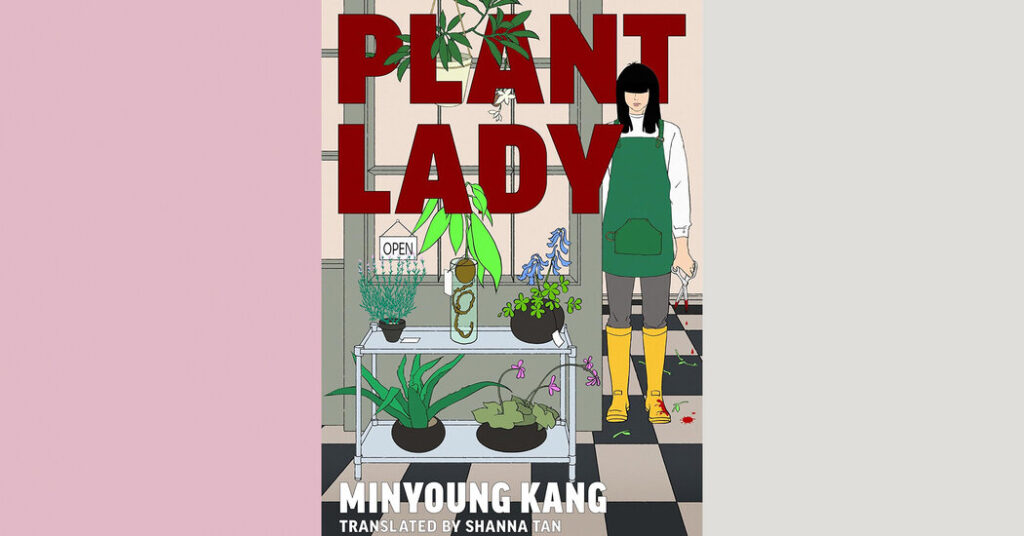
PLANT LADY, by Minyoung Kang; translated by Shanna Tan
The cozy cleanness of a neighborhood plant shop, perfectly curated for an Instagram grid. Women lift potted succulents to the light, carry ferns curling up in their shopping baskets. Visitors come to see the stray cats that wander the periphery, or to ask advice from the shop’s gentle yet magnetic owner, Yoohee.
This might sound like the beginning of a work of “healing fiction” — a newish genre to English readers that has developed out of Japan and Korea, with low-stress, heartwarming plotlines involving libraries, cafes, sometimes magic and lots of cats. But in Minyoung Kang’s “Plant Lady,” this tender veneer belies something far grislier. This shop, and this novel, provide a much more brutal kind of healing.
Yoohee is a former corporate cog now living her dream of opening a plant shop in a quiet section of a fictional city in South Korea. She’s got a green thumb, business acumen and a love of cats; but otherwise we don’t know too much about her (the novel twice calls her “enigmatic”).
“How to describe it?” the omniscient narrator asks of Yoohee’s personality. “She had the aura of someone who has chosen to leave the secular world behind and retreat into a corner of a faraway forest. Almost ethereal.” Her shop is apparently just as dreamy and alluring. It blows up on social media. Yoohee gains a devoted clientele of women, and soon cultivates a new, darker project on their behalf.
“If something bothered her,” like a dirty floor or the pests that sometimes show up among her inventory, “she had to get rid of it immediately,” Kang writes — and this quickly comes to apply to the terrible men in both Yoohee’s life and the lives of her customers.
The novel’s structure is simple but effective: Almost every chapter introduces a new woman who is trying to escape or outwit a man who is making her life hell, and who seeks refuge among the greenery at Yoohee’s Plant Shop, where she either listens to or simply senses their troubles. Soon Yoohee is murdering these men with shovels or shears or poisonous fruits, and fertilizing her plants with their remains.
There’s a certain kind of man-murdering narrative that can make for the ultimate feel-good story: Think the Southern staples of “Fried Green Tomatoes at the Whistle Stop Cafe” or the Chicks’ “Goodbye Earl.” But unlike these, “Plant Lady” isn’t about the warmth of women’s connection; each patron basically exits the story once Yoohee has solved her problems. This is, instead, a story about the ice-cold brutality of men.
Kang gives us a full range of abusers (violent, volatile artist; workplace harasser; furious, alcoholic father; cat torturer; a teenage boy who posts compromising photos of a female classmate online) and a full range of methods for offing them. There is a gleeful quality to some of Yoohee’s murders, such as the “Fargo”-esque feeding of a man into a woodcutting machine; others, like setting fire to an office building, are more solemn, simply seen as necessary maintenance, like pruning. But in every chapter, the viciousness of Yoohee’s vengeance is tempered with a dark and fizzling sense of humor reminiscent of other recent Korean fare, like Park Chan-wook’s movie “No Other Choice,” and the TV sensation “Squid Game.”
Eventually, a bumbling but obsessive detective, Cha Dokyung, looks into the disappearances of these men and their possible connections to Plant Shop, which gives way to a cat-and-mouse investigation that never really rises to code red — perhaps because of lines of detective dialogue like, “There must be something … a clue somewhere.” Dokyung is rendered in such broad strokes and cop clichés as to be more of a chalk outline than a character. It’s hard to believe he’d ever be a match for the mysterious and untouchable Yoohee.
Given the fate of men in this novel, that might be for the best. Ripe for a sequel, “Plant Lady” offers a twisted kind of escapism, and healing: an immersive world where women take down men, without conscience or consequence — a fecund fantasy of feminist revenge.
PLANT LADY | By Minyoung Kang | Translated by Shanna Tan | Berkley | 202 pp. | $28
The post Come for the Monsteras, Stay for the Murders appeared first on New York Times.