
Steve Cropper, who died Wednesday at 84, is not a household name, but the music he made is some of the most familiar in American pop. The twanging guitar line that opens Sam & Dave’s “Soul Man”—that’s him. Same for the chugging riff on Wilson Pickett’s “In the Midnight Hour” and the chopping rhythm on the soul instrumental “Green Onions.” He’s the man who finished mixing “(Sittin’ on) the Dock of the Bay,” adding the sounds of gulls and waves after his friend Otis Redding, with whom he wrote the song, died in a plane crash.
Cropper’s most enduring contribution, though, isn’t any particular song, but the way he pared the guitar techniques of R&B and blues down to their barest necessities to invent the language of rock-and-roll rhythm guitar in the early 1960s. Since Chuck Berry’s first hits, rock’s most famous instrumentalists have been lead guitarists, who step out in front of the band with flashy solos. But rhythm guitarists are essential for maintaining a song’s harmonic structure and making it groove. The Beatles, the Rolling Stones, Neil Young, Ramones—all of these artists and more built on the foundation he laid.
The setting where he did that was important as well: as a member of Booker T. & the M.G.’s, the house band at Memphis’s Stax Records and a rare multiracial group in the segregated South. The M.G.’s consisted of two white and two Black musicians, and their work was as American as possible, melding blues and gospel with country. It was music created when Cropper jammed in the Stax studio with the 17-year-old organist Booker T. Jones, and when he holed up in the Lorraine Motel with singer Eddie Floyd to write “Knock on Wood.”
Later in life, Cropper could be self-deprecating about his chops. “My playing has always sucked, but it sells,” he told Total Guitar last year. “I keep it simple, I guess. I’m not a guitar player. I never took the time.” He wasn’t totally wrong. Cropper could play perfectly tasteful blues, but he didn’t have a lot of technically impressive licks. His most famous lead, on “Soul Man,” consists of just two notes. (That’s the one where Sam Moore shouts, “Play it, Steve!”)
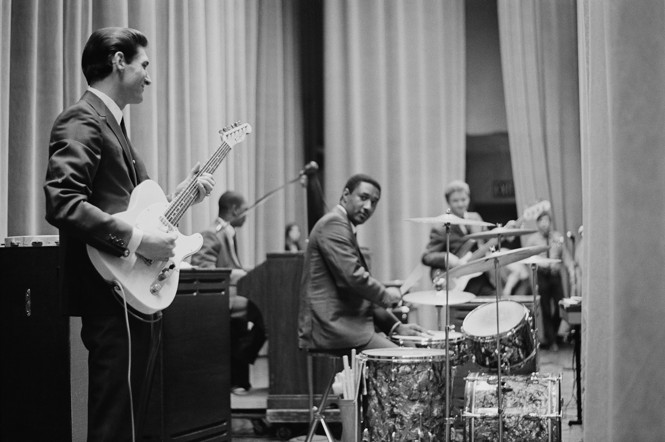
But Cropper’s diffidence about his abilities was the perfect mindset for a rhythm guitarist, whose job is to serve the song and the band rather than himself. Using a clean, thin-sounding Fender Telecaster, he made a virtue of simplicity and consistency that enabled him to lock in with any rhythm section. From his idol Lowman Pauling, the guitarist in the “5” Royales, he learned to play short and punchy fills between vocal lines. Most important, he was extremely funky, especially for a kid from the Ozarks. (When he was 9, Cropper’s family moved to Memphis, where he discovered Black music, but he never lost his Missouri drawl.)
He used a range of tricks to achieve that. One of my favorite Cropper moments is a chord solo on “Mo’ Onions,” where he plays barely anything but the same dissonant stab over and over. The mastery is in the way he bends the notes and especially in the timing. Like Ahmad Jamal and Miles Davis, he knew how to make music by leaving space.
Cropper’s approach was adopted by a range of rock genres. The M.G.’s were able to make a four-piece sound delicate or heavy, making them a more useful model for garage bands than the large crews working in Nashville and Detroit studios at the time. The Beatles revered the M.G.’s, and Cropper later played with both Ringo Starr and John Lennon (no slouch on rhythm guitar himself). The spare, chugging patterns Cropper introduced could work in punk or new wave; the Clash covered “Time Is Tight.” The influence continued into the hip-hop era, when Booker T. & the M.G.’s became a favorite source for samples.
You can trace how Cropper’s career progressed in the distance from the taut “Green Onions” to 1971’s spooky “Melting Pot,” in which Cropper rides the same funky one-chord vamp for most of the track’s eight-plus minutes. Or you can trace it from the impossibly slim, sharp-jawed young man of the early Stax days to the shaggy, bearded figure featured behind John Belushi and Dan Aykroyd in The Blues Brothers. After the M.G.’s broke up in 1971 (they reunited sporadically for tours and records until 2012), Cropper remained in demand as a studio musician and producer, working with Big Star, Paul Simon, Dolly Parton, and John Prine; the M.G.’s also backed Bob Dylan at his 30th-anniversary celebration, in 1992. That Cropper was able to fit into so many different settings is no surprise. After all, he’d created the template.
The post Play It, Steve! appeared first on The Atlantic.