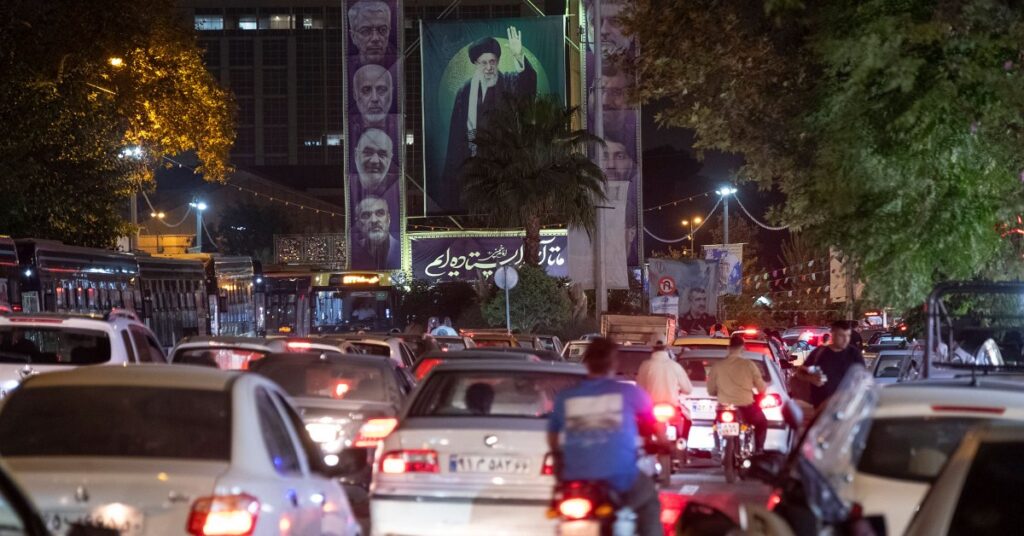
Even when no bombs are falling, the people of Iran do not experience what can truly be called peace since they live under a state that controls every aspect of their personal or public life.
[time-brightcove not-tgx=”true”]
Their peace is disrupted by surveillance, censorship, arbitrary arrest, torture, and the constant threat of violence. It is eroded by an economy hollowed outby corruption and mismanagement, by the strain of sanctions, by the daily anxiety of inflation, scarcity, and unemployment and by the relentless destruction of Iran’s environment.
Peace is not the absence of war, but the ground on which everything else must stand: democracy, stability, economic growth, social change, and the possibility of a functioning civil society. But after the 12-day war, people in Iran found themselves caught at the intersection of the regime’s war against its own people, and war between the governments of the Islamic Republic and Israel. Dictatorship and war are two sides of the same coin, as pro-democracy and peace advocates declared in statementscondemning the conflict. They called for a new political order: a secular, democratic government that genuinely represents the people of Iran, a free and fair referendum under international supervision by the United Nations, and the drafting of a new constitutional framework by an elected constituent assembly. They named clear, lawful mechanisms for a peaceful transition, grounded in international legal standards and Iran’s own democratic aspirations.
Their united stance showed that a broad, collective national movement, rooted in civil society, human and women’s rights, and Iran’s diverse democratic traditions, has the capacity to steer the country toward a historic transformation. A transition that must be first of all peaceful, based on dialogue, accountability, pursuit of justice, and respect for universal civil human rights. Knowing that anything less–collapse, chaos, or armed conflict—would put millions at risk in an already fragile region.
Iranians have consistently demonstrated a commitment to non-violentdemocratic movements. The country, after all, has always held multitudes. For thousands of years, it has been home to a mosaic of ethnicities, languages, and beliefs. Despite serious differences and political disagreements, the people of Iran have preserved long-standing traditions of coexistence, mutual respect, and communal life.
And they have made it very clear that the regime has lost its legitimacy. For over four decades, Iranians have pressed forbasic rights through peaceful, democratic movements, from women’s marches after the 1979 Revolution to the 1999 student protests, the 2009 Green Movement, the November 2019 demonstrations, and the “Woman, Life, Freedom” uprising sparked by the killing of Mahsa (Jina) Amini. The ongoing defiance of women and youth has shaken the foundations of the Islamic Republic, turning them into the regime’s worst nightmare. Those the regime tried hardest to silence became its most powerful challengers.
The truth is, Iran is already in a transition. But transitions can move in many directions. The Iranian people have proved their courage. They have endured prisons, censorship, surveillance, bullets, and the loss of their children، yet they continue to fight. Not violently. Violence, whether imposed from outside or from within, is not the answer. What they ask for is not intervention, but recognition; not foreign armies, but international solidarity; not war, but peace.
How can the world help? Like any government, the Islamic Republic responds to pressure. Change in Iran requires global pressure to end human rights violations, gender apartheid, and executions; to free political and ideological prisoners; and to enable the functioning of civil society institutions. We need the international community to rethink its approach to “change” in Iran, and lay the groundwork for a transition from authoritarianism to democracy.
My message: We are working to end religious despotism and to help lead the transition from authoritarianism to democracy. To achieve this support Iran’s civil society, independent media, and human rights and women’s rights defenders who are at the forefront of building a just and democratic future for their country. With global solidarity, democracy and peace are not just possible—they are within reach.
The people of Iran are ready. Stand with them.
The post Narges Mohammadi: Iran Is Still at War—With Its People appeared first on TIME.