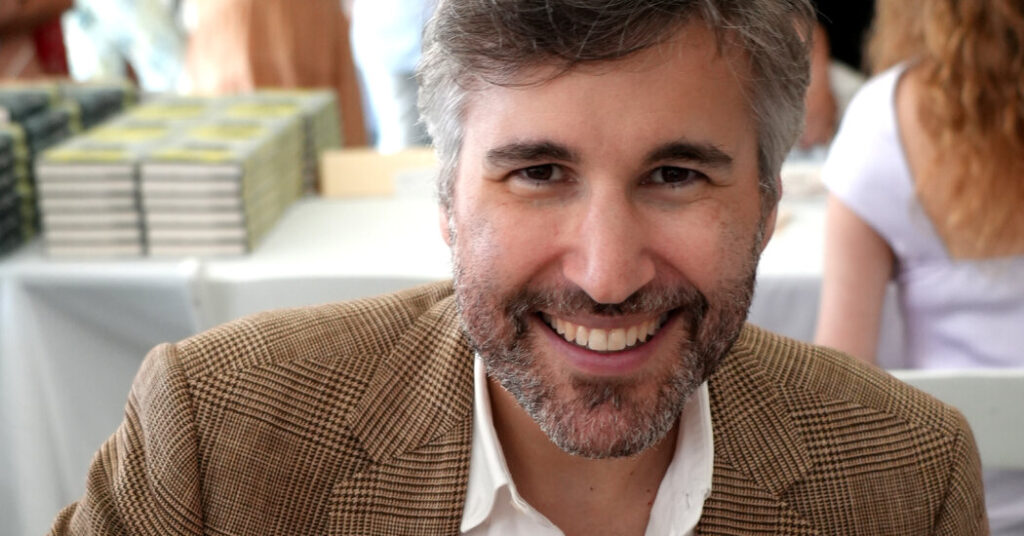
On Tuesday, the paperback edition of “Empire of the Elite,” my colleague Michael Grynbaum’s delicious history of the Condé Nast publishing house, was released. When I got my hands on the book last year, I flew through it. Grynbaum is America’s chief Condéologist, and he deftly lays out how Condé and its glossy, ad-stuffed magazines (Vogue, Vanity Fair and GQ most of all) shaped the tastes of millions of Americans throughout the 21st century … and how that empire began to erode in the internet age.
Much has occurred inside Condé since the book’s release, most of all the death of Donald Newhouse, the billionaire mogul who led his family’s publishing empire, and Anna Wintour’s decision to cede her role as editor of American Vogue. That last bit of news occurred just two weeks before the release of “Empire of the Elite,” once the book had gone to print. At a talk about the book on Monday, Grynbaum noted that Wintour’s exit certainly helped his sales. The timing did not allow him to dissect its meaning, and so he added a chapter to the paperback edition.
I chatted with Grynbaum about all that has happened at Condé Nast, how a younger generation reacted to his book and what he thinks of “The Devil Wears Prada 2.”
I was reminded reading the new chapter that Anna Wintour downplayed her decision to step down as the head of Vogue from the very moment she announced it. Did we make too much out of Anna’s career change?
I discovered that Anna was taken aback at the cascading headlines (“The Queen Is Dead!”) that accompanied her announcement. She considered it an org-chart reshuffle and hadn’t even bothered to inform some members of her P.R. team beforehand. In fact, Anna views her remit today as bigger than ever: preserving the future of Condé Nast. In relinquishing the role of U.S. editor in chief, she wanted to emphasize her focus on shepherding the international Vogue brand rather than merely its American edition.
You write that you were surprised that your book was well-received by a younger generation that gets all misty-eyed thinking about a golden moment in magazines that they missed. Do you think the 22-year-old who hoards back issues of W is still engaging with today’s magazines?
So, yes and no. I think that kid, if living in New York City, is haunting Iconic and Casa Magazines for the latest drops of Cultured, The Gentlewoman, Interview and, yes, W. I’m not sure they are subscribing to a print edition of Vogue, but I think Vogue continues to play a significant role in the fashion ecosystem — the Met Gala, Vogue World, the online cover reveals. Because Vogue is still perceived as the voice of the establishment, its decisions set the terms of the conversation, even when that conversation is a lot of people complaining about Vogue. Better to be criticized than ignored.
You write that “once Donald [Newhouse] dies, all bets may be off.” Donald has since died. So what do you think happens to the Condé empire? Does Jeff Bezos buys Vogue?
Donald, the surviving brother of Condé’s longtime chieftain Si Newhouse Jr., died in May at 96. In the past, I’ve speculated that the next generation of Newhouses hesitated to sell certain magazines out of respect to Donald and his brother’s memory. But my sources within the company tell me that little has changed after Donald’s death. The Newhouses have made cuts, certainly: Self was shut down, Glamour hollowed out. And the family has declined to funnel the vast revenues from other parts of their empire (like Reddit and the telecom giant Charter) back into Condé Nast.
However, I believe there’s still a sense of noblesse oblige in their ownership of century-old franchises like Vanity Fair, Vogue and The New Yorker, which they consider heirlooms. Other core brands like Architectural Digest and Wired are also thriving. I’m less sure about the fate of a title like Allure, which no longer publishes in print and has been usurped by the boom in online beauty and makeup sites. As for the Bezos-buys-Vogue question: I don’t see it, at least not anytime soon.
OK, so how many times have you seen “The Devil Wears Prada 2”?
I have seen “Devil Wears Prada 2” exactly once. For me, it didn’t reach the heights of the original, which I consider one of the all-time great depictions of work and ambition. But I love the fact that a movie about magazines, this ostensibly dying medium, made a ton of money at the box office in 2026. Many young people are still taken with the idea of a beautifully printed package of art, writing and photography that they can hold on to, instead of idly scroll by on their phones.
You’re a huge magazine fan. In your research what was your favorite singular issue of a Condé mag that you came across?
Very hard to pick — essentially impossible. But one I’d call out for sheer novelty, curiosity and aesthetic delight is the July 1988 issue of House & Garden, one of a handful edited by Anna Wintour during her seven-month stint leading the magazine. It has a jubilant cover with a cheeky headline (“Simply Chintz!”), an amazing spread of David Lynch’s succulent-filled garden in L.A., and an Irving Penn portrait of I.M. Pei on the occasion of his then brand-new glass pyramid at the Louvre (“Pei’s Peak”).
Other things worth knowing about:
-
A reader kindly pointed out that I failed to mention in my last newsletter that Ellen Mirojnick did the costumes for “The Odyssey.” That was an oversight. Mirojnick is a legend (come on, she did the costumes for “Basic Instinct” and “Showgirls”!), and I apologize for not mentioning her.
-
News flash: Rich people are still buying bags and baubles. Kering, Prada, LVMH and Hermès all reported increased sales this week. A recession may yet come, but luxury analysts are optimistic. For now.
-
A new Armani documentary series is in the works. This production has the blessing of the fashion house, unlike the biopic “Armani: The King of Fashion,” which was also put into motion after the designer’s death last year and which this month was given a thumbs down by the company. For my money, the ideal Armani documentary already exists: Martin Scorsese’s ”Made in Milan” from 1990.
-
An exhibition on the Burberry trench is set to open at the V&A Museum in September. If you’re in London, check it out (yuck, yuck, yuck.)
-
A hyperlocal New York bit of news: I got tipped off that Paula Rubenstein, arguably the best antique dealer in Manhattan, is moving from her Chrystie Street store to the Brooklyn Navy Yard in September.
-
Dario Vitale may have been ousted as Versace’s creative director almost eight months ago, but there are whiffs of him all over its new ad campaign.
What I read and liked:
-
Bill Buford’s 1991 plunge into British soccer hooliganism, “Among the Thugs” is one of my favorite books, so I loved this interview with Buford in The Paris Review about its legacy. “I think male behavior is perplexing and disruptive and often a good story,” Buford says. Indeed.
-
I had to save this Instagram post of scans by the stylist Julian Fetterman from a 1991 issue of the knitting magazine Rowan. This particular issue is prized as it features a 16-year-old Kate Moss (you can buy an issue on eBay for around $250), but the sweater designs themselves are sublime. The blanket cardigan is a jaw-dropper. If you have a lead on a copy for less than three figures, email me.
-
Credit as well to Liana Satenstein for dredging up this old Free People catalog with a young and scruffy Christopher Abbott, best known as Charlie from “Girls.”
-
The Ralph Lauren chief executive Patrice Louvet went on the Semafor podcast.
-
DealBook has some savvy analysis on Reformation, the mass-thrifty retailer going public next week.
Ask Vanessa
What on earth does semiformal mean today? We’ve been invited to an event with this dress code, and while we don’t want to embarrass ourselves, we do not want to invest in expensive new clothes either. — Tanya, Phoenix
“Semiformal” is one of those terrible default dress codes, like “festive” and “dress to impress” and “dressy casual” (the “jumbo shrimp” of fashion). It sounds good in theory but in practical terms causes more angst than anyone might have imagined. It’s the middle ground of dress codes, the DMZ of fashion. It may seem safe — no commitment required! — but it also leaves you stranded in the sartorial netherworld of neither here nor there. Which means you can easily get it wrong. … Read more.
Look of the week
The post What’s Next for Condé Nast appeared first on New York Times.