GREAT BEND, Kan. — A national fight over state supreme courts is flaring up in Kansas, where voters will decide Tuesday whether to replace the state’s 68-year-old system of appointing justices with direct elections — a change that could shape future rulings on abortion, voting rights and other monumental issues.
The fight over the Kansas Supreme Court reflects the growing importance of state courts since the U.S. Supreme Court ended the federal constitutional right to abortion and put claims of partisan gerrymandering beyond the reach of federal judges.
“State supreme courts are doing what the federal Supreme Court used to do — the difference being that you can manipulate the composition of the state supreme court through elections,” said Charles Geyh, an Indiana University law professor who has written extensively about state supreme courts.
The vote in Kansas will decide whether Kansas directly elects its justices or appoints them using a merit-based system it adopted decades ago after a political scandal.
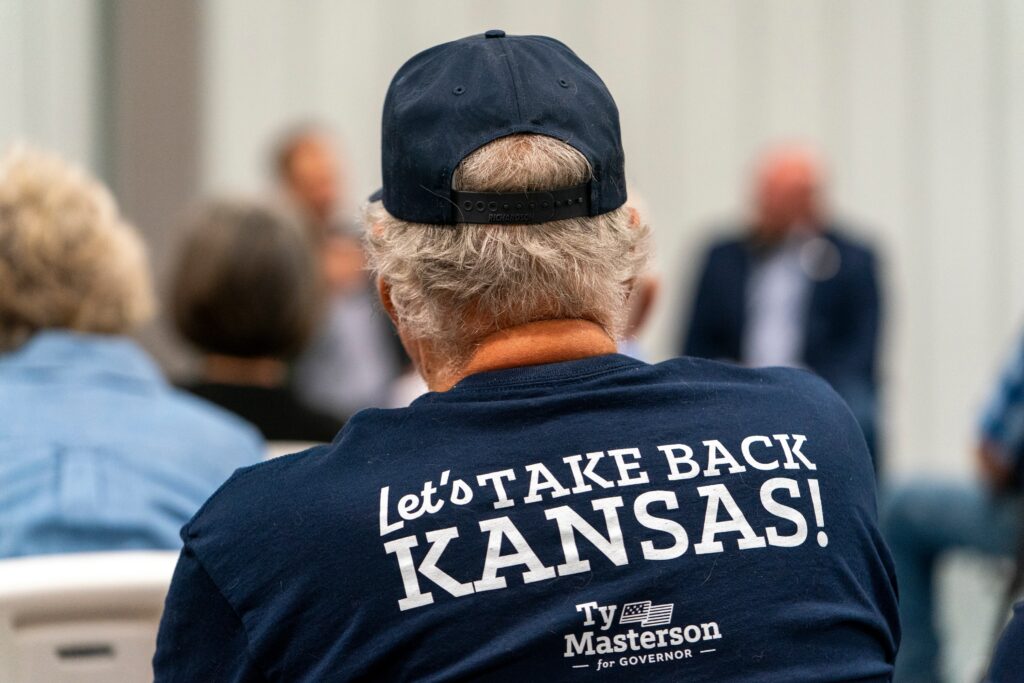
Republicans who placed the measure on the ballot say voters should directly choose who serves on the court, while opponents say it’s an effort to install justices who will undo rulings that Republicans don’t like.
The court has given conservatives some recent victories, such as decisions protecting workers who sought religious exemptions from covid-19 vaccine requirements and tightening voting procedures. But the court has frustrated Republicans in other cases, such as with rulings requiring far more money for public education and guaranteeing a right to abortion.
Republicans sought to reverse the state court’s abortion ruling with a measure that appeared on the ballot six weeks after the U.S. Supreme Court struck down the federal right to obtain an abortion. The ballot measure failed, with 59 percent opposed.
After that defeat, Kris Kobach — who at the time was between stints as secretary of state and state attorney general — urged Republican lawmakers to change how the justices are selected so conservatives could “slowly and quietly” remake the court and restrict abortion.
At a recent forum in a cavernous events center that was more like a civics class than a political rally, Kobach, who is now attorney general, argued the ballot measure is about far more than abortion, noting the court over the coming years is likely to address gun rights, property rights, voting rights and school funding. Attendees listened closely to the attorney general, including one young man wearing a John Deere hat and a shirt that said, “The pro-life generation votes.”
“There is always politics in these big decisions,” Kobach said at the event in Newton. “And so the question for you is, do you want the judges free to exercise their political views without any constraint or do you want them accountable to the people?”
Twenty-one states elect their justices. Eleven give governors or lawmakers wide latitude to appoint them. Kansas and 13 other states instead use a merit-selection system that is meant to limit partisanship on the bench. (The other four states have hybrid systems, according to the Brennan Center for Justice, a nonprofit that focuses on democracy and tracks state supreme courts.)
In Kansas, a commission consisting of five lawyers and four nonlawyers recommends three names to the governor, who then appoints one to the court. Voters are asked if they want to retain the justices every six years; no justice has ever lost a retention election.
Voters adopted the system in 1958 in response to the triple-play scandal, a sequence of shuffles in top offices that put outgoing Republican Gov. Fred Hall on the state Supreme Court. After a GOP justice stepped down, Hall resigned as governor just before his term ended. His successor, Lt. Gov. John McCuish, then appointed Hall to the vacancy, prompting public outrage.
Republicans in Kansas are pushing to elect justices as more states get mired in fights over their top courts. In Utah, GOP lawmakers this year expanded the state Supreme Court from five to seven members after losing litigation over a congressional map. Wisconsin Supreme Court elections have become partisan spendathons, with the 2025 race costing more than $100 million. And in North Carolina, the losing Republican candidate in 2024 spent six months trying to disqualify tens of thousands of ballots before conceding.
If the push to move to elections succeeds in Kansas, the drive could spread elsewhere. Oklahoma voters will decide in November whether to give Republicans more control of the state’s judicial selection commission, and some Republicans in Missouri have pushed for electing justices instead of using merit selection.
“Kansas will be just the first stop on a 50-state tour” if the measure passes, said Micah Kubic, executive director of the American Civil Liberties Union of Kansas, which is part of a coalition running ads against the measure. “They will go state by state to dismantle the fairness and impartiality of the judiciary.”
Future of abortion on the ballot
Kansas has become a key point of abortion access in the Midwest and the South since neighboring states began restricting the procedure. Planned Parenthood Great Plains performed about 14,000 abortions at its Kansas clinics last year, with about three-quarters of its patients coming from out of state, said the abortion provider’s chief executive, Emily Wales.
This ballot measure has echoes of the one that failed in 2022, she said.
“Here we are four years later, I think, once again, fighting about abortion rights, but the word ‘abortion’ is not going to appear on the ballot,” Wales said.
At an event in Salina, opponents of the ballot measure crammed into a conference room lined with signs that said, “Keep our courts impartial.” Lawton Nuss, a former chief justice of the Kansas Supreme Court, told the mostly older crowd that electing justices would unleash campaign spending that would damage the court’s independence. He pointed to Wisconsin, where billionaires such as Elon Musk, George Soros and Illinois Gov. JB Pritzker (D) spent millions to influence the 2025 race.
“We need to stop billionaire political donors from turning our impartial justices into politicians for sale,” Nuss said.
The crowd applauded the line, but elsewhere in the state conservative voters said the risk of billionaire influence is overblown. They want voters to decide who sits on the court.
“We like to make decisions for ourselves,” said retired truck driver Walt Pennington. “I’m not interested in somebody from Kansas City or Lawrence or Wichita telling me what to do.”
In the ad war over the ballot measure, opponents are outspending supporters. Groups opposed to the measure have spent $8.5 million and groups backing it have spent $3.9 million, according to ad tracking firm AdImpact.
On a recent, blazing hot Thursday, state Rep. Sherri Brantley (R) and canvassers with the state chapter of the conservative group Americans for Prosperity knocked on doors in Great Bend to promote the ballot measure. The canvassers wore T-shirts that said, “Take back the bench” and “Don’t let unelected attorneys pull the strings.”
Standing in the shade in his driveway, retired computer systems administrator Steven Morris told Brantley and another canvasser he considers himself very conservative but isn’t sold on electing justices. He said he fears Democrats could boost voter turnout and put more liberals on the bench.
“People voting are usually the wrong ones, and conservatives are usually at home or working,” he said.
Brantley, who wore a visor decorated with a rhinestone American flag to keep the sun out of her eyes, pressed him to support the measure.
“You need to trust the people,” she said. “Let them elect these judges.”
The post The next abortion battle is over Kansas’s highest court appeared first on Washington Post.