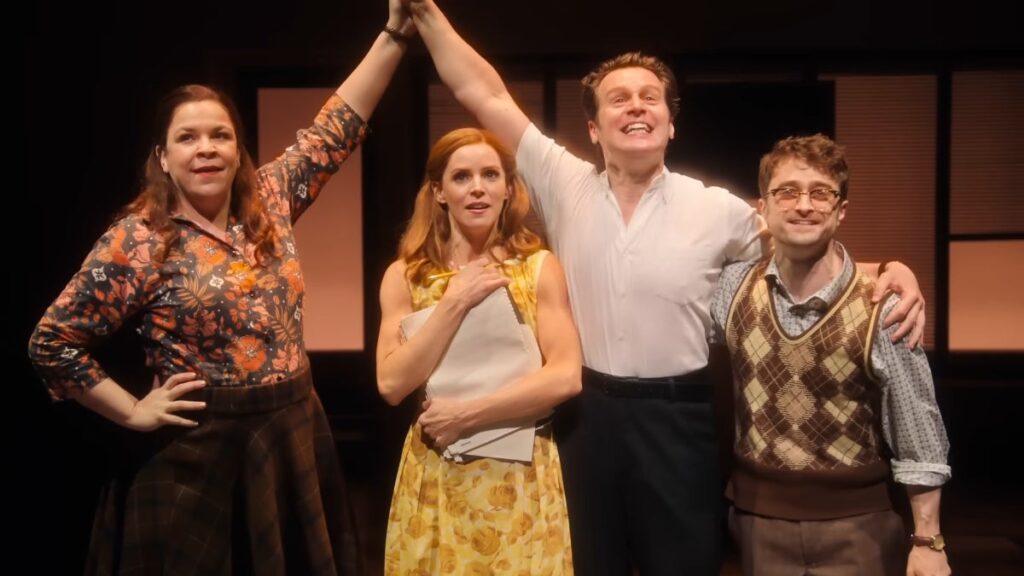
The worlds of motion pictures and musical theater don’t overlap the way they used to. For decades, after the advent of talkies, Hollywood adapted hit Broadway productions by the truckload, because they were pretty reliable hits. That trend dwindled in the second half of the 20th century, and eventually the pendulum swung the other way, with Broadway adapting more movies to the stage than the other way around, because if there’s one thing an audience loves it’s “The Lion King,” and if there are two things an audience loves it’s watching “The Lion King” twice.
So Broadway is keeping up with movies, but movies aren’t doing a great job of keeping up with Broadway. As such, no matter how big a hit it was (really big) and how many Tony Awards it won (four), I suspect a lot of film fans aren’t up to speed on the revival of “Merrily We Roll Along.” The musical comes from the legendary Stephen Sondheim, and was originally the follow-up to his game-changing serial killer musical blockbuster, “Sweeney Todd: The Demon Barber of Fleet Street.” And it was, originally, in 1981, a massive flop.
The story, based on a play by George S. Kaufman and Moss Hart, tells the story of three friends who start out as idealistic artists, grow up, grow apart, and eventually grow into miserable middle-aged jerks. The twist is that “Merrily We Roll Along” tells their story backwards, starting with their relationship in shambles, and then gradually working their way backwards, skipping back a few years with every scene, gradually revealing the nuances of their fallout, which often began with good intentions.
In some respects it’s a very traditional musical, all about the joys of putting on a show, but when you start with tragic downfall and work backwards, the “golly gee whiz” quality never takes hold. This is a bitter story that only ends happily because, through the magic of storytelling, time travel makes it possible.
If you want to see what Hollywood can do with “Merrily We Roll Along” you’ll have to wait a couple decades, because Richard Linklater took the reins and decided to film it backwards, with a young cast reuniting year after year, whenever they match the ages of the characters. So when they’re middle age, and we’re old, we’ll finally get to see it. Or, if you can suspend your disbelief and you do a little thing called “acting,” you can watch “Merrily We Roll Along” right now. The revival was filmed at the Hudson Theater in June of 2024, and despite one wonky misstep, it captures some real magic.
Jonathan Groff stars as Frank, a musician-turned-producer, who successfully leapt from the theater to Hollywood. He’s celebrating his first hit film, he’s sleeping with the young ingénue star, his wife Gussie (Krystal Joy Brown) hates him, his best friend Mary (Lindsay Mendez) is halfway to hating him too, and his former artistic collaborator Charley (Daniel Radcliffe) is dead to him. We dare not speak his name. Frank has everything. Frank, and everyone else is miserable.
“Merrily We Roll Along” leaps back a few years and finds Frank, Mary and Charley still friends, and Frank trying to drag Charley into the lucrative side of show business. Charley, ever the principled artiste, is offended by the notion, and torpedoes a TV interview by laying into Frank with an anxiety attack showstopper ditty called “Frank Shepard Inc.” If you’re a movie lover and you haven’t been keeping track of Radcliffe’s theater career, he’s come a long way as an actor, and he absolutely kills it. Murders it in the best possible way. A destructive force, a cry for help, a blistering roast, an unstoppable train wreck. We hated Frank in scene one, and in scene two, although Charley obvious has his reasons, he starts winning us back. Just a little.
“Merrily We Roll Along” is a little like “A Christmas Carol” if the Ghosts of Christmas Present and Future were hung over that day and let Christmas Past do all the work. We fill in a lot of blanks, and Groff beautifully drizzles naiveté back into Frank’s life, retroactively. He wins us back. We go from hating the monster he became to pitying the monster he gradually, insidiously, perhaps inevitably transformed into over time. It’s beautiful work, even if the attempt to de-age him by just adding a Clark Kent wisp to his hair is a little giggle-worthy.
There’s a flaw in this version of “Merrily We Roll Along,” and it’s frustrating because it’s unique to the film. Plays are performed over and over, modifying themselves every single day, a fluid and ever-evolving art form. Cinema preserves itself in amber, or at least it does if the filmmakers don’t come back years later and add CGI dewbacks into the background. “Merrily We Roll Along” is the official catalogue of one particular night in the theater, and yet it doesn’t quite capture the theatrical experience.
Maria Friedman’s revival isn’t filmed from the audience, it’s filmed right on stage, with the cameras floating around the actors, often getting right in their faces. When there’s a shot-reverse shot we can often see the lights backstage. It’s a “you are there” documentary of a “there” you’d normally never be. This can work, of course. Luis Valdez’s classic film “Zoot Suit” has all the cinematic dynamism a filmed production can ask for. But it respected the stage and the presentation, which weren’t designed for traditional filmmaking techniques. They were designed to be taken in all at once, from a single angle, in the audience, and pretending otherwise would do the catalogue of Valdez’s production few favors.
“Merrily We Roll Along” eventually settles into a fine visual balance, but the operative word is eventually. The filmed version dumps the audience into the action, in medias res, and expects us to get our bearings gradually. But the story does that for us, and the decision to emphasize the chaos in the first, protracted scene with camera movements and editing to match isn’t intriguing, it’s merely disorienting. This is a stage production and there’s no sense of space. The rapid-cutting to close-ups of actors who seem to have narrative significance but are, we finally realize, merely partygoers makes it unnecessarily difficult to simply absorb the information we’re supposed to absorb.
It’s not a huge a problem, and “Merrily We Roll Along” quickly rights the ship, but it’s risky to put the audience that far off, that early, and some might find it legitimately, understandably annoying. But stick with it, that’s what I say. This filmed production gets where it needs to go and you will too, and if you’re anything like me, as soon as it’s over, you’ll want to watch it all over again, knowing what you now know, to absorb the nuances of the story, to relive the wonderful songs, and to watch that opening scene with, at last, some sense of your bearings.
“Merrily We Roll Along” rolls, indeed, right the hell along, and it’s a lovely, sad, memorable ride. It’d better be memorable. We won’t get another movie version until 2039.
The post ‘Merrily We Roll Along’ Review: Tony Award-Winning Sondheim Revival Invites Moviegoers Onstage appeared first on TheWrap.