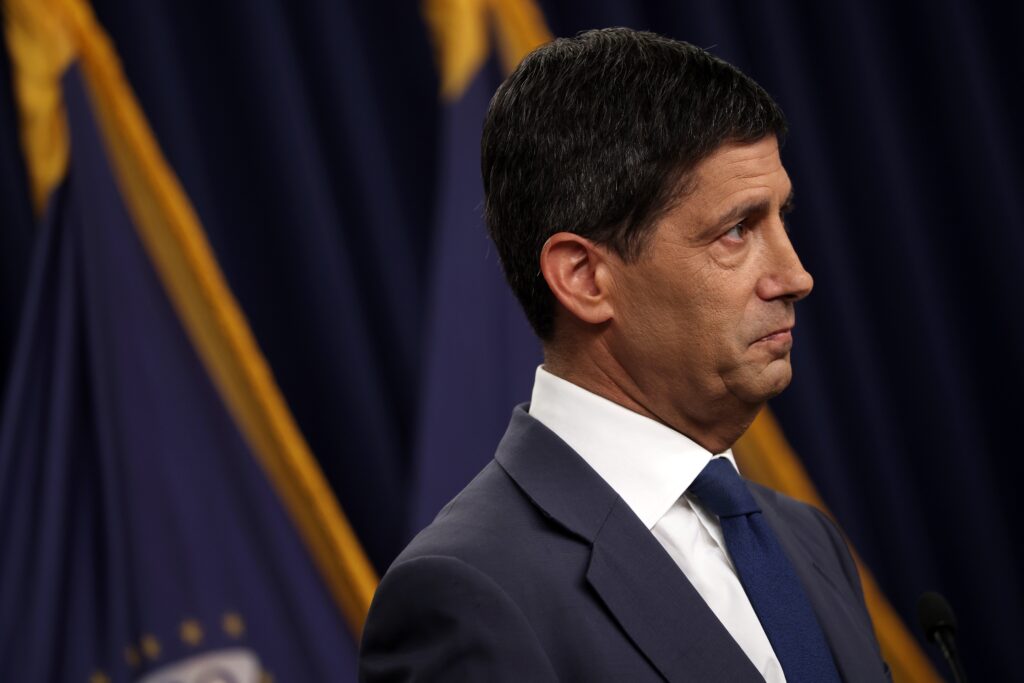
A government report Thursday showing that inflation declined in June did little to calm investors rattled by concerns over whether Federal Reserve Chairman Kevin Warsh is prepared to raise interest rates to bring rising prices firmly under control.
Prices rose at an annual rate of 3.7 percent last month, down from May’s 4.1 percent figure. The good news, however, may not last. The resumption of the U.S. war with Iran already has gas prices ticking back up to nearly $4.10 per gallon. And President Donald Trump’s plans for new tariffs could raise the cost of other goods.
The larger concern involves the nation’s central bank following Warsh’s news conference Wednesday, which left investors uncertain about his inflation-fighting credentials. When he was sworn in two months ago, Warsh’s reputation as a longtime inflation “hawk” reassured those who had feared that he might buckle under pressure from Trump to cut interest rates despite rising prices.
But Warsh’s stripped-down communication style — refusing to provide almost any insight into his thinking on Fed policy — led to a bond market sell-off that sent government borrowing costs soaring to their highest mark in roughly two decades.
“This is the markets saying ‘please, please tell us what your strategy to fight inflation is. You’re not gonna bring inflation back down to target with words alone — you need to act’,” said Nathan Sheets, global chief economist for Citigroup.
On Thursday, analysts at several banks, including Morgan Stanley, JPMorgan and Bank of America, said Warsh’s refusal to elaborate about the Fed’s anti-inflation strategy raised doubts about his “credibility.”
Investors are suddenly uncertain about Warsh’s intentions. The Fed chair has been outspoken about the need for the Fed to overhaul its traditional practices after failing for five years to bring inflation in line with its 2 percent price stability target. But his stinginess with details has left money managers spooked about exactly what he intends, especially if prices keep ascending.
“If people lose faith in how committed the Fed is to bringing down inflation, they will be more likely to overreact to new inflation news,” said Adam Posen, the president of the Peterson Institute for International Economics.
Uncertainty about how the nation’s central bank will tackle its primary mission affects everyone, not just financial insiders. The Fed’s control over a key interbank lending rate ripples across the $32 trillion economy, shaping the value of stocks and bonds, determining the cost of auto and home loans and contributing to job losses and gains.
Warsh spent several years on Wall Street, advised President George W. Bush on economic policy and served as a member of the Fed’s board of governors during the global financial crisis. He boasts degrees from Stanford University and Harvard Law School.
None of that shielded him from withering reviews of his handling of Wednesday’s announcement that the Fed had decided to leave interest rates unchanged.
Going into the two-day meeting this week, only about one-third of investors had anticipated a rate increase. But Warsh’s commentary on the decision left investors wondering if the longtime hawk had suddenly become a dove. About 60 percent of futures traders expect a rate hike at the Fed’s September meeting, down from more than 80 percent before Warsh spoke yesterday, according to CME Fedwatch.
Warsh’s suggestion that he would be slower to raise interest rates to cool off the economy than market observers had expected — and his musings about consulting a broader array of price data than the Fed traditionally has used — also left investors queasy. Stocks and bonds sold off even before he finished speaking to reporters.
Amid the Fed-related uncertainty, the average cost of a 30-year fixed-rate mortgage rose to 6.66 percent, its highest mark in a year.
More expensive home loans illustrate the risk the Fed is running by leaving investors to their own devices, said Douglas Rediker, chairman of International Capital Strategies, which advises institutional investors.
“He may have to live with the consequences. And they may not be the ones that he or the Fed board — or quite frankly the White House — is willing to accept as the outcome,” Rediker said.
As a result of his new communications strategy, Warsh has said that investors are beginning to “play the ball, not the referee” — a reference to reacting to real-world economic developments rather than matching their investment strategies to central bank commentary.
“We are not convinced. In fact, we strongly disagree,” Michael Gapen, Morgan Stanley’s chief U.S. economist wrote in a client note Thursday.
Investors routinely include a judgment about the Fed’s likely reaction in any evaluation of financial data, Gapen said. For example, markets recently reacted to rising oil prices by pricing in future interest rate hikes, which pushed bond yields higher in response to public comments from Fed officials.
On Wednesday, Warsh was unwilling to explain how he would react to incoming economic data. Asked directly whether the remedy for rising prices was higher interest rates — which Powell might have answered with one word — Warsh demurred.
“If inflation continues to be elevated through the forecast period, interest rates could well be part of that solution,” he said, “but I wouldn’t say it’s in isolation.”
The ambiguity extended to how the Fed measures inflation. Warsh named the personal consumption expenditures index, the Fed’s long-standing preferred gauge, and said the central bank was sticking with it. But in the next breath, he suggested that could change: After January, the Fed could revisit its strategy and the internal task forces he appointed earlier this month to review Fed practices “might have something to add.”
That comment fed suspicion among some Fed watchers that the task forces are “just covers to redefine the inflation challenge away,” said Michael Feroli, an economist with JPMorgan Chase Bank.
The Fed first provided “forward guidance” to investors during the global financial crisis in late 2008. After dropping its benchmark lending rate to zero and purchasing securities in the open market, Fed officials opted to describe their future policy plans as an additional crisis-fighting weapon.
Abandoning that tactic now that the emergency is long past may make sense. But refusing to provide almost any insight into Fed thinking is going too far, said Posen, a former external voting member of the Bank of England’s rate-setting committee.
“He’s saying we shouldn’t be giving the market forward-looking information. In fact, the market should be giving us information. And that’s an overreaction,” Posen said.
Excessive patience by the Fed in the face of rising prices carries profound risks. If investors become convinced that Warsh won’t support higher rates when previous Fed chairs would have, they may demand higher compensation for holding government debt, according to Eric Rosengren, former president of the Federal Reserve Bank of Boston.
“Failure to act while inflation is high risks Wall Street building models that the Fed is less responsive to inflation and may be accommodating [the] interest rate wishes of an administration less concerned about inflation than financing large deficits,” Rosengren, a former member of the Fed’s rate-setting committee, posted on X.
It’s a danger that Warsh has recognized. In a 2008 speech as a Fed governor, he said investors regarded the central bank as vigilant against inflation given its performance over decades following the high-inflation years of the 1970s.
But that reputation could be squandered one day, he said, if the Fed responded sluggishly to new episodes of rising prices.
“If the Fed were deemed too accommodative for too long,” he said, “credibility could be undermined, threatening to create a persistent inflation problem that would have to be corrected, no doubt at great cost.”
The post Spooked investors demand clarity on Fed’s anti-inflation strategy appeared first on Washington Post.