FORT FAIRFIELD, Maine — Maine Democrats have transferred Graham Platner’s working-class, populist playbook to their new U.S. Senate nominee, Troy Jackson. But the shift makes no difference to Susan Collins. The Republican senator is still leaning on her roots and record to show Maine voters why she deserves a sixth term.
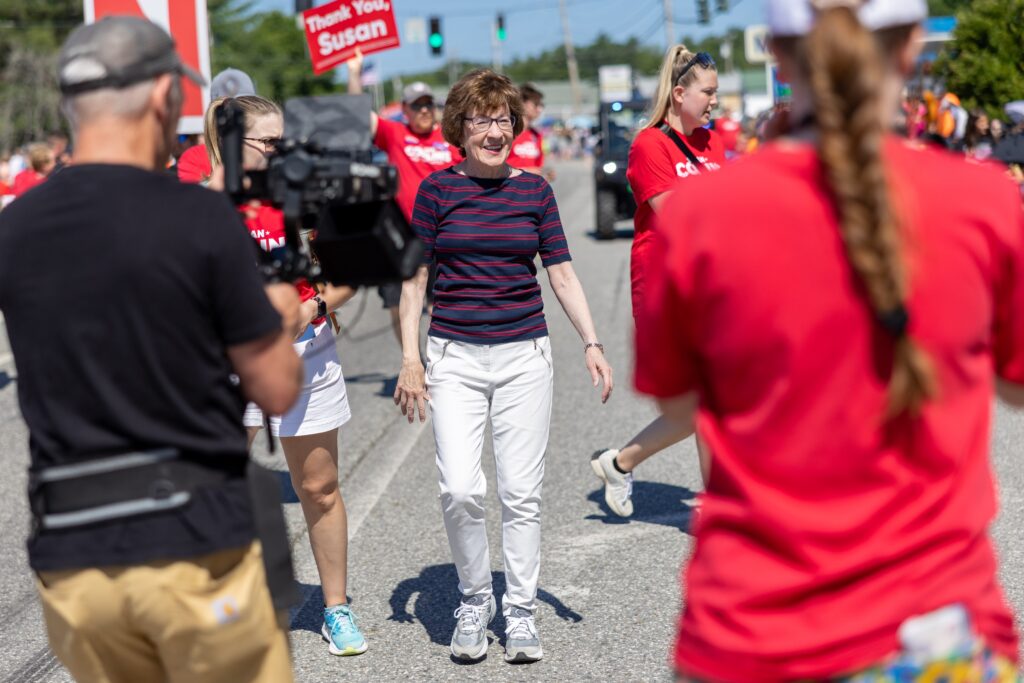
“There’s no one who has brought more money to the state of Maine than I have,” Collins told me last week in Aroostook County — or “The County,” as she calls it. Queuing for the Potato Blossom Festival parade in Fort Fairfield, the senator reminisced about growing up one town over, in Caribou, where she used to get pulled out of school to help harvest potatoes.
She told that story to voters along the parade route, explaining how the region’s starchy staple gave her the tools to deliver $1.5 billion in federal dollars to the state over the past five years. “Susan, this is very hard work, but you can’t quit,” she recounted her mother saying. “You can’t let the farmer down.” Those words, Collins said, gave her the “wonderful work ethic” that she has taken to Washington and turned into nearly 700 projects across the state over her current term, according to her office.
Collins, who is 73 years old and has a benign tremor that recently prompted attention from political observers, was a petite but prominent figure along the parade route, jogging back and forth between constituents in her New Balance sneakers. A gaggle of young Mainers held a banner thanking the senator for “leading the way to save Job Corps,” a career program for low-income youth. Last year Collins led the push to persuade the Labor Department to lift its freeze on enrollment in Maine.
“She’s a County girl,” Sandra Bonville said as she watched the parade. “You gotta be very thankful for everything that she’s done for us County people.” Darryl Peters from Eagle Lake said Collins has helped The County in such matters as dealing with homelessness and building firehouses. “Many of the communities up here are not affluent,” she said. “She’s been true to her state.”
Collins is bound to have fans on her home turf of Aroostook, one of Maine’s reddest counties. But even in bluer locales, the key question in the race isn’t whether Collins is an effective senator — it’s whether the letter next to her name is more important than her seniority and leverage.
A day earlier, at a Jackson rally in Portland, Paul Morrissey told me that losing Collins’s influence on the Senate Appropriations Committee is “certainly a concern.” But he cited the fatal Immigration and Customs Enforcement shooting in Biddeford as a reason for change: “We can no longer support someone, whether they bring in a lot of money into the state, that allows ICE to run rampant.”
Collins’s status as the first chair of the Appropriations Committee from Maine in nearly a century gives the state a valuable perch in the Senate. And one of the biggest challenges for Democrats running against her is proving they can be just as effective even as a freshman. Rather than trying to dispute Collins’s appropriation prowess, Democrats are hoping that national politics will finally close in on a state that has historically rewarded moderates.
As Maine has drifted bluer over the Trump era, Collins has become the sole Republican senator in the state, which was carried by Kamala Harris in 2024. A June poll had President Donald Trump’s approval in Maine at 36 percent.
A University of New Hampshire poll gives Jackson a three-point advantage, but he’s close to the margin of error for likely voters. Jackson’s campaign is casting Collins as an enabler of the most unpopular parts of Trump’s agenda.
“I’m not going to say that anyone that got a new fire station or something like that, it wasn’t a good thing,” Jackson told me. “But what Senator Collins has brought back the state of Maine is a pittance to what we’ve lost.”
Jackson argues that Collins’s complicity in Trump’s policies ends up costing Mainers. He used Trump’s One Big Beautiful Bill, which included Medicaid cuts, as an example: “For me that’s a pretty easy argument for anyone that actually understands numbers. She is not bringing in the money that she’s taking out of the economy.”
Collins was one of three Republican senators to vote against that bill, despite having voted to advance it to the floor. She told me the Medicaid cuts would have been “damaging to low-income families and to rural hospitals and health care clinics in my state.” The senator was careful to mention that she helped secure a fund in the bill to offset costs for rural health providers.
Collins doesn’t shy away from her rifts with Trump. She chuckled about how the president “has been known to mention it, that I have disagreed with him on some major issues.” That audacity might explain why Collins has prevailed in Maine even when her party is flailing. When Trump lost in 2020, she won by nine points.
Collins is hoping that the Pine Tree State’s independent streak will hold for yet another election as the nationalization of politics consumes local races. Maine has gotten outsize attention over the past couple of years for Gov. Janet Mills’s tiff with Trump over transgender athletes as well as Platner’s many controversies. But it’s also a place where politics is still largely conducted via Facebook to reach voters in the oldest state in the nation.
Collins feels confident that her moderation will prevail against partisanship. “Troy has a very long record as a partisan legislative leader in Augusta,” she said. “His approach is very partisan, and over the years, he’s become much, much more far left than when he first started, to the point where he’s really a democratic socialist now.”
Collins said she’ll support Trump “when he’s right” — he has her support on voter ID and the “Trump accounts” for newborns — and “oppose him when I think he’s wrong.”
She has criticized some of the most confrontational aspects of Trump’s immigration enforcement and has called for an independent investigation into the Biddeford shooting. Recently, she took Trump to task for his proposed 50 percent tariff on most Canadian goods, calling it a “huge mistake.”
Like Collins, Jackson is a political veteran from The County. He has served two decades in the state legislature, including six years as Senate president. After losing the Democratic primary for governor in June, he decided to vie to take Platner’s place after the disgraced candidate dropped out of the U.S. Senate race following a rape allegation. The Maine Democratic Party nominated Jackson as its new candidate last weekend.
At the rally in Portland, the former logger leaned into Platner’s preference for public-facing stump speeches, contrasting with Collins’s curated appearances at parades and festivals. He continues to champion such issues as universal health care, abolishing ICE and fighting corporations.
“I don’t think it’s Graham’s [movement]. I don’t think it’ll be mine,” Jackson said. It’s a movement for people who have “been waiting forever for, you know, a government that works for them.”
But Platner ran on unworkable policies as an angry newcomer without a record. It might be harder for Jackson to sell wholesale change after so many years in state government.
As for Collins, she’s promising more of the same. And she seems comfortable letting that record stand.
The post Will Maine uproot Susan Collins? I went to a potato festival to find out. appeared first on Washington Post.