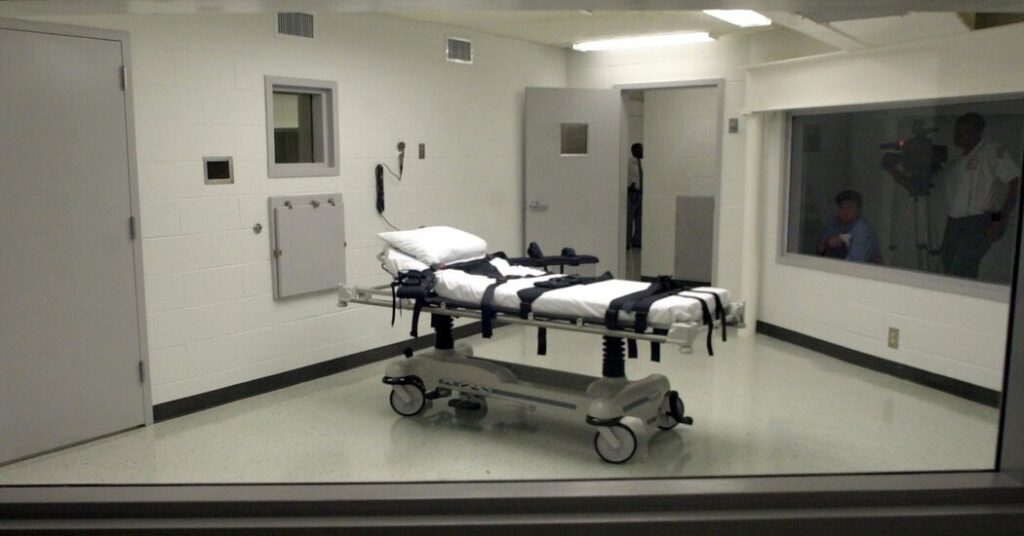
Gov. Kay Ivey of Alabama said on Thursday that the state would try again to carry out the execution of a condemned man whose life was spared last month after the Supreme Court intervened, blocking the state from putting him to death by nitrogen gas.
In a letter, Ms. Ivey instructed corrections officials to schedule the execution of the inmate, Jeffery Lee, for Sept. 17 — this time using lethal injection.
The state had previously tried on June 11 to execute Mr. Lee, 49, using the method known as nitrogen hypoxia, which Alabama introduced in 2024. The method, which has also been adopted in other states, emerged as states struggled to find the necessary drugs for lethal injection executions.
Mr. Lee’s legal team did not immediately respond to messages seeking comment on Thursday evening.
Mr. Lee’s case renewed the debate over the constitutionality of the method, and whether it clears the standard of not being cruel and unusual punishment.
With nitrogen hypoxia, a mask is placed on the inmate, forcing the inhalation of only nitrogen gas and depriving the person of oxygen. The inmate is supposed to be unconscious within minutes. But witnesses have described a far more drawn-out and agonizing process in which inmates have thrashed and gasped for nearly 20 minutes.
The Supreme Court, in a highly unusual move, stopped the execution at the last minute, upholding lower court rulings and denying an appeal from Alabama officials. The order was unsigned and included no reasoning.
But lower court judges had cited that execution using the gas was “likely unconstitutional” in Mr. Lee’s case.
Mr. Lee himself had selected nitrogen gas as his preferred method of execution after Alabama passed a law allowing for its use in 2018. But after the method was put into use, Mr. Lee was among a group of condemned inmates who filed lawsuits challenging its constitutionality, citing accounts from witnesses of “prisoners convulsing, shaking vigorously, and gasping for breaths,” according to one of the suits.
In his legal challenge, Mr. Lee put forth a firing squad as a less painful alternative. A Federal District Court judge agreed with his argument that death by firing squad — with four .30-caliber bullets aimed at his heart — “significantly reduces a substantial risk of severe pain.”
The state said it did not have a protocol in place for Mr. Lee’s suggested alternative or the necessary legislative approval or staffing. The court orders, notably, prevented Mr. Lee’s execution from being carried out using the gas, but it did not address his actual death sentence, and the judge pointed out the state had other legal means of applying the death penalty, including electrocution and lethal injection.
Mr. Lee has been on death row since a jury convicted him of killing two people and wounding a third when he stormed into a pawnshop near Selma, Ala., in 1998, with a sawed-off shotgun.
In a parallel debate over the merits of the death penalty in his case, some — including prominent conservative legal figures in Alabama — have argued that his life should be spared because he was condemned by way of a practice since abandoned by Alabama, known as judicial override.
The jury in his case opted for a life sentence, but the judge in the case discarded that decision in favor of the death penalty. Alabama was the last state to grant judges that authority, until the practice was forbidden by state law in 2017.
In the letter to corrections officials, Ms. Ivey, a Republican, noted that she had “no current plans to grant clemency in this case.”
The post Alabama Plans Inmate’s Execution After Supreme Court Blocked Last Attempt appeared first on New York Times.