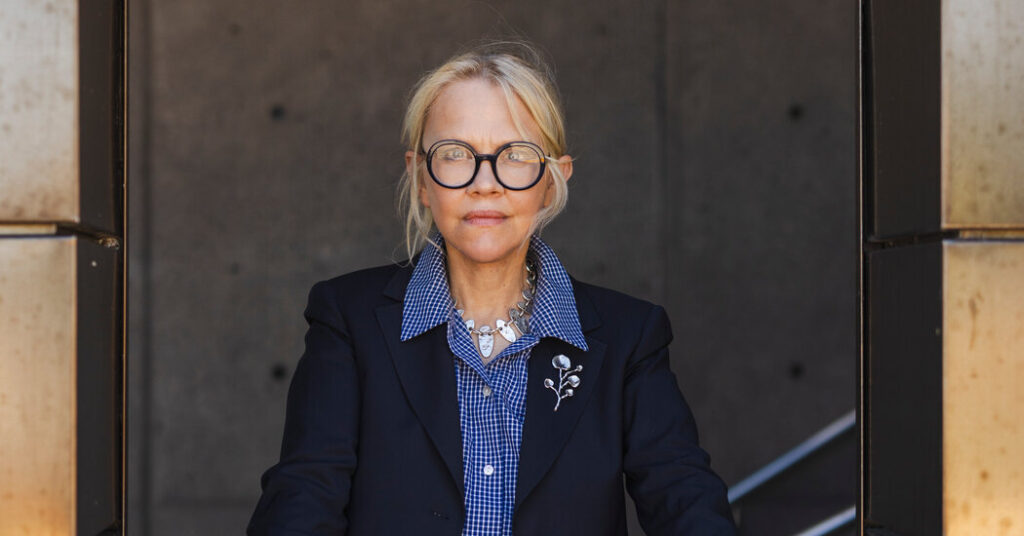
After work one day last week, Kim Sajet sat down at her computer with a cup of coffee to watch a former Smithsonian colleague, Anthea M. Hartig, director of the National Museum of American History, testify before a congressional panel.
The White House had just released a scathing report that accused Ms. Hartig and the museum she leads of downplaying the role of the nation’s founders while promoting “extreme political activism.”
Now Ms. Hartig was under fire from Republican lawmakers who embraced the White House’s findings.
“Who gave you the authority to turn the National Museum of American History into a vehicle for progressive political activism?” asked one lawmaker.
“When was your gender revealed to you?,” asked another, disturbed by a museum exhibition about girlhood that explored identity issues.
“I was incredulous,” Ms. Sajet recalled in an interview. “Really? The president of the United States is spending his time going after a museum director? I would’ve thought he had more pressing matters to attend to.”
Ms. Sajet (pronounced SAY-et) understands Ms. Hartig’s situation on a personal level. Last year she was targeted by President Trump, who described her as “highly partisan” and directed she be fired from her post as director of the Smithsonian National Portrait Gallery. The Smithsonian, which has long operated independently of the executive branch, asserted its legal authority over personnel, but Ms. Sajet still chose to resign.
“I could see that it was going to become a real witch hunt,” she said. “I didn’t wish that on my colleagues and I didn’t wish that on the Smithsonian.”
These days, Ms. Sajet is far from Washington, having last fall accepted a position as director of the Milwaukee Art Museum. But there is perhaps no more interested observer of the administration’s pressure campaign on the Smithsonian than she because she bears the scars.
She is not, however, the first Smithsonian director to ever come under fire. The head of the National Air and Space Museum, for example, was ultimately forced to resign after a 1995 exhibition on the Enola Gay B-29 warplane that dropped the atomic bomb on Hiroshima. Some viewed the exhibit as too critical of American’s use of atomic weapons to end World War II.
Still, the scrutiny of Ms. Hartig and Ms Sajet has been of a different order of magnitude. For one thing it’s been directed, not by a variety of external critics, but by the White House. In addition, it’s been uncommonly personal. The White House report issued on July 4 mentioned Ms. Hartig more than 200 times.
“There is something unusual about the vitriol that was so personally directed,” said Steven Conn, a professor at Miami University who focuses on American intellectual and cultural history.
The White House did not respond directly to Ms. Sajet’s remarks but Vince Haley, who helped direct the administration’s report, reiterated its objections to the way history is presented there, asserting in a statement that the museum had become “an instrument of ideological activism and advocacy.”
“During this 250th anniversary year of our heroic founding,” he added, “the least our citizens are owed is an honest and inspiring account of American history.”
Ms. Hartig, who earns about $370,000 a year in her Smithsonian role, declined to comment. But during the hearings, which took place last week before two separate congressional panels, she defended her tenure, her museum and herself.
“As a historian, I have spent my career studying, teaching and preserving the history of the United States,” she said in her opening remarks before each committee. “My family has served this nation since the Revolutionary War and I was raised with a deep sense of obligation to it and the democratic ideals that the country asks each generation to build and to uphold.”
Ms. Sajet said that, in watching, she saw irony in the fact that the sessions were called hearings, “but the legislators were not listening.”
She pointed to the intensity with which some legislators pushed Ms. Hartig to give only yes or no answers. Scholarship, she said, is considerably more complex.
“Wouldn’t it be lovely if history was that black and white?” Ms. Sajet said. “There is always nuance. But they don’t want to hear the context. They want the sound bite, they want to get the score.”
Mike Gonzalez, a senior fellow at the Heritage Foundation who has written critically about the Smithsonian and appeared at both hearings, suggested in his testimony that the White House effort was not aimed at individuals as much as a way of thinking that had overtaken its museum leaders.
“Teaching lessons about American wickedness is now the mission of the Smithsonian,” he said in his testimony, adding, “You need to clean house and relieve all Smithsonian leadership of their duties.”
In an interview he disagreed with the suggestion that the questioning by lawmakers had been objectionable. “Some questions are ‘yes’ and ‘no,’” he said.
He cited, for example, a moment when Ms. Hartig was asked “if topics on sexuality are suitable for kids” while an image of a crotch harness from a past exhibition on gay history was displayed.
“Should children have access to depraved sexual content?,” he said, roughly paraphrasing several of the questions that Ms. Hartig faced. “The answer is ‘no’ always. I don’t see how you can equivocate on that one.”
Overall, Mr. Gonzalez said, “The hearings did a very good job of exploring this issue.”
“She is accountable to the American taxpayer,” he added, “and the elected representatives of the American people have the right to ask her questions about what she has done.”
Just days after the hearings, President Trump — in an unusual directive — ordered warning signs and exhibits installed outside the American history museum to alert the public that the museum does not, in his view, accurately reflect American history.
It was the latest salvo in his effort to transform the Smithsonian, which he accused in an executive order last year of undermining “the remarkable achievements of the United States by casting its founding principles and historical milestones in a negative light.”
In pursuing its effort to terminate Ms. Sajet, the White House had created a list of grievances that it suggested made her an inappropriate choice to lead a national museum, including public comments about racial and gender inequality in America.
The intensity of the president’s focus on the Smithsonian is a departure from prior administrations, though political operatives for President Nixon are said to have pressured the institution into closing an exhibition on voting rights ahead of the 1973 inaugural ball.
The Trump White House has on several occasions pointed out that the Smithsonian relies on federal sources for most of its $1 billion budget and that the money should be spent in ways that are aligned with Mr. Trump’s policies. Ms. Sajet said that her departure was spurred in part by the administration’s threat to withdraw Smithsonian funding.
While no cultural institution is perfect, Ms. Sajet said, in general the Smithsonian’s 21 museums have sought to provide the public with comprehensive information, informed by multiple perspectives, deep research and scholarship. She said she found the White House report, which accused the history museum of failing to properly celebrate the achievements of men like George Washington and Benjamin Franklin, to be “cherry picked” and “biased.”
“The Museum of American History doesn’t make the history — they’re just reporting on what’s happened,” she said. “That’s what I did as the director of the Portrait Gallery. We didn’t say whether so-and-so’s actions were good or bad. We just said, ‘This is what they did.’”
She cited Abraham Lincoln and, yes, she said, he united the union, but she said he was also slow to end slavery.
“I always said that there is no moral test to be in the Portrait Gallery,” she continued.
Ultimately, Ms. Sajet said, what happens to the Smithsonian is up to the American people. “The overarching thing we’ve all got to ask ourselves is, do we want politicians deciding how history is taught and understood?” she said. “Is that the role of government — to control what we learn about the past and ourselves? I would suggest it’s not.”
Ms. Sajet said she thought Ms. Hartig “did the best that she could” under difficult circumstances.
“Anyone who’s been in public office will attest that there is always this balance of responding in a way that then doesn’t become additional fuel,” she said. “You want to be careful that your answer doesn’t make it worse.”
She said she reached out to Ms. Hartig by text after the hearings with words of support to this effect: “My heart is with you. I’ve been thinking about you. You did great. Take care of yourself.”
“Having to sit for congressional testimony,” she later noted, “is not what you expect when you apply for the job.”
The post For Museum Boss Who Became a Trump Target, It’s Déjà Vu All Over Again appeared first on New York Times.