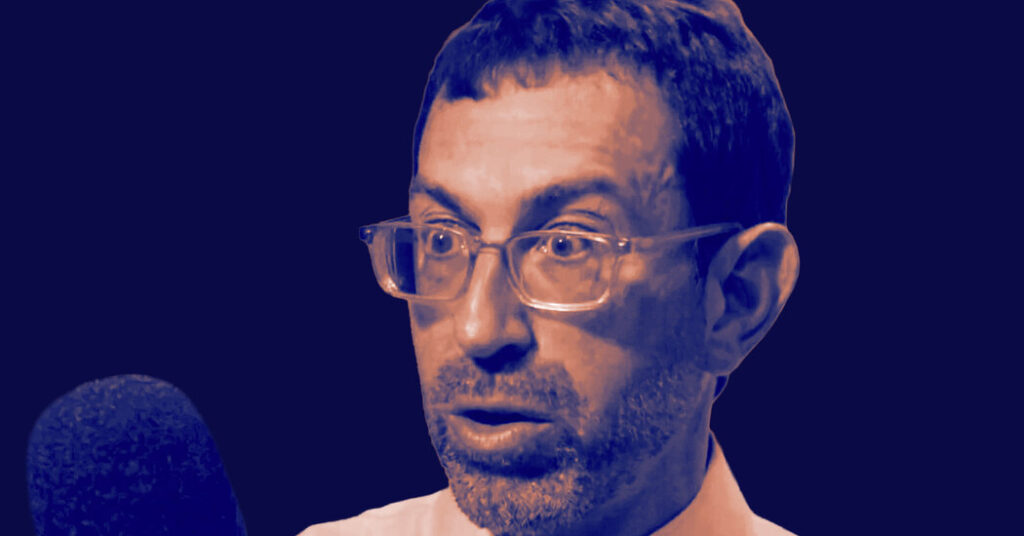
American leaders are staying in office past their prime. Boomers are reluctant to relinquish control — from political offices to corner offices — to the detriment of their juniors. In a society where the elderly hold so much power, should younger generations revolt?
My guest today is Samuel Moyn, a professor at Yale Law School, and he argues that American democracy is distorted by the power of the old. We discuss how seniors have hoarded wealth and influence and how Americans can renew an intergenerational compact.
Below is an edited transcript of an episode of “Interesting Times.” We recommend listening to it in its original form for the full effect. You can do so using the player above or on the NYTimes app, Apple, Spotify, Amazon Music, YouTube, iHeartRadio or wherever you get your podcasts.
Ross Douthat: Forget fascism. Forget socialism. What if the real threat to American democracy is the tyranny of the elderly?
America’s leadership class has grown very, very old. And the rising generation seems to feel like their elders are hoarding the American dream.
My guest this week is Samuel Moyn, a Yale Law professor and the author of “Gerontocracy in America,” a new book that argues that the concentration of wealth and power among older Americans is our least-discussed crisis.
Samuel Moyn, welcome to “Interesting Times.”
Samuel Moyn: Are they interesting, though?
Douthat: I mean, we’re going to find out.
Moyn: Good.
Douthat: This conversation will determine just how interesting people find the times.
We’re going to start with aging politicians. Right now we are watching Mitch McConnell, formerly the Senate majority leader, still an active senator, essentially seeming to die in office, with various conspiracy theories swirling about whether he is in fact already dead.
One of the most consequential political decisions of the last decade was Ruth Bader Ginsburg’s decision not to retire from the Supreme Court. Nobody on the Supreme Court seems to have learned anything from that.
And, of course, there was the Joe Biden incident. And there are some people who think that our current president may even be not quite young enough for the job.
Start with the psychology of this phenomenon. What do you think is behind the refusal of older politicians and justices and powerful people to retire?
Moyn: I’m surprised you said: Mitch McConnell seemed to die. A lot of us are not sure he is alive.
I think there’s a deep existential reason to retain power, apart from the old saying that power corrupts, and anyone who’s powerful wants to keep their power. It’s that as we age, we face mortality. The shadow of death hangs over us our entire lives ——
Douthat: We’re starting hard.
Moyn: We are. But I think there’s no way to explain the retention of power as we age except, in the face of decline, to deny it.
But there are other reasons. I think we get used to a sense of our significance in our vocation or our job, especially when one is in the news so often, when one is instrumental to making policy, and that’s a powerful drug. It’s hard to imagine weaning oneself from it if one doesn’t have to.
Douthat: Is there some specific American thing or generational thing, or is this just if you put any group of human beings in a position of power at 84 years old, they will be likely to hold on to it?
Moyn: I think there’s something universal, and that’s the fear of decline and death, which I think is baked in.
I wouldn’t want to scapegoat the boomers, who were kind of in the right place at the right time. They benefited from something new, which is that we don’t just enjoy long lives — almost all of us — but doctors have succeeded in making us high functioning until near the end. They coined a phrase for it called “compression of morbidity” — saving death for the end rather than having us decline.
And there are American features that have less to do, I think, with the boomers and much more with the incumbency in office that our politicians benefit from.
After all, if you look across the water to Western Europe, even though half of humanity lives under political leaders over 70, Western Europeans are generally exempt from it, even though they have life spans that are as long, or in some cases longer, than ours.
Douthat: Is that term limits? Age limits? What’s the Western European secret?
Moyn: I think that their way of organizing political competition, funding elections and governing parties has a lot to do with why, in general, they have not had the gerontocratic crisis in the political class that we have.
If you’re interested in judges — and I’m deeply interested in them — they don’t have lifetime tenure, which our Constitution offers and has, on principle, from the start. Their judges do have mandatory retirement and often specific age limits.
Douthat: How far does this extend beyond the political realm, especially in the United States? Mitch McConnell, R.B.G., Donald Trump and Biden — these people are front and center, but do you see the same phenomenon in corporate and private sector leadership?
Moyn: Absolutely. It turns out that aging politicians are the tip of the iceberg. Part of the reason politicians are so old in the United States is that the electorate is so old. Wealth, in a lot of its forms, turns out to be age inflected.
And there’s very good data that, despite the illusion, thanks to the mythology of Silicon Valley, C.E.O.s in America have been aging, and indeed, just in the last bit of time, aging rapidly.
We should disaggregate and look at different sectors. Because of the adage “Write what you know,” I do privilege universities a bit in the book, where faculties, especially at elite universities where I teach and you have taught, have aged substantially. I am in my mid-50s. I’m still below the ——
Douthat: How old are you exactly?
Moyn: I’m 54 years old — 54 and a half.
Douthat: When do you join the gerontocracy?
Moyn: I’m aging gracefully into it, and I have a lot of gerontocratic power awaiting me, which is why I wanted to seize the opportunity while I still identified a bit with those younger than me — and above all, my own children — to strike a blow against power that I will inherit if I stay around.
Douthat: What is so bad about this state of affairs beyond the specific desire not to have someone who’s not up to the job in a position of power?
Assuming that lots of these older C.E.O.s are still capable of doing the job, what is the structural problem that this creates for society?
Moyn: First off, life extension is a miracle.
Douthat: You’re in favor of it.
Moyn: I’m in favor of it, especially when it comes to my life. I do think we should benefit from life extension. Individuals should extend their vocations if that’s what they want to do, all other things being equal. And we should benefit as a society from the new lease on life that many of us can expect to have far into the future.
But I think there are some drawbacks — a dark side, if you will. One is the injustice that comes from not fairly organizing a succession process. Most firms have an internal hierarchy, and there are very few people, who tend to be old, at the apex. Those beneath them, like in the HBO show “Succession,” are waiting for their time. And I don’t think that’s good for anyone.
Then there’s an existential side, which is that maybe, because of the cult of longevity and the age-old wish for eternal life, we are not reckoning with our future. And we’re holding on — despite the other things we could be doing — in a last chance to reinvent ourselves, from taking advantage of the extension of life, which grants us potentially an ideal retirement, not just hanging on for dear life until death comes.
Douthat: So the gerontocrats themselves are moral, philosophical, existential victims of the system, in the sense that they are encouraged to remain with power instead of confronting themselves, or spending time with their grandchildren — or both?
Moyn: I believe so. And we wouldn’t want to miss that a gerontocratic society tends to produce policies that often hurt elderly people a lot, too, especially when older people control the political system.
Douthat: What kinds of policy are you likely to get in a gerontocracy? And we should stipulate, as you said earlier, that when we’re talking about gerontocracy in politics, we aren’t just talking about the power of Mitch McConnell. We’re talking about older voters wielding power through older elected representatives. How does that, in your view, shape and warp public policy?
Moyn: I think this is probably the most important question, because it wouldn’t matter how old the politicians are if there’s still government not of but by and for the old.
I think that we become more conservative with a small C as we age. Some people are conservative as youths. Many people become more conservative ——
Douthat: [Laughs.] Some are born to it. Some have it creep upon them.
Moyn: That’s right. I’ve given myself a lot of room to move right. But again, my point is not about left-right ——
Douthat: Dispositional change is good.
Moyn: It’s about whether we think about stability as the most important thing and about the protection of what we’ve painstakingly acquired. Do we think about the future in the same way a younger person would?
There’s an ancient debate. Cicero, in the greatest defense of older people in power ever written in our tradition, says that older people plant trees for the future.
Well, they don’t. Aristotle says: No, older people live in memory rather than hope.
When we look at specific issues, we find that the older you are, the less likely you are to prioritize climate change as a policy area.
Take immigration, for example, which I think is an especially fascinating one. We should note that older people are whiter to an extreme extent. We also know that older people, as they age, tend to be more and more hostile to the welcoming of newcomers to the country. Of course, that’s true across the Atlantic, not just in the United States.
Now we could get into whether there’s a need for border control and immigration restriction, if you want. But I’ll just observe that as we age and we need care, someone has to fund it in a context where there aren’t as many young people being produced, and someone has to do the caregiving.
So there’s a very credible argument, I think, that more immigrants would actually help older people as they age, and yet they’re the ones most against it.
Douthat: These are ways in which essentially a gerontocracy skews right in its politics.
On government spending, what do you think the net effect of an older skew is? It seems like you could say, well, it also skews conservative or Republican because old people have more resources.
At the same time, the American welfare state, built by your left-wing forebears, is designed heavily around retirement protections — Medicare, Social Security. These are the third rails of American politics.
What do gerontocrats want when it comes to taxes and spending?
Moyn: I think that’s a super point, and it’s really important to say this: It’s not that the old are on the right. They may be small-C conservative, but that is true of aging liberals, too.
As an example, the No Kings protests, especially as they continued, became more and more white- and gray-haired in their constituencies. We could argue that following their old standard-bearer, Joe Biden, they were nostalgic in character, looking for a status quo ante Donald Trump, preferably a more liberal version of the 1950s and ’60s, the glory days, when many boomers were involved in civil rights activism and antiwar protest.
But the side you’re raising is so-called entitlements. It is true that older people tend to be fanatical about the protection of their entitlements, no matter the budgetary consequences.
I think it’s sad that the concerns I’m voicing for fairness to younger people have generally been mobilized by those who want to get rid of those entitlements. To me, a more obvious approach to not just guaranteeing entitlements but expanding the care that older people need and that Medicare doesn’t cover, would be raising taxes.
But no matter whether they’re left or right, most older people tend to be, let’s say, concerned with taxes. And I think it’s no accident that the gerontocratic era of American history has been the era of tax revolts.
Douthat: Let’s go a little deeper on the material side. It’s not just about Medicare and Social Security and takes, right?
When the welfare state was first being constructed in the New Deal era and so on, old-age poverty was sort of a central zone of poverty in the United States. Today, there’s still senior poverty, but if you’re just looking at balance sheets, savings, stock portfolios and homeownership, how are old people doing?
Moyn: The fortunes of older people in our country have radically shifted. Of course, it’s true that they were once the worst off, in part because when we were a country that involved much more physical labor, people were injured out of their jobs and had nothing to turn to.
It’s for that reason that Franklin Roosevelt’s Social Security Act in 1935 was such a transformative moment. At the same time, it wasn’t that costly because there were so few older people living on, and there was an enormous number of able-bodied younger workers who could fund these programs.
That’s not true now. While it’s important to acknowledge how many older people there are who are poor, the rate of their poverty is no greater than any other cohort of adults’. And, of course, they’re way better off than children.
Donald Trump’s One Big Beautiful Bill cut SNAP benefits for children in poverty. If we’re concerned about poverty, we should maybe look a lot more than we have at children.
Older people, especially when you get to the upper echelons of the class structure, have been the great winners of the latter part of the 20th century, in part because of some asset bubbles, in part because of all the special privileges that have been built into our tax code and in part because of the abolition of mandatory retirement.
Douthat: Why was mandatory retirement abolished?
Moyn: Well, it was abolished across the country due to the AARP and a federal law called the Age Discrimination in Employment Act that was revised a few times between the 1960s, when it was first written, and the early 1990s.
Essentially, in all but a few sectors, like air traffic control or for airline pilots, mandatory retirement was made illegal. So what we call the age wealth gap has been expanding ——
Douthat: What are the specific benefits that seniors get in our system, in terms of policy, that you were just referencing with, let’s say, home ownership?
Moyn: I think it largely consists of tax breaks ever since California started the property tax revolts of our time. The outcome of many of our tax laws has been to immunize older people’s possessions from taxation, which once would have been a very noble cause, given that they’ve lost income.
But as a result of some of these asset booms, these aging Americans are sitting in very nice houses — the best there are. They’re blocking the construction of new housing for everyone else, including senior-appropriate housing.
And it might be true that many of these relatively wealthy older people can’t access their wealth because it’s tied up in a house. But they’ve created an incentive structure where they don’t want to sell.
It’s a perfect storm that has resulted in a lot of injustice.
Douthat: As a larger generalization, do you think there’s any evidence that boomers or boomers going into the silent generation have been stingier with their children or less likely to pass on resources while they’re alive than prior generations?
Moyn: I don’t think so. I think generations do have different experiences that can lead them to behave differently in the aggregate.
From what I can see, the boomers were, just like the rest of us — in a particular time and place, especially with some early good fortune and then some asset bubbles along the way, that benefited them hugely and have made them the standard-bearers of gerontocracy. But we will all inherit it from them.
Douthat: There’s an ongoing debate: How screwed are millennials? This was a generation, or at least part of a generation, that came of age around the Great Recession. They have been the ones most likely to be priced out of certain areas and neighborhoods. They have been the ones most likely to say: Well, I can’t get a home in this school district because homes are too expensive, and no one is building new homes. And so on.
At the same time, there’s a lot of countervailing evidence that says: No, if you actually look at overall salaries and overall income and so on, millennials seem to be doing just fine.
Where do you come down on that debate?
Moyn: I think some of the trends that we’ve been talking about have been relaxed or even reversed in the couple of years since the pandemic. But when you look at the broad swath of the past half-century, it’s staggering how far there’s been a shift in wealth upward to older people.
We had a trillionaire for a bit, and I’m not going to say he’s old, but if you look at the billionaire class on a worldwide scale, 90 percent of those people are over 50, 45 percent are over 70.
I’m not calling for generational warfare, in part because my nightmare is that millennials will do fine. It’s just that they’re in a waiting game to come into the resources. Our political question has to be: When in life — not just whether — do you get the resources you need?
Douthat: Do you think that, as a sort of base line, it is better for society to have younger people in strong positions of influence — because, let’s say, young people are more creative and dynamic? And that people are more likely to figure out the best idea for a new business or understand a new political problem or something else at age 36 than they would be at 56?
Moyn: That’s a substantial part of it. If we’re interested in why we are stuck, why are we on this timeline, I think we could ask: Have we gotten the balance right between the kinds of gifts that relatively younger people bring to their organizations compared with relatively older ones?
And I call for balance since, what psychologists call crystalline intelligence, which is about the kind of experience and habituation ——
Douthat: Wisdom?
Moyn: It can be called wisdom. But then you would need it balanced, especially if you purport to care about creativity, innovation, dynamism — which we ought to, in a modern society.
Douthat: OK, I’m going to save the defense of the gerontocrats for after you give me some prescriptions.
Moyn: OK.
Douthat: So anyone listening or watching who’s waiting to have someone speak up, it’s coming.
Moyn: Remember, I’m a lot older than you.
Douthat: I know. So be prescriptive. What do we actually do about this? You just said you’re not calling for generational warfare.
Moyn: No.
Douthat: But aren’t you calling for generational warfare?
Moyn: No. In part out of the real concern that, as you suggested earlier, unlike the time of the boomers, who were rebellious in their youth, even if they paradoxically built a pretty objectionable world in the end ——
Douthat: In the end, we all build a somewhat objectionable world, probably.
Moyn: I don’t know. I’m not counting you out, or myself.
Douthat: OK.
Moyn: The distinctive feature of the boomers is that they were very numerous, and they had a chance, by coming into power early, to shape the world that no successor generation has gotten.
And I speak as a Gen X-er. We’re the forgotten generation. Our mantra is “Reality bites.” That was really a reference to the world at the end of history that we, in a sense, weren’t bequeathed because the boomers hung on.
Douthat: Right. They kept running it.
Moyn: But I guess I would say that it’s not just out of that strategic concern that there aren’t enough youth who aren’t already resigned that I say we need intergenerational solidarity. Again, gerontocracy hurts older people, too. I’m convinced that there are a lot who see that they have hung on and that they’re part of an unjust structure.
Just as we’ve had transracial movements to attack racism, we could imagine intergenerational solidarity to think about a better form of succession in American society.
Douthat: Let’s say you get this intergenerational solidarity. Give me the anti-gerontocratic agenda. Give me the three pillars.
Moyn: I would say there are buckets. There are the politicians from whom we could benefit either with age limits or mandatory retirement for them — or better, a way with youth quotas, of having different age cohorts represented in our political bodies.
When it comes to elections, we didn’t talk about those, but elections are stunningly old, especially nonpresidential elections, in our country.
Douthat: So what do you do about that?
Moyn: I think there’s a range of fixes, some more modest, like mandatory voting or stopping our practice of punishing young people for mobility or for their inability to leave work as easily as a retiree.
I’ve gotten in some hot water for proposing we consider overweighting the votes of younger people or assigning the youngest eligible voters proxy votes for the unrepresented children of our country. So those are edgier.
Douthat: Why not assign them to those children’s parents?
Moyn: Because there’s a divergence of interests between parents and children. I think it’s likelier that young people — not people who are raising families — will have the best insight into the interests of children.
Whereas, if you were awarded five proxy votes ——
Douthat: I think that’s daft. I think it’s absurd to imagine that a 24-year-old recent college graduate has a better assessment of the interests of my own children than I do.
And I say this with all due respect to 24-year-old recent college graduates, of whom I hope to be the parent of in nine years or so.
Moyn: I think parents generally confuse the interests of their family with the interests of their children. I think part of our goal as parents, but also as a society, is trying to make sure that children aren’t the hostages of their parents, as much as we rely on parents to raise them.
Douthat: In my experience, parents are more likely to be the hostages of their children.
But look, I would love to live in a world where you and I sat down at the bargaining table, and we’re trading your weighting of votes for 20-somethings for my extra votes for parents. In practice, in the United States, where we have a system of “one person, one vote,” we have various constitutional issues, and then we have no one in Congress standing up and proposing giving parents votes for kids. This seems fun but fanciful.
Moyn: Yeah. I just said: Let’s throw the edgier ideas on the table.
I will mention we already do have weighted voting. Those who happen to live in less populous states have votes, not just because of the Senate but because of the consequences for the Electoral College, which is not one person, one vote.
If we accepted that we have such a thing, maybe we could experiment with it more. But I agree with you that in the short term, we’re dealing with more actionable proposals.
Turning to the last bucket, which involves wealth and the obscenity of having the age wealth gap that we do, aside from proposing a mandatory retirement for those retaining jobs in many sectors, I basically think we should rethink our tax code.
And far from punishing the worst-off seniors by stripping them of their badly needed entitlements, we should fund them better, and we should recognize how well off many seniors are and redesign our tax code to catch up.
Douthat: OK. I have more questions about the realism of this.
But just at the level of existing political factions, you are on the left. Your book has been reviewed by a lot of people on the left.
There is a running left-wing critique that basically says, no matter how much you are trying to cover yourself and present this as just: I’m going to tax Elon Musk and a lot of 80-year-old billionaires, and we’re going to redistribute, and it will be great — you are still scapegoating the part of the population that has benefited from the welfare state that liberals built. And in so doing, you are handing ammunition to the right, to libertarians, to budget cutters. And that really, all that a good leftist should say is: The old have what everyone else should have.
How do you respond to that critique?
Moyn: I’d say we have to distinguish the description of what we’re living through from our prescription of what to do about it. The left view, often on the more descriptive first side, is to say age isn’t really why there’s advantage in the United States — it’s just class. And that’s easy to dodge, because it turns out that you can’t understand class today without seeing how it’s age inflected.
Douthat: Class advantage compounds.
Moyn: Exactly. And absolutely, I’m sensitive to the criticism that my ideas could be easily mobilized to scapegoat older people and hurt the wrong ones. If that happened, I’d be horrified.
But as far as I can see, there’s no way out of our quandaries without having an honest, open conversation about this experiment we’re running, which is demographic in the first instance.
I think we have a chance to save the really just view that there’s intergenerational inequity from those who are abusing it in the name of attacking older people and destroying the welfare state.
If we don’t talk more about age and politics, we’ll have not just misunderstood our situation, we’ll have missed the chance to create a new coalition of youth and old.
Douthat: OK. Now I’ll speak for the malefactors who would twist your perspective.
Moyn: OK, let’s hear it.
Douthat: It seems like, from a right-wing perspective, if you start with your analysis — you don’t have to become Paul Ryan tomorrow — but if this is your perspective on the world, you should not just want to impose crushing wealth taxes on entrepreneurs or something.
No. We’re dealing with a society that redistributes, through the welfare state, resources upward to people who are not dynamic and productive. We should be means-testing Medicare and Social Security so that older people who are well off aren’t getting benefits that they don’t need. We should be stripping out regulations that prohibit building new housing of the kind that you mentioned.
And you can go on from there. Why doesn’t this analysis make you, a man of the left, more libertarian, a little more Paul Ryan-esque?
Moyn: Well, I do want to insist that we should have policies that are aimed, at least some of the time, at unleashing our capacities and stoking innovation.
Where I might differ from some other podcasters at The New York Times is that we’re not just concerned about abundance and novelty with economic innovation and economic growth.
But where I think I’m going to differ most with the libertarian or the neoliberal P.O.V. you’re rehearsing now is that there’s still this question about the floor of care to which everyone is entitled, especially as they age. There are lots of ways of making that not just less costly but more generous.
And we really should. I think we could get into some ——
Douthat: But to get that uplift, you need growth and dynamism. You need money that, given our budget deficit picture, we don’t have at the moment.
So somewhere in there ——
Moyn: Absent raising taxes.
Douthat: Right. Well, you can fix part of the fiscal picture by raising taxes on some of the wealthy old.
Moyn: Yes.
Douthat: But you still need to generate economic energy.
Moyn: You do.
Douthat: Why is that not a deregulatory, abundance-oriented mission?
Moyn: Well, it is, but you’re now presenting what I would hope turns out to be a false choice between deregulatory and regulatory policies on the one hand and generating the funds to pay for care on the other.
I don’t see any conflict between those two missions. It’s going to be really hard work, but if we abandon either, we’re lost.
Douthat: Is it possible, in order to get that kind of politics, to have younger Americans think of themselves as a politically engaged constituency unto themselves, in the way that the AARP did for seniors?
It seems like for your politics to work, I do think you would need a sense of intergenerational warfare as part of politics.
Moyn: I think that’s very fair, Ross. I do think maybe our biggest political problem is the alienation of younger people from the political system.
I see it in my own daughters. My children, college age, have inherited a world they think is irreparably broken and beyond redemption in many ways. I think that’s a tragic thing.
We do have to imagine them angrier than they have been. Also, if they could be activated in the way you’re envisioning, they could see the need for establishing cross-generational solidarities — not just for strategic reasons but on principle. They could be a new universal class, thinking of themselves as acting for the sake of everyone.
Douthat: I wonder, though, if it almost isn’t the 35- to 45-year-olds who are more of the challenge. Young people may be apathetic, but it’s sort of natural for the 20-somethings to think of themselves as kind of oppressed by the weight of the world that older Americans have built. Whereas it’s people in the thick of it, in the midst of their working lives or their family lives and so on, who seem less likely to think of themselves as a class with coherent interests.
Moyn: Yes, absolutely. I feel bad, even in our conversation, that it’s easy to slip into a dichotomy of age versus youth. But actually, it’s age versus everyone else.
That would, most of all, from my perspective, include the broad middle of those in the prime of their lives who are under-resourced, who are stagnating and haven’t been bequeathed by their elders — whether within their families or on a social basis — with, in a sense, their inheritance, which are resources, when they could most use them to make our world a better and more creative place.
Douthat: OK. Now let me speak on behalf of those elders. I think the argument that would be made by them, and on their behalf, is that what you call unjust hoarding — or holding on to houses that you should sell or stock portfolios that would benefit your kids — is, one, a rational preparation for a world where, whatever you do in your professional life, you’re going to live longer than anyone has in recorded history. And you need resources for that future.
Two, in maintaining those resources, aren’t you actually, in the end, reducing certain burdens on your middle-aged kids? One of the stories of American life, before the 1930s, before Social Security: What happened to old people when they were injured and couldn’t work anymore? Well, they moved in with their kids.
Moyn: Absolutely.
Douthat: And you had a whole system based on that kind of intergenerational burden-sharing that imposed really big burdens on younger people and workers and so on.
Now we’re in an age when people live a long time, people need long-term care, they need all of these things. Isn’t gerontocracy just planning for that future?
Moyn: Well, there’s a lot there.
Douthat: Well, I have to speak on behalf of my elders.
Moyn: Absolutely. And it was a very moving peroration.
I will say that I believe very deeply that we’ve created a society in which it is rational to hoard because we will live indefinitely long. We know from the pandemic that the state of care to which we’re entitled at the end of our lives is horrendous. I mean, horrifying. And it is completely understandable that one would stash away everything one could to avoid that fate.
It’s also because, as you say, we’ve moved away from the intergenerational family, which we could revive, but we could also revive intergenerational community. That also has gone by the boards.
There’s enormous age segregation in the way we live residentially. Part of the reason is that older people control the best real estate, but also because I think there is a kind of alienation where young people no longer want to support not just their aging parents but older people in their society, generally. In terms of remedies, I think we have to do something culturally to overcome these problems.
What, to me, is not a viable solution is to have older people retain so much that they, in a sense, disinherit the future because they are convinced they will have to spend down an enormous amount just to survive until the end.
Douthat: What is the standard of care that you’re aspiring toward?
So right now, I observe, and I’m sure many people watching and listening have observed, the end of life of people who are technically millionaires. People who own a home, it has appreciated, it’s worth $1.2 million or whatever, and they enter end-of-life care.
And it’s not just Republican grinchiness to say there’s a lot of trade-offs here that are not resolved by just taking a tax bracket up a little.
Moyn: There are. Look, you’ve got to be right, and I’m not trying to downplay the immense complication of these policy domains. But we also know there’s a lot of rationalization involved in, let’s call it, hoarding. And there are a lot of reasons one has for not pivoting to more intergenerational generosity.
If we just have this fiction that older people are there for the wisdom they have in their heads, and not everything they’ve acquired and are keeping that they should begin to pass on under the right conditions, then I think we haven’t really organized the inevitable succession that our humanity involves very well.
Douthat: Do you think that there’s a different kind of attitude toward the old from 40-somethings or 20-somethings that would encourage that kind of attitude in return?
Moyn: Yes.
Douthat: How should the middle-aged think about their parents that they don’t now?
Moyn: So they’re not going to get everyone among the old on their side. But they could deploy some tough love, let’s call it that. It would involve an insistence like: You’ve had your turn. And you have a chance, one more time in your life, to reinvent yourself. But what you cannot do is deprive the rest of us of our futures, or just make us wait until we’re old to enjoy resources.
There would also be, I think, some promise there: We provide you care. We make retirement great — because neither care nor retirement have been great things for most of them who’ve been lucky to get them.
We’re just at the beginning, I think, of imagining what an ideal old age could look like. And young people and people in their prime would have to be as committed to it, as invested in, making it real as older people.
Douthat: But invested not just at a fiscal level but at a personal level?
Moyn: That’s right. It would mainly be the resources fiscally of the elders, but it would have to be a participatory project across generations to be real.
Douthat: OK. Let’s end by talking about maybe the starkest alternative to that vision of care, which you touch on in the book ——
Moyn: Yes, gingerly.
Douthat: Right, which is assisted suicide and euthanasia. These are ideas and policies that have themselves gained a lot of ground under conditions of aging populations in North America and Western Europe.
Give me your general views first on assisted suicide. Is it desirable policy? A human rights victory? Something dangerous?
What do you think?
Moyn: I think it’s a legitimate and noble thing if one, under one’s own power, and freely, decides to end it. But of course, we would need to understand that in the conditions of our day, where older people often are suffering from depression, a sense of neglect and prematurely end their lives, let’s say, under psychological duress — we’d want to make sure that these choices were free. And maybe that’s not always the case.
Douthat: I’m interested in this because there are a couple of poles here in the euthanasia debate. There’s the argument that you just made, which says: If people are making this decision absolutely freely, feeling that they’ve lived their life and want to go out on their own terms, that’s OK or maybe good. Or if they are suffering from depression, poverty, all these kinds of conditions that render them incapable of making the decision, that’s not ideal.
But I think, just based on what you’ve been describing in this conversation, there’s a middle zone, where you basically feel a kind of pressure toward euthanasia, toward assisted suicide. That you don’t want to burden your children and your grandchildren, and so you end up feeling a sort of pressure to go out as soon as you’re not in good shape.
Moyn: Sure. Yes.
Douthat: It seems like that could be the way that societies end up reconciling these difficult forces. They’d say: Look, we’re not going to take away your big house or your comfy retirement. We want you to enjoy all those fruits. But it’s just that when you get to the last three years, when it’s really expensive, then we want you to feel some pressure to exit early.
I guess it’s a dystopian vision, but it just seems like where these lines could intersect.
Moyn: Sure. It’s a credible nightmare scenario, but it would be a travesty of my views if that came about.
Douthat: No, I’m not imputing it to you.
Moyn: No, I understand.
Douthat: I wonder if you have a gerontocracy that sets up a system of assisted suicide, what does that look like?
Moyn: Well, I would just contrast it with a utopia, which seems to me more plausible to achieve in real life, which is that we insist that as we age, we never become a burden or useless. It’s actually our ancestors, some of the premoderns I talk about in the book, who did have euthanasia — even euthanasia accepted by the aging, when they were burdensome.
We live in circumstances in the wealthiest country in the world that we should never tell anyone that they’re a burden. On the contrary, we have the resources to, as long as doctors can perpetuate life, not to provide immortality — that’s Bryan Johnson talking for an elite — but at least to provide care to the end.
Douthat: Would you rather die as a burden on your loved ones while being cared for, or relieve them of that burden? Do you want to be a burden?
Moyn: I definitely want to impose a lot of burdens on my children to take care of me in the future, and I am already talking about it. They are critics of my hoarding of books, among other things, and insisting that I divest myself of those things so that they don’t have to. But I think it’s eminently just for me to be a burden on the future, on my own children, or my society generally.
If there’s a point at which I’m nothing but a burden, including to myself, because I have nothing left to create or explore, then maybe I should have the choice to exit on my own terms rather than in some other way. Because there will be an exit.
Douthat: How did this play out for your own parents? And did you have profound conversations about gerontocracy or personal conversations about intergenerational obligation with them?
Moyn: Not with my father, to whom my book is dedicated. He died long enough ago that I didn’t have the chance. My mother is still alive and thriving in her 80s, and we have talked about it now and again.
My father-in-law recently passed away, and we talked about these issues all the time because he was a realist. I’ve also had the benefit of going to his synagogue and talking to many people who are actively, as aging Americans, thinking about these issues every day.
I think it’s been a fascinating conversation to interact precisely, not so much in my own direct family but with older people generally — who are all over the map on these matters. And I get as much fan mail as hate mail.
Douthat: Well, you and I, like everyone, will reach a point of greater familiarity with these dilemmas. But for now, Sam Moyn, thanks for joining me.
Moyn: Thank you, Ross.
Thoughts? Email us at [email protected].
This episode of “Interesting Times” was produced by Sophia Alvarez Boyd, Victoria Chamberlin and Raina Raskin. It was edited by Jordana Hochman. Mixing and engineering by Pat McCusker and Efim Shapiro. Cinematography by Marina King. Video editing by Dani Dillon, Julian Hackney, Arpita Aneja and Steph Khoury. The supervising editor is Jan Kobal. The postproduction manager is Mike Puretz. Original music by Isaac Jones, Sonia Herrero, Pat McCusker and Aman Sahota. Fact-checking by Kate Sinclair, Mary Marge Locker, Julie Beer and Michelle Harris. Audience strategy by Shannon Busta, Kristin Lin and Andrea Betanzos. The executive producer is Jordana Hochman. The director of Opinion Video is Jonah M. Kessel. The deputy director of Opinion Shows is Alison Bruzek. The director of Opinion Shows is Annie-Rose Strasser. The head of Opinion is Kathleen Kingsbury.
The Times is committed to publishing a diversity of letters to the editor. We’d like to hear what you think about this or any of our articles. Here are some tips. And here’s our email: [email protected].
Follow the New York Times Opinion section on Facebook, Instagram, TikTok, Bluesky, WhatsApp and Threads.
The post Why Won’t America’s Aging Elite Retire? appeared first on New York Times.