The director Kiyoshi Kurosawa has never been a model of consistency, but when he’s on, he’s on. To a career that includes some of the best examples of contemporary Japanese horror (“Cure”) and domestic drama (“Tokyo Sonata”), he can now add a superb 16th-century period piece, “The Samurai and the Prisoner.” Although for more than 30 years his name has required the disclaimer that he’s not related to Akira Kurosawa, in this case the comparison seems pertinent: “The Samurai and the Prisoner” is set at roughly the same time as that other Kurosawa’s late triumph “Kagemusha” (1980), and it recalls that film’s focus on leadership, strategy and deception.
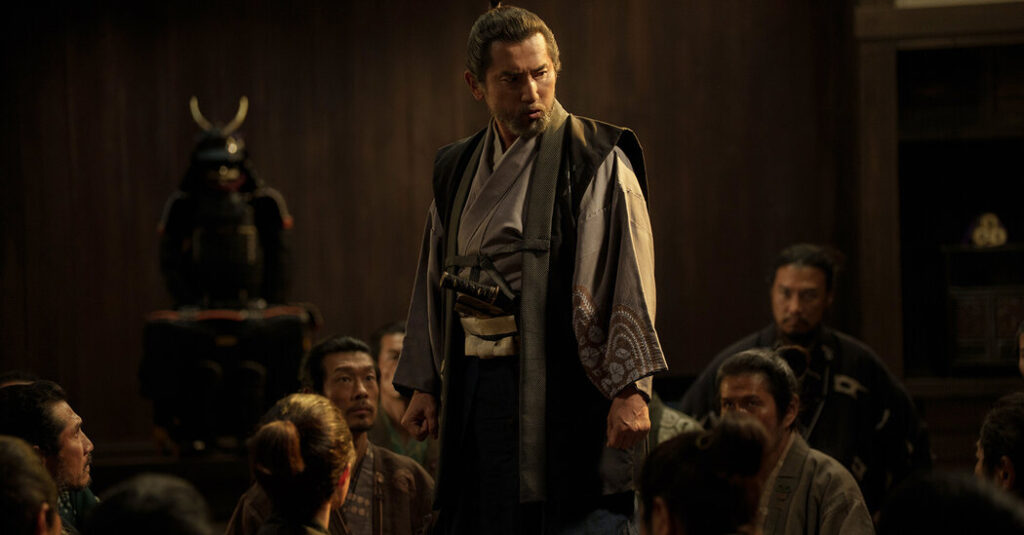
The source, however, is more recent: a 2021 novel by Honobu Yonezawa that the filmmaker has adapted himself. Despite its title, “The Samurai and the Prisoner” isn’t action-packed, at least not in the obvious sense. As the curtain rises, in 1578, Lord Murashige (Masahiro Motoki) has turned against a warlord, Oda, to whom he was previously a loyal retainer. Murashige’s betrayal has left his castle under siege. When Kanbei (Masaki Suda), an envoy from Oda, turns up with a message, Murashige takes him captive. That isn’t the samurai way, Kanbei insists; if he does not return and there is no proof of his death, Oda will think he has switched sides. Murashige’s refusal to kill Kanbei may feel merciful in the moment, but it places Kanbei’s son, and his bloodline, at grave risk.
At this point, “The Samurai and the Prisoner” pulls a bit of a switch: It turns out to be less a war film than a series of whodunits. Murashige is forced to solve a succession of mysteries around the castle. Who murdered a young hostage without leaving a trace? Which clan deserves credit for the killing of an ambitious general? What exactly happened the night that a priest and a skilled swordsman were found dead, and what role did a priceless tea urn play in the crime? And finally, who shot a spy, in a public slaying that — thanks to a fortuitously timed lightning bolt — is understood by Murashige’s men as divine punishment?
Kanbei becomes Murashige’s confidant, the only person shrewd enough to solve these puzzles. Kanbei’s motives involve a complex mix of enmity, intellectual prowess and mutual respect. “Not a single man, besides myself, can understand you,” Kanbei tells Murashige, who may not have the upper hand. In one moment, Kanbei, still chained, tricks him into slaughtering a guard.
“The Samurai and the Prisoner” offers its share of gratifying sleuthing (the forensics behind a phantom arrow are especially fun), but the core of the movie is the interplay between the men and their running argument about the role of ruthlessness in wartime. Murashige is a samurai who is reluctant to kill, a noble stance that nevertheless violates his code, as Kanbei continually reminds him, and that may invite karmic payback. Kurosawa doesn’t supply a simple answer as to whether Murashige’s instincts are justified.
The movie is talky and densely plotted; it’s nearly impossible to catch every detail of the story in a single viewing, but it is also not necessary. Kurosawa directs with mature economy: His excellent actors are aided by the shading of Yasuyuki Sasaki’s cinematography and by subtle coups of staging; various scrims and panels define the relationship between Murashige and his wife, Lady Chiyoho (Yuriko Yoshitaka), the only match for Kanbei in her ability to predict his thoughts. Kurosawa’s well-timed camera moves cut like daggers. What emerges is a samurai picture that feels simultaneously classical and modern, austere and capacious, familiar and surprising.
The Samurai and the Prisoner Not rated. In Japanese, with subtitles. Running time: 2 hours 27 minutes. In theaters.
The post ‘The Samurai and the Prisoner’ Review: Solving Castle Mysteries appeared first on New York Times.