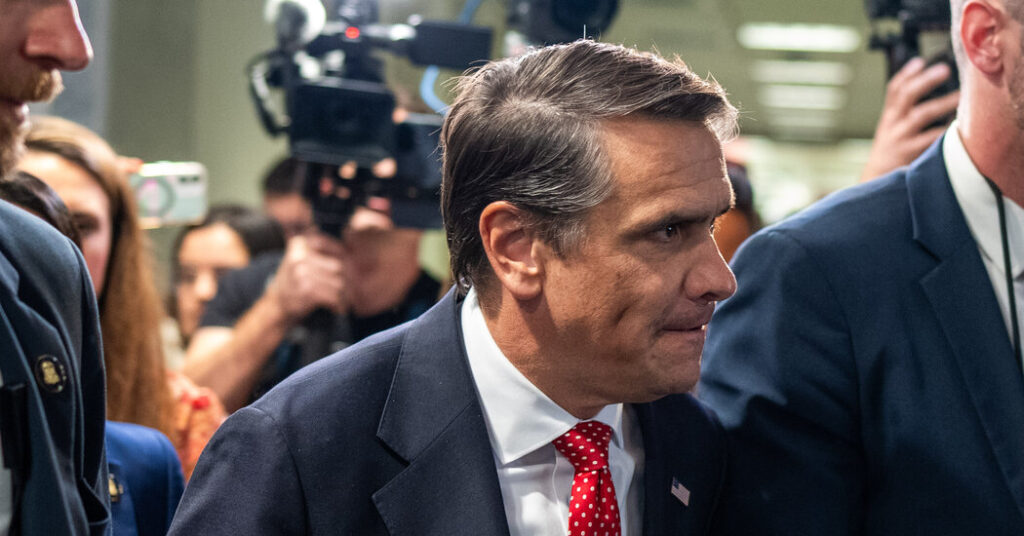
Republicans on Wednesday night postponed a critical vote on Todd Blanche’s nomination as attorney general after two key G.O.P. senators threatened to derail it over a deal he cut to settle President Trump’s lawsuit against the I.R.S.
The senators, John Cornyn of Texas and Thom Tillis of North Carolina, who are not returning to Congress next year, accused Mr. Blanche of refusing to put on paper his promise to kill aspects of the deal.
In June, Mr. Blanche said he would drop a proposed $1.8 billion fund to compensate purported victims of Biden-era actions by the Justice Department but said a provision shielding Mr. Trump and his family from tax investigations would remain in place.
The tax provision emerged as the biggest sticking point on the eve of a scheduled Judiciary Committee vote. Mr. Cornyn, a former state judge who lost a primary to a Trump-backed challenger, Ken Paxton, said he had received no written assurances from Mr. Blanche that the audit shield would not apply to future tax liabilities or be extended to a wider circle of people.
After a day of muddled wrangling, Senator Charles E. Grassley, the Iowa Republican who leads the committee, announced late Wednesday that the vote had been postponed to allow negotiations to continue — and “to secure sufficient support” for Mr. Blanche’s uncertain nomination, according to his spokeswoman.
That the fate of an attorney general would be jeopardized by the administration’s apparent determination to keep in place a tax deal offering a sitting president enormous financial advantages illustrated a defining characteristic of Mr. Trump’s second term: a president’s personal interest, along with public interest, is now a factor in governing.
Mr. Grassley, a loyal White House wingman, did not explain why Mr. Blanche has thus far refused to comply with what many Republicans see as a reasonable request to formally remove provisions that critics point to as corrupt self-dealing.
His office said he was acting as an intermediary, adding that he “works to set President Trump’s nominees up for success in committee, not failure,” his spokeswoman said.
Mr. Cornyn repeatedly expressed astonishment on Wednesday that the administration did not simply comply with what he regarded as a narrow request to place limits on a deal.
Mr. Cornyn, stating that he was not “prepared to vote yes,” gave the department until 4 p.m. to produce clear written guarantees on the fund and tax deal, and scrapped a scheduled meeting with Mr. Blanche on Wednesday morning.
That kicked off a day of frenetic back and forth, with no sign that Mr. Blanche was willing, or empowered, to trade a concession to secure own elevation as the Senate-confirmed leader of the Justice Department.
Mr. Trump, speaking to reporters at the Oval Office, chalked up Mr. Cornyn’s resistance to the senator’s pique at his defeat at the hands of Mr. Paxton.
“I don’t know, maybe John Cornyn is upset with me because I didn’t endorse him,” he said. “I don’t know what it is, but I haven’t heard that there’s a problem.”
Mr. Cornyn scoffed at the idea he was on a vengeance trip, telling the herd of reporters trailing him from meetings, “That’s a convenient excuse and it happens to be untrue.”
Mr. Blanche, who can continue as acting attorney general indefinitely, cannot afford to lose a single Republican vote if he hopes to gain a title he long coveted.
He appears, for the moment, to be two short.
Mr. Tillis expressed solidarity with Mr. Cornyn but appeared to be considerably more sanguine that the two sides would reach an agreement that would clear a path for a floor vote on confirmation.
“We’re trying to work just to get the language,” Mr. Tillis told reporters. “I really do believe it’s just a drafting exercise. I don’t believe that we’re apart in terms of the objective.”
He added that he believed the central issue was “the remaining language on the audit” deal with the I.R.S. and suggested that Mr. Cornyn was already comfortable with “language related to rendering the 1776 fund inoperative.”
During Mr. Blanche’s confirmation hearing this month, Mr. Cornyn joined Democrats in questioning Mr. Blanche’s independence from White House control and ultimately refused to commit to supporting his nomination.
While politely praising Mr. Blanche’s public service, he said it was a very difficult position “to be the president’s personal lawyer, and then to end up being a member of the cabinet.”
Justice Department officials have been in communication with Mr. Cornyn’s staff over the past week to win him over.
An administration official with knowledge of those exchanges was under the impression that Mr. Blanche had addressed many of Mr. Cornyn’s concerns about the exemption, which could result in a $100 million windfall for Mr. Trump and his family.
It was not enough, and Mr. Cornyn seemed to grow increasingly annoyed as the day dragged on. “Why don’t you call over the Department of Justice and tell them they have one hour and 50 minutes to get me what I asked for?” he said. “We actually sent them a red-line strikeout of what we need, and they just need to make a decision.”
Mr. Cornyn said he did not know what the holdup was, but he did not rule out that Mr. Trump was intent on keeping the tax provision in place.
“I can see why he wants it, because it provides immunity from audits no other taxpayer would get,” Mr. Cornyn added.
The post Vote on Blanche Is Delayed After Senators Express Skepticism Over I.R.S. Provision appeared first on New York Times.