A 4-year-old child began having behavioral problems when his father left for war.
A wife whose husband works in Army intelligence is already dealing with heightened anxiety, even though he hasn’t been deployed yet.
A woman who found this year that she is struggling to cope with the news of conflicts at home and abroad, nearly 20 years after she lost her fiancé in combat.
More than 80 percent of military families have reported elevated stress from the war with Iran, driven by safety concerns, deployment changes, and the fear of escalation, according to a March poll of an estimated 200 families by Blue Star Families, one of the largest nonprofits supporting active military and veterans.
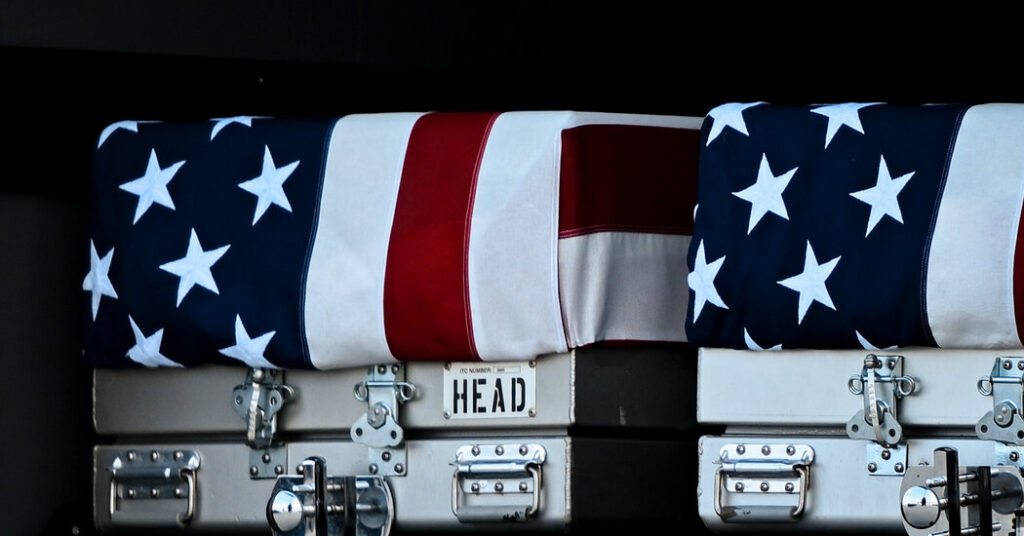
As the war with Iran persists, mental health counselors say they are attending to more military families who are reporting stress and anxiety about a conflict that has taken the lives of at least 18 service members and wounded more than 400.
“We have tripled our caseload,” said Hannah Simms, the founder of Rise Alone Therapy, a tele-therapy provider that caters to the military and their families. “Everybody is kind of on edge.
“There was this understanding that this was going to be a short-term deal,” Ms. Simms said, noting President Trump’s declarations at the beginning of March that the war could last four to five weeks.
Five months later, the war has flared again, following the end of a cease-fire agreement and then two weeks of bombing. The Strait of Hormuz has again been closed, sending gasoline prices over $4 a gallon, diplomatic efforts are at a standstill and the latest round of U.S. attacks do not seem to have deterred Iran.
A Pentagon spokesman declined a request seeking details about how the military helps the families of service members cope with the stresses of war. But military officials have said that there are a variety of counseling and support services available, including a 24/7 service called Military OneSource that provides free and confidential support.
In interviews, military families said the war has triggered grief once thought to be healed. Some cope with feelings of guilt brought on by the conflict, a common emotion among military families, counselors said. Others lamented the lack of transparency and communication that has left them not knowing when their spouse, child, brother or sister will come home.
“I don’t know where he is,” said Elisha Puente, a mother of four, whose husband deployed in February as part of Operation Epic Fury.
Ms. Puente’s husband, who is in an artillery unit in the Marine Corps, calls home about every three weeks, she said. He does not have access to his personal device and must use a satellite phone on base to make the call, often waiting in a line of Marines doing the same.
The communication lapses have roiled her children, who range in age from 11 months to 12 years old.
But Ms. Puente, 34, has developed strategies for her children to manage the absence. She keeps dolls and stickers of her husband at home. Her children love watching videos of their father, particularly those of him swimming with turtles.
Still, Ms. Puente, who has been in therapy to help with her husband’s deployments, said she has sought counseling for her four-year-old, who is currently on a wait list.
“I just knew that it was time to maybe ask for some more help for him,” she said.
Last month, Kelsey Smith, 35, started counseling to help cope with the stress caused by the war, even though her husband is stateside. She had struggled to control her emotions recently — blowing up over small things, she said.
“It’s better,” she said, adding that the therapy has helped. But overall, she said, “I’m not better.”
Her husband is an intelligence officer for the Army and supports the Middle East campaign from a base in the Northeast. Since he started working around the clock, Ms. Smith began completing a tuxedo cat Lego set, about 1,700 pieces, to calm her nerves, she said.
“I know how hard my husband’s working and the amount of stress he’s under,” said Ms. Smith, who used her maiden name because of her husband’s work in intelligence. “So there’s a level of guilt of just feeling like I’m not doing enough or not working as hard as he is.”
For veterans whose children are now in the military, a deployment can trigger anxiety as they recall their own deployments.
Eric Dorner, who lives in Mountain, Wis., is a veteran whose 27-year-old son Brenden just returned home after an extended deployment, serving 13 months as a sergeant in the Middle East. His contract officially ends at the start of August, but he could be deployed again anytime in the next three years.
“It is difficult because I knew he had already seen and been through traumatic things,” said Mr. Dorner. “I did struggle myself as a veteran, even though he went through way more than me.”
Kyle Harper, who is a communications adviser for Tragedy Assistance Program for Survivors, a service that connects people who have lost loved ones in the military, restarted trauma therapy three months ago to help process her own grief.
In 2007, her fiancé, Army Staff Sergeant Michael Hullender, responded to a vehicle that had been struck by a roadside bomb in Iraq. As a medic, Staff Sergeant Hullender approached to offer aide. Leaving his vehicle, he stepped on an I.E.D. and died as a helicopter rushed him to the nearest military hospital.
For almost two decades, Ms. Harper said she has been healing from the loss that has partly defined her adult life. She wears the engagement ring Staff Sergeant Hullender gave her on her right hand. She has completed two full Ironmans in his honor.
When she learns of military casualties, in combat or in training, Ms. Harper always feels a pang of grief — knowing how difficult it may be for those families.
“I look at the faces and read the names of people who served and died because I wanted someone to do that for Mike,” she said.
Ms. Harper said she returned to therapy to work with someone who understands “the layers of loss.”
“It felt strange to go back and talk about some of this stuff,” she said, adding, but “the world seemed really overwhelming again.”
The post Families Face Anxiety, Angst as Loved Ones Are Deployed to Fight Iran appeared first on New York Times.