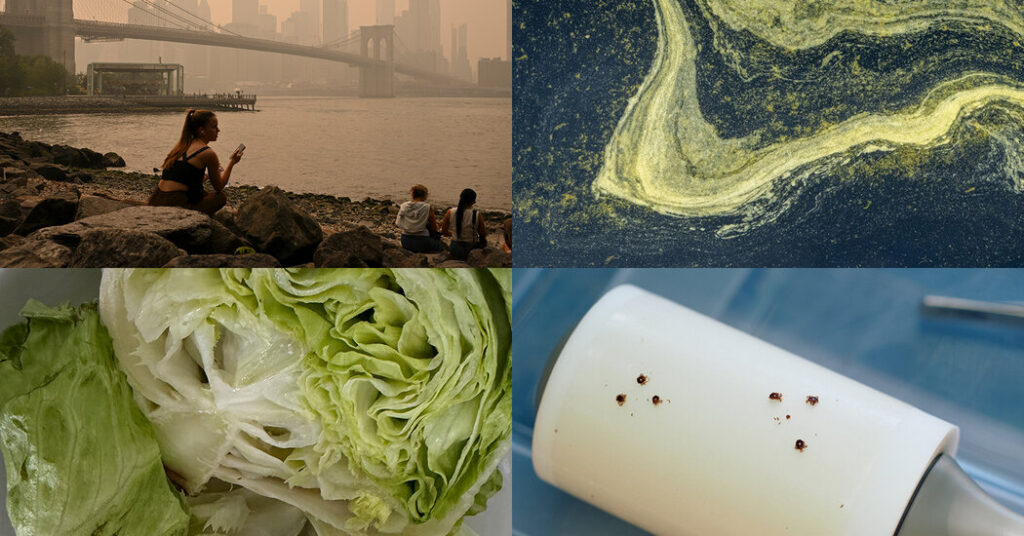
Welcome to the summer of the bummer: a season of wildfires and heat domes, flooded streets and hazy skies, sharks skirting popular beaches, rattlesnakes haunting hiking trails, meadows teeming with ticks. Even the simple pleasures of eating a fresh salad are now fraught, thanks to a cyclospora outbreak.
Spoiled vacation plans are nothing new. What’s unusual about the summer of 2026 is that, perhaps for the first time, not even people of means can fully escape the crises and catastrophes usually left to those of us without a waterfront estate.
“It has been a summer of weather warnings,” read an editorial in The East Hampton Star. The newspaper noted that about a week and a half before wildfire smoke from Canada turned the sky a sickly yellow, a storm had brought hurricane-strength winds to parts of Long Island.
“At the end of the day, we’re all living in human bodies,” said Brooke Harrington, a sociology professor at Dartmouth College who studies extreme wealth. “You can’t escape these forces of decay and potential death.”
Plenty of summer pleasures are free or inexpensive, but that doesn’t mean everyone can access them with frequency or ease. As of 2025, 20 percent of working Americans in the private sector have no paid vacation. Some 32 million work outside in punishing heat and driving rain. So it is a remarkable moment when even the rich are boxed in by the brutal realities of climate change.
“I think this summer marks the end of one of luxury travel’s oldest illusions: that if you have enough money, there’s always somewhere untouched to escape to,” said Jenny Southan, a travel trend forecaster. “Heat waves don’t stop at the gates of a five-star resort, and neither do wildfires or ecological collapse. Nature doesn’t recognize wealth.”
That lodge in Idaho’s postcard-perfect Sun Valley? Maybe not a great idea with the wildfire smoke wafting over from Oregon. The $4,000-a-night “cottage” at the Beach Village at the Hotel del Coronado, the historic San Diego beachfront resort? “Excessive” flows overwhelmed a nearby wastewater treatment plant, temporarily closing surrounding beaches. A local conservation group posted an Instagram video of murky water coated with brown sludge.
Martha’s Vineyard, the Massachusetts island that is the preferred vacation destination of presidents, celebrities and financiers, has also become the summer home of the lone star tick. The tick’s bite can cause a strong allergy to red meat and dairy, a condition known as alpha-gal syndrome. In 2024, a 47-year-old pilot in New Jersey who collapsed after eating a hamburger became the first fatality linked to an alpha-gal food reaction. The ticks, historically a scourge of the Southeast, are causing dread as they spread across the country.
“People are really freaked out by it — it’s a topic of conversation all the time,” Alexandra Styron, a writer, said. “Every time you go to dinner, there’s a conversation about alpha-gal because the host has to figure out what to cook, and everybody’s dietary issues come into play.”
Things are not much better in the Hamptons: Flesh-eating bacteria have been found in Georgica Pond, where Jay-Z and Steven Spielberg spend summers, as well as in Sagaponack Pond and Mecox Bay, where Alan Alda and Jennifer Lopez own homes.
Ponds in the East End have also been afflicted with cyanobacteria, which can cause greenish scum, potentially harmful to both humans and animals, to form on the surface of water. (Meanwhile, the National Mall in Washington is struggling with a blue-green algae problem of its own.) The organisms thrive on nitrogen, which is present in the fertilizer that gives Hamptons lawns their signature deep green color. And as the Hamptons have also increasingly become a party destination, with large groups packing into rental houses, sewage has overwhelmed the septic systems, leaching nitrogen and phosphorus that further contribute to cyanobacteria growth.
“I’ve lived out on the East End for 27 years now,” said Christopher J. Gobler, a marine biologist at Stony Brook University and an expert in local waterways. “There’s just a lot more people, a lot more activity, and that is a contributing factor.”
Even staying home in New York City has become dangerous for some. On the Upper East Side of Manhattan, there has been an outbreak of Legionnaires’ disease — a severe form of pneumonia — that has claimed the lives of five people and infected at least 85 others.
“There was a feeling that, during Covid, the super rich were able to use their money to buffer themselves from the worst of it,” said Jenny Jackson, the author of the novels “Pineapple Street,” about East Coast elites, and “The Shampoo Effect.”
“The rich could retreat to their country estates; they could eschew commercial air travel; they could work remotely from their private enclaves; they could golf at their clubs,” she added. “The thing about this strange summer is that money can’t insulate people from this new round of scourges in the same way.”
The post It’s a Hot Scourge Summer appeared first on New York Times.