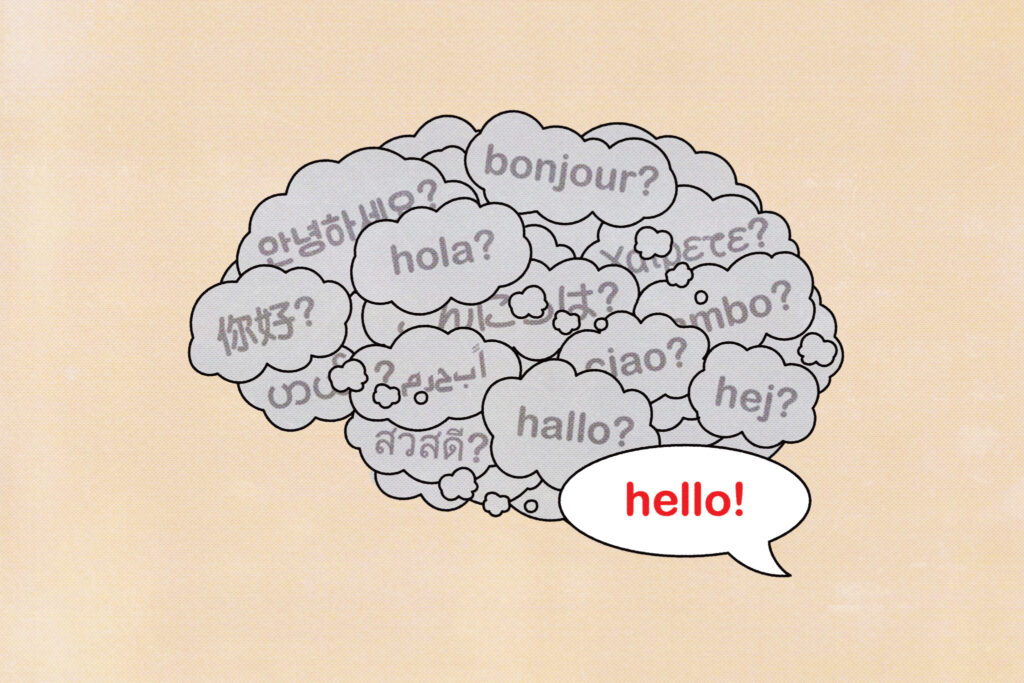
Learning a new language is good for your brain.
Being able to speak and understand another tongue offers a form of mental stimulation, which keeps the brain active and sharp as we get older. In fact, researchers have found that being multilingual may delay dementia diagnoses and slow down how fast the brain ages.
Unlike, say, music that someone may practice a few hours a day, the mental stimulation from language is “intense and constant,” said Ellen Bialystok, a distinguished research professor emeritus of psychology at York University in Canada, who has studied the effects of languages on the brain for more than five decades.
Knowing more than one language — and practicing it often — is akin to constantly strength-training your brain. Being multilingual changes how your brain functions and how it’s structured.
“If you are constantly using your brain for difficult, engaging and stimulating challenges, your brain will be healthier,” Bialystok said. “And learning a language is hard, and that makes it worthwhile.”
How languages change the brain
If you know several languages, your brain has them “on” all the time, even when you aren’t speaking them.
For people who are bilingual, there are cortical areas in the brain’s language network that respond to both languages. But within that large area, there are specific regions that respond to only one language, said Lucia Amoruso, deputy scientific director and leader of the group of neurobiology of language at the Basque Center on Cognition, Brain and Language in Spain.
While you speak or listen in one language, “the other language is also active in your brain. It’s not sleeping,” said Amoruso, who noted that she needed to suppress Spanish, her first language, as she responded in English. (Amoruso also speaks French and Italian from living in different European countries throughout her career.)
As a result, multilingual brains are constantly monitoring what they’re hearing and saying, assessing for the languages they know.
“There is no language switch,” Bialystok said.
That’s why people who speak several languages may be better at controlling their attention, focusing on what is relevant and ignoring distracting information, research shows.
This monitoring occurs very early in life. Seven-month-old infants growing up in bilingual households can already tell when languages switch. They also perform better on certain attention tests than infants living in monolingual households.
The constant challenge of paying attention, distinguishing and deciding what language to use — and not use — seems to train the brain, building more resilience.
“You get a brain that has been exposed to this more complex linguistic environment and develop the attentional resources or whatever it needs to cope,” Bialystok said. “And so, as life goes on and brain stuff happens, it’s more resilient.”
A more efficient brain
In one study, Bialystok and her colleagues used EEGs to measure brain electrical activity in people who speak two languages compared with those who speak one. They found that bilingual people had overall less, but more focused, activity at rest.
Other research finds a similar pattern when multilingual people are given simple attention tests: They had less brain activation compared with monolingual people performing the same tasks, suggesting that knowing more languages made their brains more efficient.
“The electrophysiological activity in the bilinguals’ brains is less active, less bothered. It’s easier. You don’t have to ramp up as much to get to the same level. So there’s something about this that speaks to efficiency,” Bialystok said.
Increased brain efficiency — an improvement in functionality — is important in aging, especially if there are pathological changes that can cause conditions such as Alzheimer’s disease. A more efficient brain could keep working longer despite the slowdowns that come with age or disease, she said.
At the same time, knowing another language seems to keep different brain networks distinct and specialized. These networks are made up of different, tightly connected brain regions that work together on certain functions. With aging, “the boundaries between your brain networks start to blur,” Amoruso said.
There may be a mechanism in “multilingualism that is maintaining your brain network segregated,” she said. “So it’s a way to fight against cognitive decline that is present and is normal in aging.”
Brains that look ‘younger’
Researchers had evidence that speaking more than one language can make your brain more efficient. But could it also make your brain younger?
To find out, Amoruso and her colleagues trained machine learning models with imaging and biological data from more than 86,000 people.
In the study, published last year in Nature Aging, they found that, across 27 European countries, countries with more spoken languages were associated with slower brain aging. There was a dose-response, meaning that “the more languages you speak, the stronger the protection or the more youthful your neurocognitive profile looks like,” Amoruso said.
Speaking just one language, on the other hand, was linked to about double the risk of accelerated aging.
However, this research analyzed differences across countries, not people. So in a follow-up study, Amoruso and her colleagues created brain-age clocks using electrical brain activity data from 728 people. The research, recently presented at the Federation of European Neuroscience Societies conference but not yet peer-reviewed, found that people who spoke two or three languages had brains that looked six years younger. Those who spoke four had brains that looked 13 years younger.
Interestingly, the more similar the languages someone knows, the larger the brain protection they get, potentially because the brain needs to work harder to distinguish and switch between them, Amoruso said.
The link between languages and dementia
Knowing more languages seems to increase cognitive reserve, which is the brain’s ability to adapt and compensate despite age- or disease-related biological changes.
People who are bilingual have more delayed dementia diagnoses compared with people who speak one language, and they are able to function longer even if they have advanced Alzheimer’s pathology, research shows.
“You get like four or five years where they’re functional. And their brains look like Alzheimer’s brains, but clinically it’s not interfering with their functionality,” said Bialystok, who wrote a 2021 review on how bilingualism contributes to increased cognitive reserve.
How to learn a new language
Learning a new language has many benefits in addition to cognitive ones, even if you don’t become fluent.
“It allows you to speak to people you might not have been able to speak to, or travel to places you might have been resistant,” Bialystok said. “So it’s an opening experience, not a closing experience.”
It’s also never too late to start. Some research suggests that learning languages later in life can improve memory and cognitive flexibility.
The level of cognitive boost goes hand-in-hand with the work you put into it. “My view is the longer the better, the more intense the better,” Bialystok said. “The more proficient the better.”
There is no single approach to language learning. You can more formally study in a class or through an app, such as Duolingo or Rosetta Stone. Websites such as Italki and Verbling can help connect you with online tutors. These lessons can be accompanied by watching shows or listening to music in that language, which will help you be more familiar with the sounds.
But the key to language is using it, Bialystok said in an email. “I think an approach that includes a component of conversation, especially interactions with a native speaker, is most effective.”
The post This skill may keep your brain younger. Here’s how to learn it. appeared first on Washington Post.