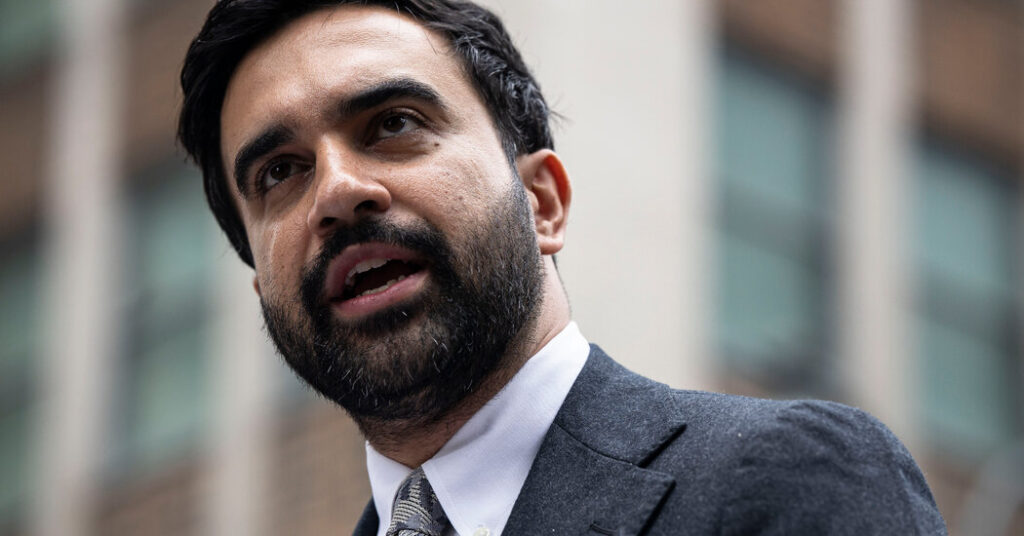
When Mayor Zohran Mamdani last week unveiled the 18-person committee that will advise him on his judicial nominations, he said the committee reflected the city it served.
But something seemed off.
Though Jews make up an estimated 10 percent of the New York City population and represent such a significant share of New York City lawyers that the Jewish lawyer has become a cultural stereotype, the mayor’s 18-person committee seemed to have no Jews on it.
On Monday, Elizabeth Forspan, the president of the Brandeis Association of Queens, a group of Jewish legal professionals, sent a letter to Mr. Mamdani protesting the apparent absence of Jewish representation. The letter was co-signed by leaders of the Jewish Lawyers Guild of Manhattan, the Brooklyn Brandeis Society and the Bronx County Jewish Bar Association.
“Not a single Jewish attorney, former judge, or legal professional was appointed to a committee your administration described as one that would be ‘truly reflective of New York City,’” they wrote, citing the news release the mayor sent out announcing the appointments.
A spokesman for the mayor did not contest the letter’s determination. He declined to comment.
The slate of members who will advise Mr. Mamdani on judicial selections represents a broad cross-section of the city’s legal professions, including former state judges, litigators, former prosecutors and law professors.
The apparent omission of Jews comes amid a particularly turbulent time in Mr. Mamdani’s relationship with New York City’s Jewish community. Last week, Mr. Mamdani posted a two-minute video denouncing Israel’s conduct in Gaza and explaining why the law barred him from following through on a campaign vow to honor the International Criminal Court’s arrest warrant for Israeli Prime Minister Benjamin Netanyahu. Mr. Netanyahu is planning to attend the United Nations General Assembly in September in New York City.
Two days later, on Thursday, a man stabbed an Asian man and then a Jewish man wearing a yarmulke on Manhattan’s Upper West Side, while yelling “Allahu akbar,” the police said. Prosecutors have charged Raul Morales with two counts of attempted murder as a hate crime.
The next day, Jewish leaders gathered in front of an Upper West Side synagogue to denounce rising antisemitism and to beseech the mayor to tone down his anti-Israel rhetoric, which they believed was feeding antisemitic sentiment in New York City.
Some progressive rabbis rejected that notion, arguing that Jewish safety did not require silence on Israel’s actions.
Mr. Mamdani agreed.
“They are critiques of a political leader, not of people of a specific faith or a religion or a background,” he said to NY1 on Friday. “My responsibility as the mayor of this city is to keep every New Yorker safe, no matter where they come from, what they believe in or, frankly, even if they agree with my politics.”
The Mayor’s Advisory Committee on the Judiciary consists of nine members selected by the we mayor, including the chair, and nine others recommended by judges and deans of the city’s law schools.
The letter from Ms. Forspan said that one representative who had been recommended, Retired Appellate Division Justice John Leventhal, was rejected by the mayor’s office. “We find your unprecedented rejection of the highly respected retired Appellate Division Justice John Leventhal particularly disconcerting given the lack of any Jewish representation on the committee,” it said.
A city official said the retired judge did not pass the vetting process. Justice Leventhal could not immediately be reached for comment.
Though Steven Banks, who is Jewish and the mayor’s corporation counsel, is not on the committee, he is part of the core group that will advise the mayor on his final judicial selections. Others in the core group include Ali Najmi, the committee’s chair, and Ramzi Kassem, the mayor’s chief counsel.
Mr. Najmi was one of Mr. Mamdani’s first appointments to his administration. A friend of the mayor, he also served as Mr. Mamdani’s transition team’s lead counsel.
At the time of Mr. Najmi’s appointment on Jan. 2, both he and Mr. Mamdani pledged to bring the process of selecting the city’s judges out of the shadows so New Yorkers could better understand it.
“I am committed to making our judicial selection process more transparent and inclusive,” Mr. Najmi said then.
He declined to comment on Monday.
In tandem with naming Mr. Najmi to helm the advisory committee, Mr. Mamdani issued an executive order that he said was intended to expand the pool of judicial appointments and create a “merit-based, independent, fair, and publicly credible” process.
The executive order from Mr. Mamdani said committee membership “shall reflect the cosmopolitan population of the City of New York.” Members serve four-year terms, except for members appointed at the recommendation of deans of law schools, who serve for two years.
That promise contained in the executive order was not fulfilled, according to the four Jewish lawyers’ groups that signed the letter.
“To have no Jews on the committee that’s selecting New York City judges is pretty remarkable,” said Matthew J. Kluger, the president of the Bronx County Jewish Bar Association. “It certainly sends a strong message.”
The message, Mr. Kluger said, is that the administration doesn’t seem interested “in hearing from the voices of Jewish lawyers and judges, in terms of picking judges. It’s pretty clear.”
Mr. Kluger worried that the composition of the committee would end up influencing the makeup of the bench.
“There are certainly very, very well-qualified Jewish applicants who are going to say, ‘Why even bother,’” he said.
Katherine Rosman contributed reporting.
The post Mamdani’s Judicial Panel Appears to Be Missing Something: Jewish Members appeared first on New York Times.