Meta Platforms Inc.’s Facebook and Instagram have served thousands of ads for AI “nudify” apps in breach of the company’s policies, delivered by one of its few advertising partners in China, according to the nonprofit Tech Transparency Project.
Beijing-based GatherOne Inc., which connects Chinese firms seeking to advertise on Meta’s social media services with the US company, has been responsible in recent months for some 7,600 ads for mobile apps that can transpose women’s faces onto naked bodies and create sexualized videos, the agency said in a new report. It singled out an app, created in China, that allows for the sharing of material some users have flagged as child pornography.
Meta’s rules prohibit sexually suggestive ads or those for apps that purport to strip the persons depicted. But TTP’s work, which aims to hold Big Tech companies to account, shows repeated failures from the likes of Apple Inc. and Alphabet Inc. to curb such apps. Regulators, victims and their families around the world have been calling on tech firms to do more to combat so-called deepfake porn services.
“Meta appears to be giving a free pass to one of its top Chinese advertising partners when it comes to nudify ads,” said Katie Paul, TTP’s director.
While Instagram and Facebook aren’t available in China, they’re attractive promotional tools for China-based businesses looking for a global audience. Paul said her agency’s findings contradict Meta’s statements about prohibiting ads for deepfake-nude apps and suggest the company prioritizes ad revenue over concern for its users.
“We do not allow non-consensual intimate imagery or nudify apps on our platform and we take aggressive steps to combat them,” said Cindy Southworth, Meta’s Head of Women’s Safety Policy.
“All advertisers have to comply with our advertising standards, and failure to comply with our policies and standards can lead to the cancellation of ads placed, financial penalties, and termination of ad accounts,” a Meta spokesperson said.
GatherOne said it complies with Meta’s advertising policies and all applicable international legal frameworks. The company maintains a zero-tolerance policy against deceptive practices, adult content, non-consensual explicit AI-generated material, child exploitation and fraud, it said. Its website says it works with clients in gaming, e-commerce, entertainment and finance, helping them place ads across the networks of Meta, Alphabet’s Google, ByteDance Ltd.’s TikTok and Elon Musk’s X.
GatherOne is suspending the creation of new advertising accounts for services related to AI nudifying and face-swap services, it said in response to queries from Bloomberg News. It added that it is undertaking a comprehensive compliance upgrade to address the technical evolution of synthetic media.
TTP is a research arm of the Washington, DC-based nonpartisan corporate and government watchdog Campaign for Accountability.
The report, due to be published Monday, provides a rare look at how Meta derives revenue from a country of 1.4 billion people where its services are blocked. Companies in China selling products and services outside the country use intermediaries like GatherOne to buy access and exposure to international users.
Meta said it made $18.4 billion in China sales for the year ended 2024, which amounted to 11% of its global revenue. That was more than double the sales it made there in 2022. It has not broken out its China revenues since.
Sarah Wynn-Williams, a former Meta executive turned whistleblower, testified before Congress last year that the company has over the years offered censorship tools to China and helped the country advance in the artificial intelligence arms race with the US. She said China remains a key market for the company, as demonstrated by its ongoing China revenues. Wynn-Williams’s 2025 memoir Careless People details her time as director of public policy at the company.
A Meta spokesman at the time disputed Wynn-Williams’ comments.
Reuters in December reported that internal Meta documents showed the company concluded in 2024 about 19% of its China revenues that year came from ads for banned content such as pornography, scams and illegal gambling. It cited GatherOne as an ad agency that its tests showed facilitated ads for scam services.
Meta disputed the accuracy of Reuters’s report at the time. It has said it is dedicated to rooting out fraud and scams, which are spiking across the internet, and takes action when it determines its rules are violated.
The ads this year, which TTP found between April and June, were eventually removed by Meta after being shown to users. Many of the ads were suggestive, showing images of young women in sexual poses along with text reading “Create a video with any face.”
GatherOne is listed on Meta’s business-facing website in China as a way to advertise on its social media services overseas, as one of 11 official agents. The GatherOne website displays a photo of what appears to be its chief executive officer receiving an award, standing beside two top Meta executives at a gathering in Hong Kong in January. Meta’s logo is displayed on a sign behind them.
Meta last year said it was cracking down on deepfake-nude apps, filing a lawsuit against a Hong Kong-based app developer it said was behind such services.
TTP found that one cluster of ads directed users to an Android app called BAfter. Upon opening it, TTP found a “ShareZone” section that offered pornographic face-swap options showing women engaged in sexual acts.
Several reviewers flagged on the app’s Google Play app store page what they describe as “illegal child porn” and AI videos of minors. BAfter, whose developer is shown as being based in China’s southern Guangxi province, is listed as suitable for all ages.
BAfter’s developer couldn’t be reached for comment. The app disappeared from Google Play on July 21 and GatherOne said it’s permanently terminated all advertising access for the associated entity.
In response to Bloomberg’s queries, Meta said it has banned BAfter and is no longer allowing links to several other nudify apps. Google, which develops the Android operating system and operates the Google Play store, did not respond to requests for comment.
More than half of 557 teenagers surveyed recently in the US by George Mason University said they had used nudification tools to create at least one image of themselves or others. More than a third reported being victims of such tools. Many teens already know how to access those services via messaging apps or directly via their websites, said Chad M.S. Steel, a George Mason digital forensics researcher who led the survey. That means actions taken by social media services or app stores to limit their spread may have limited impact, he said.
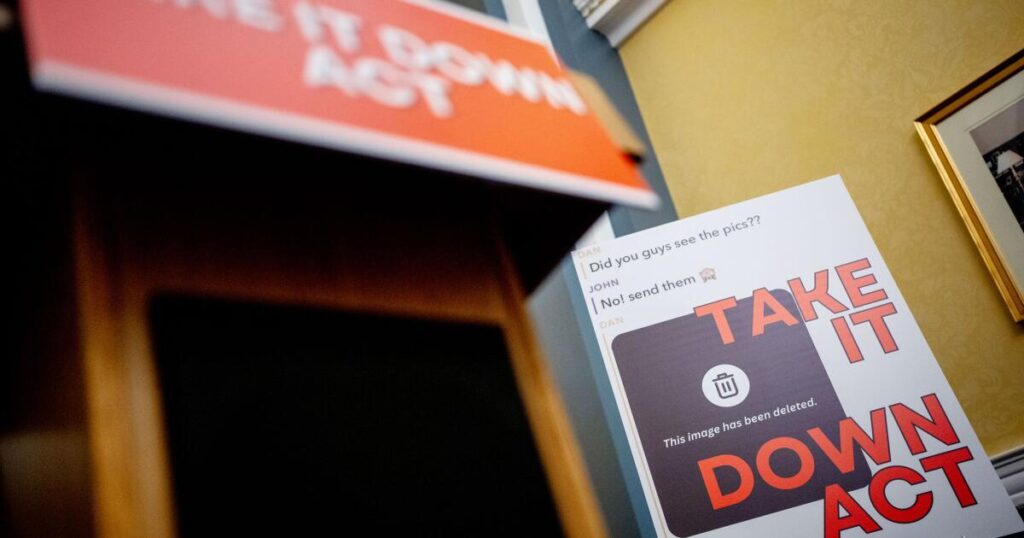
President Donald Trump last year signed the Take It Down Act, which criminalizes the publication of non-consensual sexual content and forces social media and website operators to remove such posts. The Federal Trade Commission commenced enforcement of that law in May.
TTP discovered that ads were connected to GatherOne by examining disclosures in Meta’s ad library. While it is unclear how many app installations the advertisements drove, a handful of those that the group studied have collectively been downloaded more than 2.5 million times globally, according to data from market researcher AppMagic provided by TTP.
Purnell writes for Bloomberg.
The post China-linked AI ‘nudify’ ads flooded Facebook and Instagram, watchdog says appeared first on Los Angeles Times.