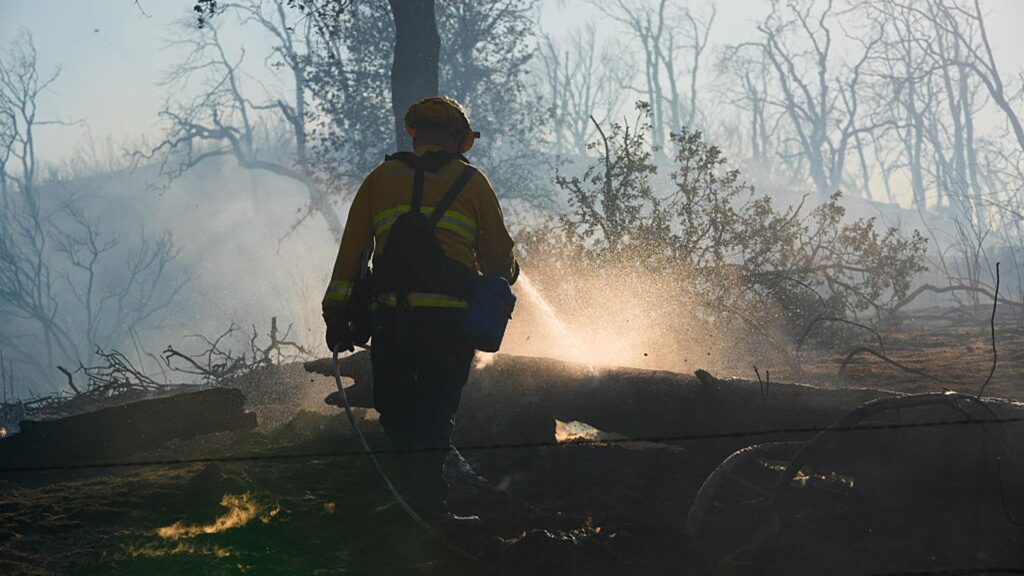
Federal officials have moved the national wildfire preparedness level to its highest level: a five out of five. That means that, as we approach peak fire season in the U.S., federal agencies might not have enough resources to address every new fire.
What are U.S. wildfire preparedness levels?
A number of federal agencies, including the U.S. Forest Service, U.S. Fire Administration, and the National Weather Service, are responsible for allocating federal resources for tackling wildfires, like helicopters, airtankers, funding, or firefighters. The wildfire preparedness levels, which range from the lowest, 1, to the highest, 5, help the agencies track what resources are available. “It’s a framework for determining resource allocation,” says Craig Clements, director of the Wildfire Interdisciplinary Research Center at San Jose State University. “As the fire season progresses, those resources are used around the country by different agencies. When we get to level five, that means that resources are running low because there’s so many incidents ongoing.”
What does a national preparedness level 5 mean for wildfire risk?
At level 5, national resources are already committed to fighting fires around the country. “The fire hazard is at its greatest, and the resources are at their most strained level,” says Peter Sunderland, professor of fire protection engineering at the University of Maryland.
That means that federal agencies might not have the resources to respond to new fires. “If there are existing fires, they won’t pull anybody off those fires,” says Sunderland. “But as new fires arise, the state managers can’t expect the same level of service that they’d get at level one through four. In other words, they may say we just can’t help with that new fire.”
That presents a new challenge, since fires are easier to put out in the first few hours after they start, a period of time known as the “initial attack.” “[Firefighters] try to get helicopters and crews on as soon as possible, so that way it doesn’t become a big fire,” Sunderland says. “Once it becomes bigger and larger, it takes a lot more resources to contain that fire, and it takes a lot more time.”
Wildfire season in the U.S. usually lasts from May to November, peaking in the summer. It’s not uncommon for the U.S. to reach level 5 in July. “This is pretty typical,” Clements notes. “It’s almost August, so we are in the prime time of fire season.” The National Interagency Fire Center (NIFC) previously declared a level 5 preparedness level in July of 2018, 2021, and 2024.
Does wildfire preparedness level 5 affect me if I don’t live near a fire?
If you don’t live near an area at risk, you might not be directly impacted by a fire. However, as wildfires in Canada earlier this summer proved, smoke can travel a long distance from the initial blaze, impacting air quality for people thousands of miles away.
Why is this year such a dangerous wildfire year?
Much of the country has seen dry, hot conditions this year, setting the stage for an active wildfire season. This past winter was the second-warmest in U.S. history, with 19 states—including Nebraska, Oklahoma, and Texas—all experiencing one of their 10 driest winters on record, according to NOAA.
This year has already set a record for the number of fires. So far in 2026, the U.S. has seen 41,779 fires—the most one season has seen in the last 10 years.
How long does wildfire season last and how is climate change impacting wildfires?
“We are seeing more and more climate extremes,” says Sunderland. “Generally we’re having drier summers and higher winds.” That creates the perfect conditions for wildfires to spread.
Fire season is also lasting longer than in decades past thanks to climate change. While wildfire season might once have lasted around four months, they can now stretch on for six to eightmonths in some areas.
The fires we see now are also more severe than those of a decade ago—in no small part due to climate change. A recent study led by researchers at the University of California, Los Angeles found that forest fires now burn 10 times as much acreage annually as in 1985, while high-severity fires alone increased thirtyfold in California between 1985 and 2024.
What should you do if your area is under high fire danger?
If you live in a fire-prone area, make sure you know your evacuation plan well before you need it. Listen to authorities and evacuate while it is still safe to do so. There are steps you can take to protect your home ahead of time—like clearing out brush, clearing your gutters, and staying up to date on fire code. Nearly nine in 10 wildfires are human caused, so be vigilant about accidental fires when camping outside, says Clements: “As long as we can limit the amount of ignitions, we can get out of this problem.”
The post The U.S. Is Now At Its Worst Level of Wildfire Preparedness. What Does That Mean? appeared first on TIME.