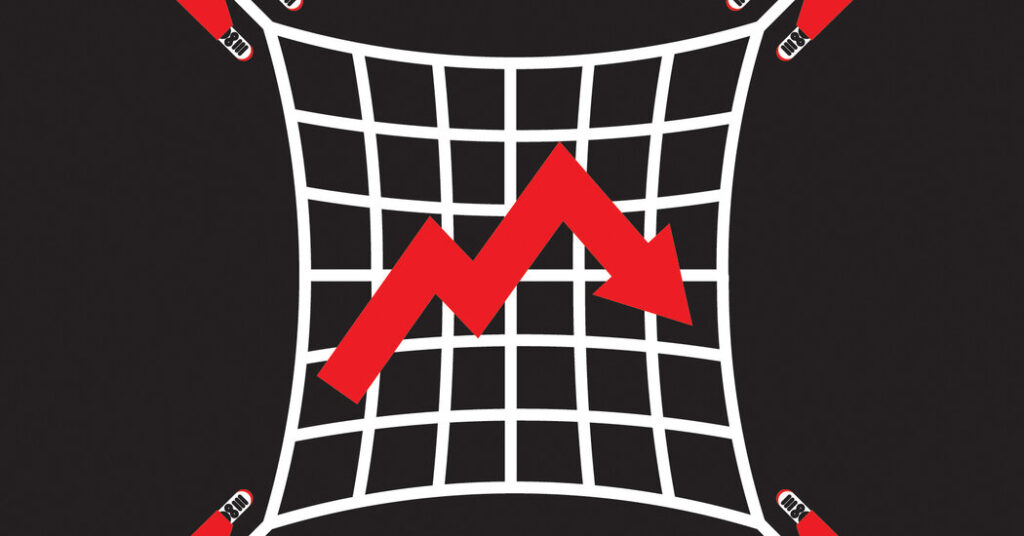
The stock market has been sustained lately by expectations that the Federal Reserve is about to cut interest rates again. But that could change in an instant.
It already has, several times. At the end of October, the markets deemed a Fed rate cut in December a near certainty, and that conviction bolstered stocks. On Nov. 19, though, they gave only a 30 percent probability of a Fed rate cut in December, presumably because of worries about inflation, and stocks floundered.
Just two days later, the consensus reversed again, with the probability of a rate cut reaching 71 percent, according to CME FedWatch futures prices. This past week, futures prices showed confidence that a rate cut is coming at next week’s Fed meeting, and the stock market has been fairly calm.
It wouldn’t take much to freak out the markets again, however. Volatility is the watchword in financial markets these days. When the mood shifts, markets swing wildly.
Whether the Fed will trim rates — this coming week and in the months ahead — is only one of the many factors affecting the stock, bond and commodity markets. There is deep uncertainty about the future political and economic alignment of the United States. If you allow yourself to contemplate the multitude of issues facing the nation and the world right now, you may wonder how you can plan, and invest, at all.
Accepting uncertainty as a constant condition is an unfortunate necessity, especially now, with the Trump administration’s constant stream of disruptive policies. Under these circumstances, thinking in advance about how to protect yourself is essential. Understanding the risks is a first step for any investor.
This is a vast topic. Here are the key points: Diversify to reduce risk, and keep things cheap and simple. Use broad, low-cost index funds to hold many stocks and bonds in reasonable proportions. Hold cash in safe places. Mix stock and bond investments in a reasonable proportion. The classic 60/40 portfolio, with 60 percent stocks and 40 percent bonds, is a good starting point.
As for cryptocurrency, gold, real estate (as an investment, not a home), meme stocks, other commodities, private equity, hedge funds and exotic holdings involving derivatives, you don’t need them. I’d be careful about taking advice from anyone who says you do.
That’s it, in a nutshell. You have to rely on yourself.
Here are some ways of looking at the central risk-reward problem.
Policy Hazards
Last month, I wrote that the soaring valuations of the artificial intelligence stock market were making me uneasy. So are Trump administration policies on an extraordinary range of areas. These include, but aren’t limited to, the tariffs that are making the Fed’s task in taming inflation so difficult; radically tightened curbs on immigration and surging deportations; a headlong embrace of cryptocurrency and financial deregulation; reduced funding for scientific research; disdain for environmental safety; attacks on vessels in the Caribbean; and intervention in the domestic politics of numerous countries in the Americas and on other continents. I’ll stop there to take a breath.
The various Trump policies could foster a continuing bull market in stocks and lead to greater economic prosperity, as the administration hopes. But, unquestionably, the size and degree of the policy changes are adding risks that many investors do not necessarily grasp.
For the markets’ immediate prospects, I’d emphasize the administration’s unrelenting pressure on the Fed. President Trump says that early next year he will nominate a new Fed chair who will be committed to lower rates. The markets may like that idea initially, but expect a harsh negative reaction if inflation gets out of control.
Hedging against each of these risks specifically isn’t possible for most of us. But it’s worthwhile zeroing in on how broad classes of financial assets may perform in a major downturn.
Risk Assessment
You won’t earn much if you avoid risk entirely. The important question is whether the risks you are taking are worthwhile — whether the potential payoff justifies the potential loss.
Stocks are the riskiest asset class that most people need. In descending order of risk, bonds and cash are the two other critical investing ingredients. I’ve been cutting back on risk lately, in the tried-and-true manner: by adding bonds and cash and reducing the swollen stock allocation in my portfolio, after the boom of the past couple of years.
It’s worth noting, however, that the traditional stock-bond-cash risk hierarchy isn’t as straightforward as it looks. Accept that even in the safer asset classes, risks abound.
For example, finance textbooks sometimes call U.S. government bonds risk-free. Yet in the real world, many people have lost money trading these seemingly safe securities. That’s because market prices for government bonds decline when yields in the market rise. People who held long-term Treasuries and needed to sell them in 2022 took big losses, as I’ve noted in previous columns.
What’s more, U.S. Treasuries are no longer Triple-A investments. Mounting sovereign debt levels, for the United States and many other governments, raise the risk of grave “financial stability” challenges for the world, as Pablo Hernández de Cos, the general manager of the Bank for International Settlements, warned on Nov. 27. Martin Wolf noted in The Financial Times that the bank had issued an early warning before the financial crisis of 2007-8, and that it was signaling danger again now.
During that 2007-8 financial crisis, U.S. Treasuries rallied as global investors sought safety under the umbrella of the U.S. government. I will continue to hold Treasuries, but amid incessant political conflict and rising debt burdens in the United States, I’m less confident that Treasury bonds will be entirely trustworthy in the future.
Even cash isn’t truly risk-free. It can be lost or stolen, and while you can protect it, there’s a good chance that inflation will chip away at its value. Government money market funds — which hold Treasuries and other government securities — are where I keep most of my cash, but they depend on the reliability of the government itself, and on the prudence of the companies managing the funds. This isn’t a foolproof solution, either.
Bank savings accounts and money market accounts, which are protected by the Federal Deposit Insurance Corporation up to $250,000 per depositor, per bank, are a fairly safe bet, but they, too, rely on the U.S. government as a backstop.
Still, high-quality bonds and conservative cash holdings are far safer than stocks. Holding small numbers of individual stocks is extremely risky. Research by Hendrik Bessembinder, a finance professor at Arizona State University, has shown that most stocks fail to match the returns of Treasury bills. Over the short term, the stock market is inherently unstable, while Treasury bills are quite steady.
A relative handful of high-flying stocks, like Nvidia, Apple, Microsoft, IBM and, in early eras, Philip Morris, Exxon and U.S. Steel, produced the overwhelming majority of long-term returns in the stock market, this research showed. Holding only the winners would make you rich, but most people can’t pick the fabulous shares in advance. Holding a piece of the entire stock and bond market is much less hazardous.
A ‘Free Lunch’
As Harry Markowitz, the Nobel winner who created modern portfolio theory, said, diversification is the only “free lunch” in investing because by owning a little of everything in these public markets, including things you don’t entirely like, you can reduce your risk.
Using only publicly traded securities in a portfolio allows an investor to benefit from the scrutiny that markets apply to companies in a regulated financial system. But reducing regulations, as the Trump administration is doing, and encouraging the introduction of private investments into the portfolios of ordinary people, with little disclosure, could raise investor risk levels appreciably.
The Social Security system’s financial problems pose another major risk for the great majority of Americans, for whom Social Security is the most valuable investment. Failing to address the system’s financial problems, while increasing the government’s debt, could reduce the value of everyone’s retirement account. Social Security lifts more people out of poverty than any government program, and poorer people can’t do much to offset possible declines in future Social Security revenues. Those lucky enough to own investment portfolios may want to emphasize relatively safe assets like bonds, in anticipation of possible reductions in their Social Security checks in the coming decades.
Innumerable specific events — like the Fed’s interest rate policy and political decisions on war or deportations or climate change or the funding of Social Security — matter considerably. I’ll come back to these issues in the months ahead.
There are so many systemic risks out there now, individuals can’t manage them on their own. But do the best you can with what you can control. Reduce unintentional risk-taking so you can bear the long-term risk of the stock market, and hang on through what is certain to be a tumultuous ride.
Jeff Sommer writes Strategies, a weekly column on markets, finance and the economy.
The post The Markets Are Temperamental. Understand Your Risks. appeared first on New York Times.