I’m not sure I’ve ever been as scared in a concert hall as I was on Wednesday night when the Pittsburgh Symphony Orchestra played Shostakovich’s Fifth Symphony at Carnegie Hall.
Shostakovich wrote it in 1937, at a time when his career and even his life were in danger, a year after Soviet authorities had denounced him for his opera “Lady Macbeth of Mtsensk.” Since then, time and history and politics have convinced us that what somehow appeared to those same authorities as an acceptably, straightforwardly triumphalist symphony was in reality fraught with ambiguity, cast in irony and laden with hidden meanings.
“Victory is indeed found,” Manfred Honeck, the Pittsburgh Symphony’s music director, has written of the piece, “but it is victory through great pain” — not “the victory of a free human, but rather a person under the extreme pressure of an inhuman regime.”
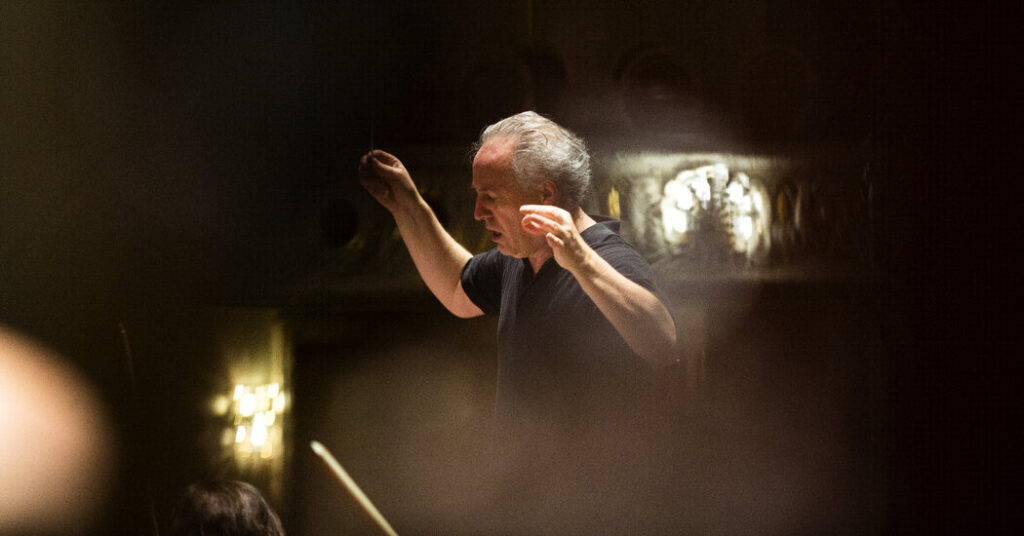
Artists working at a distance from such things can make them seem trite. But not Honeck. Like a historian who puts you in the throes of an event, Honeck made that pressure, that inhumanity, above all that pain physically palpable at Carnegie. Brasses roared with punitive force; strings attacked notes as if lashing them; woodwinds sang plaintively in desolate, forbidding isolation. Shostakovich’s symphony came off less like any kind of victory and more like a protest, even a call to arms.
This was an unsparing demonstration of how orchestral sophistication of the highest order can be put to profound aesthetic ends — a testament not only to what musicians can do, but also to why they must do it.
The Pittsburgh Symphony flew in to Carnegie on a high, making its first appearance in 11 years at a hall that bears the name of one of its own founding fathers. Every major orchestra in the country has struggled in the shadow of the Covid pandemic, and the Steel City ensemble has been no exception. Melia Tourangeau, its president and chief executive, said in an interview that the problems the organization has faced are broadly those that others confront: sluggish downtown revivals; permanent changes in how people consume art and entertainment; inflation outstripping revenue growth; the collapse of the subscription model, to such an extent that for each subscriber the orchestra loses, it has to find seven concertgoers to replace them.
Last month, though, the orchestra announced strong results for the past season, including a surplus of $2.3 million on a $34.6 million budget and a 17 percent increase in ticket sales.
Some of that strength has come from things that might prove hard to sustain, like the appearance of Yo-Yo Ma, Lang Lang and Itzhak Perlman in a single season, and savings from jobs that are not yet filled. Earned revenue is 23.5 percent of the overall budget, which is not unusual but lower than anyone would really like. There are structural issues, too, not least that Heinz Hall is absurdly large, seating just a hundred or so fewer people than Carnegie itself.
Even so, Tourangeau pointed to broader trends that give reason for optimism. Film screenings with live orchestral accompaniments have taken off in Pittsburgh as they have elsewhere, and market research suggests that they are proving a “gateway drug,” as she put it, for core classical programming. The orchestra has doubled down on promoting choose-your-own packages to three or more concerts instead of season-long subscriptions; sales of those are up fivefold. Social media engagements have risen to 50 million from 350,000 in a year after significant investments in data analytics and digital marketing, as well as an influx of younger musicians.
“I feel,” Tourangeau said, “like we’ve got a lot of great momentum right now that we haven’t seen for a long time.”
Artistically, the Pittsburgh Symphony has enjoyed rare momentum for more than a decade. It has long been an ensemble of worth; its former music directors include Fritz Reiner, André Previn and Mariss Jansons. But it has taken on renewed prominence in its 18 years under Honeck, largely by making recording a priority — one so firm that it is inked into his contract — at a time when other organizations have not.
Released on Reference Recordings and produced exquisitely by engineers at SoundMirror, some of the results in Beethoven and Brahms, Bruckner and Tchaikovsky rival and perhaps even surpass the finest accounts made by the great conductors of yore. A handful of others suggest just how risky Honeck’s taste for expressivity and drama can be.
Honeck talked modestly about such things in an interview, with the deference of a man who can still remember what it is like to be an orchestral player from his days as a violist in the Vienna Philharmonic. “I wanted to have a document of them, not because of me, I personally don’t need it,” he said of his players. “People should know what is going on in Pittsburgh, and what kind of quality we can offer.”
Asked if he ever thought he would remain in Pittsburgh for so long, Honeck admitted that he had considered leaving at the end of an earlier contract, anxious about overstaying his welcome, but relented after the musicians asked him to extend. He was often chattered about as a contender for posts at ensembles as storied the New York Philharmonic or the Chicago Symphony Orchestra, but four years ago signed a deal to remain in Pittsburgh through 2028.
“The reason why I did that is actually the quality of the orchestra,” Honeck said. “It’s just a unifying sound.”
Even so, it is exceedingly clear that Honeck holds these musicians to stratospherically high standards, and it is an ensemble that he has shaped as much in his image as Franz Welser-Möst has with the Cleveland Orchestra. Honeck has now hired more than half the orchestra, and he has been careful to make sure that those musicians fit his style; he is picky enough, he said, that it took him seven years to select David McCarroll as the concertmaster after Noah Bendix-Balgley left to become first chair of the Berlin Philharmonic.
McCarroll was just one of the musicians who made a strong impression on Wednesday night, giving solos in the Shostakovich that were effective not only on their own terms, but also in their deep awareness of what was going on around him. In the third movement, Honeck imagines a succession of wind solos over icy, almost silent string tremolos as the laments of three of Shostakovich’s imprisoned friends; the oboist Cynthia Koledo DeAlmeida, the clarinetist Michael Rusinek and the guest flutist Jessica Sindell made the idea hauntingly, distressingly plausible.
Not every individual contribution to the evening was so successful. Seong-Jin Cho was the piano soloist in Rachmaninoff’s “Rhapsody on a Theme of Paganini,” in which the theme from the last of the virtuoso’s Caprices duels with the “Dies Irae”; Cho and Honeck seemed duly to conceive it as a dance with death, but the hectic pace flattened much opportunity for demonic character at the keyboard. Nor did “Frozen Dreams,” an indistinct new work by Lera Auerbach that served as a prelude, add much to the evening.
The Shostakovich was the thing. When Honeck and the Pittsburgh Symphony play like that, they play with a primal sort of mastery — as if they are revealing that this is what an orchestra is supposed to sound like.
The post The Pittsburgh Symphony Plays How an Orchestra Should Sound appeared first on New York Times.