Like many other components of our constitutional system meant to restrain an overreaching executive, the Senate power of “advice and consent” on the president’s nominees is in a state of disrepair. Early in his administration, Donald Trump strong-armed senators to confirm Cabinet appointees; later, unable to get around the objections of a few Democratic senators, he deployed a complicated legal shell game to install a handful of prosecutors to top positions in blue states across the country. Five courts have now rejected this scheme—creating a significant mess for the Justice Department and calling into question the longevity of Trump’s strategy to evade congressional checks and hand prosecutorial power to his loyalists.
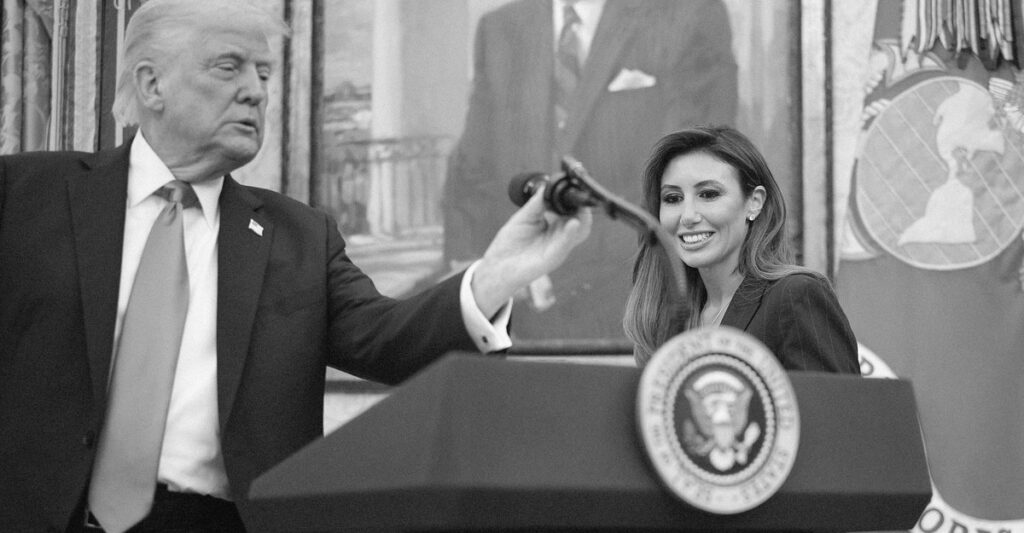
The two most recent rejections came in quick succession over the past two weeks. On Monday, a panel of appeals-court judges upheld a lower court’s ruling that Alina Habba—formerly Trump’s personal lawyer—had no authority to lead the New Jersey U.S. Attorney’s Office. The Monday before that, a district judge in the Eastern District of Virginia ruled that Lindsey Halligan—also formerly Trump’s personal lawyer—had likewise been unlawfully slotted into the job of chief prosecutor at the U.S. Attorney’s Office there.
The specifics of these legal disputes are dry and hypertechnical. But the chaos crystallizes Trump’s disregard for rules, distaste for professionalism, and obsessive need to turn the regular work of government into an engine of personal advantage. The U.S. attorneys who head these offices, scattered across 94 federal districts, take the lead in enforcing federal law around the country. For that reason, these illegal appointees are central to Trump’s effort to use the Justice Department as a political tool: Without any Senate oversight, the president granted them the authority to harass his enemies. In this way, Trump has contorted an appointments process meant to restrain his power into a means of maximizing it.
Between Habba and Halligan, the latter’s disqualification from the job makes for a splashier news story. Appointed to the role as part of Trump’s push for vengeance against his political enemies, Halligan briskly secured indictments against former FBI Director James Comey and New York Attorney General Letitia James—both of which the court has since tossed out, on the reasoning that Halligan had no authority to bring those charges in the first place. The Justice Department will now have to decide whether and how to navigate the thicket of legal quandaries required to press forward with the president’s revenge quest. (Yesterday, a different prosecutor on Halligan’s team reportedly failed to convince a grand jury to re-indict James.)
By contrast, the Habba ruling—which came from a district judge in August—has yet to result in any prosecutions actually being thrown out. Even so, the legal uncertainty around her role led to paralysis and confusion in the New Jersey’s federal courts. Two other courts have disqualified lead prosecutors in Nevada and Los Angeles, and two more are weighing similar challenges in New Mexico and Albany, New York. Other districts might face similar challenges; Democratic Senator Chris Coons has suggested that the U.S. attorney in his state of Delaware is “probably” serving illegally.
The legal rules that Trump is abusing are so complicated that multiple judges have resorted to bullet points and spreadsheets to explain how the president violated them. It’s perhaps easier to understand how things should work, and, by extension, how Trump’s evasions are setting that balance askew.
As he does with other Senate-confirmed officials, the president nominates candidates to lead U.S. Attorney’s Offices, whom the Senate can then confirm or reject. Alexander Hamilton reasoned in The Federalist Papers that this process “would tend greatly to preventing the appointment of unfit characters” within the executive branch. The president will be less likely to put forward candidates qualified only by his own “favoritism,” Hamilton argued, given the prospect of embarrassment before an unimpressed Senate. Likewise, senators can use the confirmation process as a means of extracting information from the nominee and securing commitments—ensuring that officials are accountable not just to the president but also to another branch of government as well.
That’s the Schoolhouse Rock version of events. Practically speaking, this does not always happen with the speed that presidents, senators, and nominees would like. The top job can be left vacant—sometimes for lengthy stretches—either because a president can’t decide who should fill the role or because the Senate hasn’t had a chance to approve a nominee yet. For this reason, Congress has established alternative means of temporarily filling these positions, which allow another prosecutor to step into the role as either an “acting” or an “interim” U.S. attorney. (The fact that these similar but not identical titles describe similar but not identical routes to filling the office only adds to the difficulty of parsing the relevant laws.) It’s not unusual, for example, that a career Justice Department official will step up when the Senate-confirmed prosecutor leaves at the end of a presidential term, minding the shop until the new president can get around to nominating somebody. Anne Joseph O’Connell, a Stanford law professor and an expert in these temporary appointments, describes this legal structure as attempting a “balance between accountability and workability.”
Trump chafed against the confirmation process during his first four years in office, relying heavily on acting officials across government: “I like acting,” he said in 2019. “It gives me more flexibility.” This time around, Republicans in the chamber have proved willing to rubber-stamp nominees obviously lacking in qualifications. Witness the antics of Trump’s Senate-confirmed Cabinet members such as Defense Secretary Pete Hegseth and FBI Director Kash Patel. But much to Trump’s fury, Republican Senator Chuck Grassley, who chairs the Judiciary Committee, continues to recognize so-called blue slips for U.S. attorney nominees. Under this system, senators from the state where a nominee’s new office will be located gain veto power over potential appointments.
Trump has therefore been limited in his ability to appoint MAGA prosecutors in the Democratic states through the normal confirmation process. That’s a significant problem for his revenge campaign, given that the targets of his ire largely live and work in those blue states and are most easily prosecuted in them. To work around this, he and Attorney General Pam Bondi have exploited the silences and ambiguities of the system for installing temporary appointees, cobbling together questionable legal mechanisms for extending those appointments well past their expiration date.
For months, this strategy of extending temporary appointments produced results that Trump could be happy with. In New Jersey, Habba oversaw charges against Newark’s Democratic Mayor Ras Baraka and Democratic Representative LaMonica McIver following a scuffle at an immigration detention center. (The charges against Baraka were rapidly dismissed; McIver is seeking to have her case thrown out.) In New York, the temporary U.S. Attorney John Sarcone subpoenaed Letitia James’s office over her past investigations into Trump and the National Rifle Association. The other prosecutors who would soon be questioned in court have, variously, urged the FBI to investigate supposed anti-Trump conspiracies, clashed with judges, and aggressively prosecuted anti-ICE protesters.
[Read: The Trump administration’s favorite tool for criminalizing dissent]
Then the judiciary stepped in. Habba was the first prosecutor to face judicial skepticism. District Judge Matthew Brann ruled her appointment illegal in late August, holding that she had been serving unlawfully since July 1. Over the next two months, judges in Nevada and the Central District of California likewise ruled against the administration, disqualifying the U.S. attorneys serving in those districts. Other challenges to the U.S. attorneys in New Mexico and the Northern District of New York were also percolating. In Albany, James challenged the subpoenas sent by Sarcone on the grounds that his original temporary appointment expired in mid-July.
Perhaps, in the midst of this chaos, the administration should have been more careful when it used a similar mechanism to appoint Halligan as the head prosecutor in the Eastern District of Virginia. But doing so was necessary to satisfy Trump’s desire for retribution. After Halligan’s predecessor, Erik Siebert, reportedly refused to move forward with spurious prosecutions of Comey and James, Trump pushed him out and installed Halligan, who promptly brought the charges that Siebert had refused. (Siebert had garnered the approval of Virginia’s two Democratic senators, a fact the president pointed to when calling for his dismissal.) According to Judge Cameron McGowen Currie, who last week found Halligan’s appointment illegal, Halligan is distinguished by having served illegally from the very beginning of her time in the Eastern District of Virginia, thanks to the Justice Department’s decision to put her into her role as a backfill for Siebert. (This is distinct from the other prosecutors, who were reappointed to extend their own tenure.)
Although four district judges have now deemed the administration’s machinations illegal, the Third Circuit is the first appeals court to consider the array of legal questions raised by Trump’s approach. The fact that a higher court so resoundingly—and unanimously—rejected the government’s arguments is a serious blow to the president. The opinion is technical and reserved, but definitive: “Habba is not the Acting U.S. Attorney for the District of New Jersey.” The state’s two Democratic senators, who had initially objected to Habba’s appointment, took a victory lap, announcing, “U.S. Attorneys must be independent and installed consistent with the rule of law, not because of their political loyalty or through political maneuvering.”
After Habba’s original disqualification, in August, the Justice Department responded pugnaciously. Bondi decried “activist judicial attacks,” and Habba insisted on Fox that she was the “pick of the president.” But the administration has been a great deal quieter following the appeals court’s ruling. It will now have to decide whether to simply let Habba go, or fight it out by asking the Third Circuit to reconsider or appealing directly to the Supreme Court—or, perhaps, choosing to wait and see how other courts handle these questions. In February, the U.S. Court of Appeals for the Ninth Circuit will consider whether Nevada’s U.S. attorney is serving legally. Yesterday, a district court in the Northern District of New York heard arguments in Letitia James’s challenge to John Sarcone’s appointment.
Trump rarely likes to abandon a fight. But the benefit of his appointments strategy, weighed against the headaches it has created for the government, may have finally tipped over in the wrong direction. The Justice Department did not return a request for comment on whether it plans to battle the Third Circuit’s ruling on Habba. As for Halligan, White House Press Secretary Karoline Leavitt initially said that the administration would fight to keep the former insurance lawyer in her current post. Halligan was “legally appointed,” Leavitt insisted, and “extremely qualified.” A week and a half later, however, the Justice Department has yet to file an appeal.
The post The Trump Lawyer Scandal Is About Something Much Deeper Than Legal Technicalities appeared first on The Atlantic.