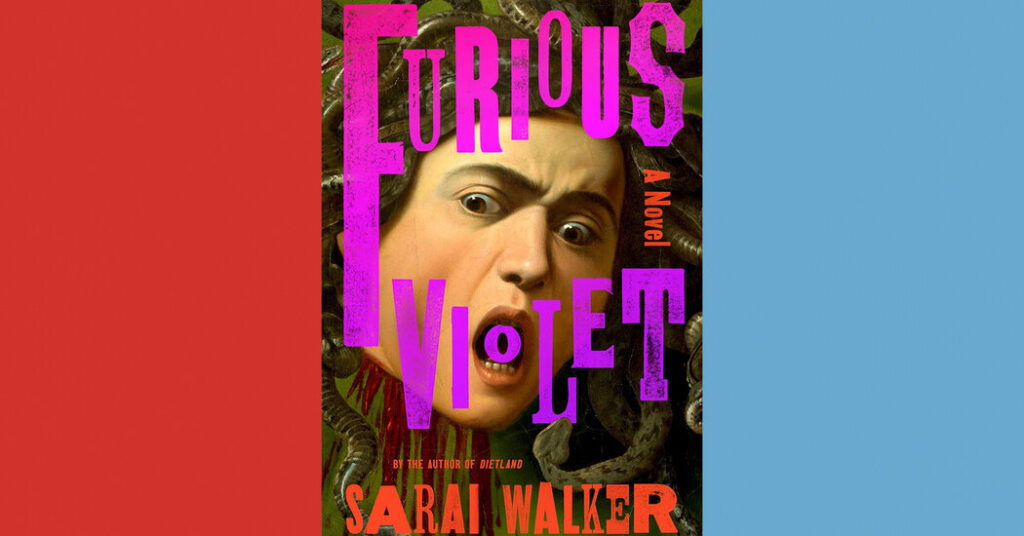
FURIOUS VIOLET, by Sarai Walker
“Hello Mother.”
Who knew these two words could be so unsettling? When a childless (and motherless) true crime writer reads them in an anonymous note left on her windshield, they unleash a terror that preys on her rawest emotional wounds. Sarai Walker’s new thriller, “Furious Violet,” follows the woman as she races to figure out who is behind the message — and tries to stay alive.
Violet West Shelley, who goes by West, is doing research for her next book about a serial killer in the 1970s and ’80s who called out for his mother immediately after his crimes (“I don’t want to do these things, Mommy”). She’s also dreading the 50th anniversary of her own mother’s suicide, which occurred just a few months after West was born.
“I was a child who never had a mother, and then I became a woman who never had a child, and there was a symmetry there that made sense to me,” West explains, reasonably. Yet the subjects of motherhood and daughterhood remain fraught. No wonder she keeps a gun hidden in a diaper bag.
West’s mother, Juliet, was a volatile writer who assumed mythic status, “one notch below Emily Dickinson in the pantheon of dead American lady poets.” She bears more than a passing resemblance to Sylvia Plath, particularly in the themes of her work and in the cultish devotion of her fans.
It’s a complicated inheritance. Juliet’s devotees make life miserable for West, and fetishize her flesh-and-blood link to their idol while finding her wholly unworthy of the connection. “I was not the lithe blonde my mom had been, I didn’t have a big fabulous brain like she had,” West thinks. “I had an ordinary brain that churned out books about murder in the suburbs.”
She’s already been bracing for an onslaught of attention from her mother’s fans because of the anniversary, anticipating them arguing over Juliet’s legacy “like children fighting over a doll.” And then comes her stalker.
Might a Juliet obsessive be sending West these threatening missives? Or the serial killer she’s researching? Having reached the “God Tier level of true crime writing,” West has a good handle on criminal pathology, but she’s lucky to count a hacker, a linguist and a retired F.B.I. agent among her friends as she scrambles to solve the mystery.
Walker packs quite a bit of feminist commentary into the novel, along with pure, unadulterated adrenaline. West loves life on the road, self-medicates with three Advils, a Tylenol and vast quantities of Mountain Dew, and is self-sufficient to a fault. No model of womanhood seems able to accommodate her: not the brainy, tortured poet typified by Juliet, nor the classic female archetypes of maiden, mother or crone.
Like Walker’s previous novels, “The Cherry Robbers” and “Dietland,” “Furious Violet” is attuned to people on the margins: West herself, but also the subjects she chooses to cover. As a middle-aged, single woman on the brink of menopause, West fits the profile of someone whom society (and contemporary literature) tends to overlook. Sardonic and self-aware, she also takes genuine pleasure in food, the junkier the better — yet another rarity in recent fiction. Looking for a brief respite, she pulls into the parking lot of a natural foods grocery, “a place no one would ever think to look for me.” That’s the mind of a true crime writer, and someone who’s logged countless hours of therapy, at work.
Despite West’s self-deprecating quip that “I was simply roadkill on the feminist literary criticism superhighway,” the novel has lofty ambitions, taking aim at the gendered assumptions around motherhood and aging, the perils of celebrity, the true crime industrial complex. Sometimes these topics crowd out the central mystery. But as a psychological portrait and an occasion for literary sleuthing, “Furious Violet” is outrageously entertaining.
FURIOUS VIOLET | By Sarai Walker | Harper | 340 pp. | $30
The post A True-Crime Writer Becomes a True-Crime Victim appeared first on New York Times.