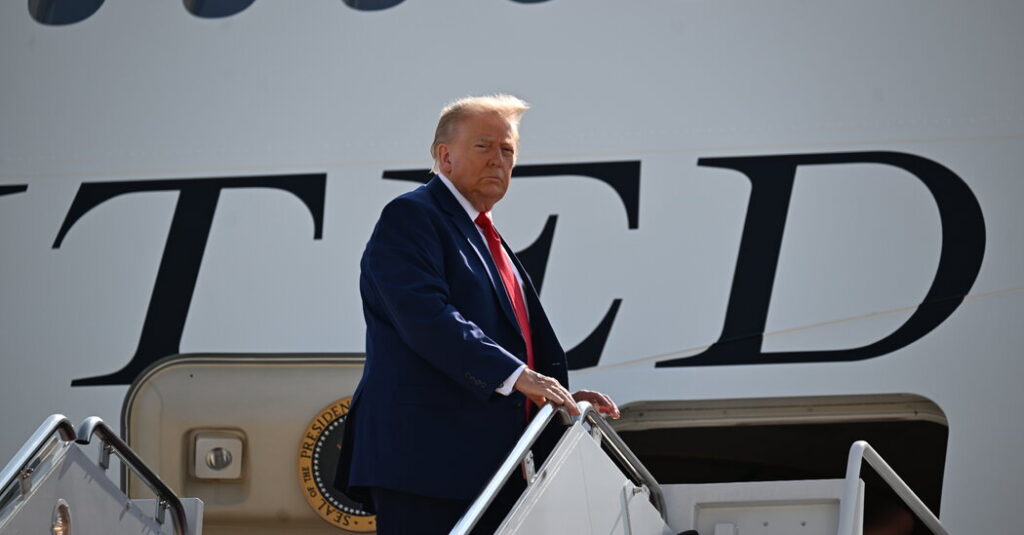
President Trump has set aside, at least for now, plans to sharply escalate the American military assault against Iran, with particular concern that intensifying the war could dangerously drain the Pentagon’s already diminished stockpile of Patriot antimissile interceptors and other air defense munitions in the Middle East.
The threat to interceptor stockpiles is one of many considerations that has made a return to major combat operations a hugely risky endeavor, administration officials say. Mr. Trump and his top aides are also uneasy about the prospect of a widening war in the Middle East, the alienation of key Gulf allies who are vulnerable to Iranian attack, a global economic crunch, and growing energy and refugee crises.
The latest turn in Mr. Trump’s handling of the conflict with Iran came after a meeting on Friday with top advisers and senior members of his cabinet, according to two people briefed on the discussion.
The private deliberations have focused on the Pentagon’s shrinking inventory of Patriot interceptors and other air defenses, the officials said, discussing operational matters on the condition of anonymity. Three U.S. soldiers in Jordan were killed last Friday when a ballistic missile slipped through American air defenses fending off a barrage of Iranian missiles and drones, a senior U.S. official said.
Gen. Dan Caine, the chairman of the Joint Chiefs of Staff, has cautioned privately that resuming major combat operations against Iran was doable but that it would dangerously deplete interceptors available to the military’s Central Command, which is responsible for operations in the Middle East, the officials said. A spokesman for General Caine declined to comment on advice the general gives the president.
Steven Cheung, the White House communications director, said that the president has “always been consistent in saying he prefers a diplomatic solution, but he continues to retain all options if Iran continues terrorist activities in the Straight of Hormuz or against allies.” He added that after enduring crippling sanctions and repeated strikes, “it would be wise for Iran to work towards a negotiated deal; otherwise, they know what will happen.”
Mr. Trump has been wrestling with how to proceed in his nearly five-month war against Iran and specifically with how to reopen the Strait of Hormuz, as gas prices climb again amid the resumption of hostilities over the past two weeks. Diplomacy has broken down, and the latest round of extensive U.S. attacks do not seem to have deterred Iran militarily.
Few if any in Mr. Trump’s inner circle believed the plan to escalate was wise, said the two people briefed. One senior U.S. official, who also spoke on the condition of anonymity, expressed doubts that resuming major combat operations would drive Iran back to the bargaining table.
The official said the strikes have the opposite effect of what is intended, keeping Iran cohesive and allowing Iranian leaders to focus attention on an external threat.
Fighting between the United States and Iran appeared to abate for the first time in two weeks on Saturday, but tensions remained high as hostilities flared between Saudi-backed forces and Iran-aligned Houthis in Yemen. After 13 straight nights of attacks on Iran, U.S. forces did not announce any overnight strikes on Saturday.
Going into Friday’s meeting, Mr. Trump had indicated that the military was ready to carry out heavier assaults if ordered to do so even while leaving open the door to a diplomatic solution.
“Look, we’re locked and loaded,” Mr. Trump told reporters on Friday afternoon. “We’re ready to go, but we’re talking to them, so maybe there will be, maybe there won’t be a tipping point.”
The meeting on Friday took place as Mr. Trump faces a potential inflection point in his approach to Iran, after the collapse of a fragile cease-fire and a memorandum of understanding that was intended to bring the United States and Iran back to the negotiating table for a longer-term denuclearization.
Several Pentagon officials and U.S. military commanders said earlier this week that Mr. Trump seemed to be leaning toward approving an initial phase of a multistage bombing campaign. The campaign would counter coastal radars, anti-ship missile launchers and a fleet of small Iranian attack boats and other sites that the Pentagon says have contributed to attacks on commercial ships transiting the strait.
The Pentagon rushed more forces, weaponry and supplies to the Middle East in recent days to prepare for any escalation. The military has also damaged or destroyed an increasing number of railway bridges that civilians use but that also enable Iranian commanders to flow supplies to the southern coastal region near the strait. Increased attacks on those kinds of targets, as well as energy facilities and Iran’s nuclear sites, including Pickaxe Mountain, were also under consideration.
Mr. Trump previewed some of his discussions in an interview with Axios on Thursday, saying: “I am considering a massive attack. Bigger than ever before. I am close to making a decision. We are all set for it.”
But by late Friday, Mr. Trump appeared to temporarily put aside the bigger bombing plans, apparently persuaded, at least in part, by his military advisers’ assessment of dwindling supplies of munitions to defend American troops in Jordan, Kuwait, Bahrain and the United Arab Emirates, whose bases there have come under heavy Iranian fire in the past two weeks. A major attack would most likely have drawn a heavier Iranian retaliation, putting more pressure on U.S. air defenses.
In late April, The New York Times reported that the Pentagon had used more than 1,200 Patriot interceptor missiles in the war, at more than $4 million apiece, leaving inventories worrisomely low, according to internal Defense Department estimates and congressional officials. The situation has worsened since then, military officials said this week.
Instead, many of Mr. Trump’s advisers, including Jared Kushner, his son-in-law, say there is a plausible alternative pathway with less risk: continuing negotiations and economic pressure on Iran over a longer period of time.
It is unclear what negotiations, if any, are underway and whether any talks could overcome the apparent internal rifts in Iran’s government over whether to pursue a deal.
The recently reimposed U.S. naval blockade of ships trying to enter or leave Iranian ports has had mixed results, analysts say. The Iranians were able to resume some oil deliveries after the memorandum of understanding was signed in mid-June, mainly to China, U.S. officials said. Much of that oil is just now being delivered, so it will take time to restart the economic squeeze.
Treasury Secretary Scott Bessent said on Tuesday that China has reduced its crude oil purchases by approximately 40 percent in recent months, a decline he said was significantly reducing Iran’s oil revenues.
On Friday, the Treasury Department imposed sanctions against nine firms and four people in the business network of the Iranian financier Babak Zanjani, who is under sanctions
David E. Sanger contributed reporting.
The post Trump Holds Off on Major Escalation Against Iran as Advisers Raise Concerns appeared first on New York Times.