When my son, Daniel, was 6 years old, he joined the Cub Scouts, and my husband and I became his den leaders. I watched older scouts mentor younger ones and children develop a particular kind of confidence — not the kind that comes from being praised but the kind that comes from being cold and wet and figuring it out anyway.
At the same time, I was leading my 8-year-old daughter’s Girl Scout troop. Girl Scouts is a fine organization with a meaningful history, and the volunteers I served alongside were as devoted as any I have known. But the two programs, as we experienced them, were built differently: My daughter’s troop introduced the girls to the world, while my son’s pack asked the boys to develop skills and test themselves within it.
The girls visited nursing-home residents, toured a bank and took cooking classes. The boys tied knots, identified plants and built fires. Those were small things at the time. But they became the groundwork for what came later: portaging a canoe across an island or sleeping in a tent as the temperature dropped into the 20s and the tent poles froze solid.
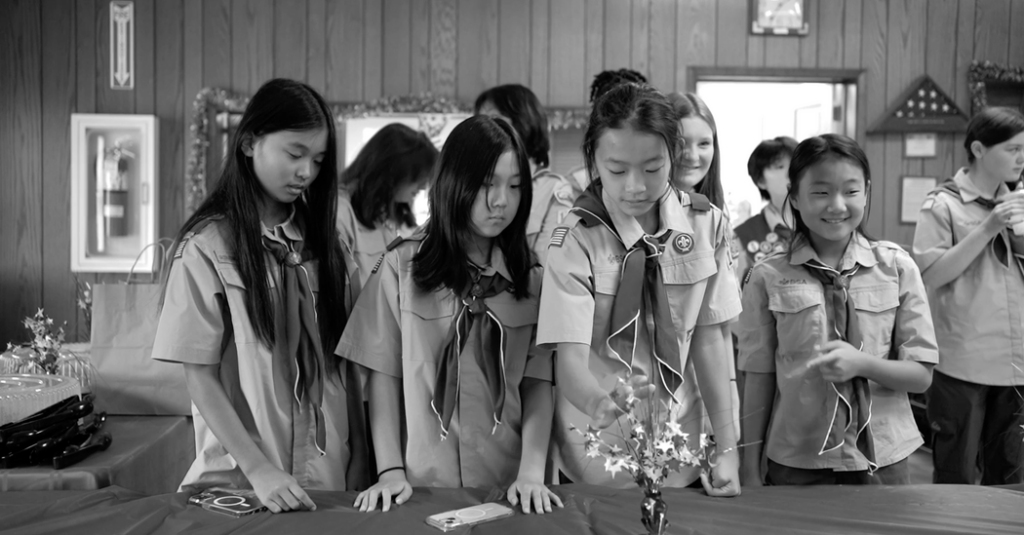
When the Boy Scouts of America voted in 2017 to welcome girls into its core programs, I described Cub Scouts to my Girl Scout troop of 10 girls. Seven of them made the switch and have never looked back.
The first night of our first canoe trip through the lakes of the Adirondacks, I sent five 12-year-old girls into the woods to gather firewood. My co-leader and I waited. And waited. Forty-five minutes later, the kids emerged from the trees, beaming and proud, each holding one stick. (At the time, troops were single-gender; now they can be coed. The organization has also changed its name to Scouting America.)
Our teenage guides surveyed the pile of wood and delivered their verdict: You’re going to need a lot more than that if you want to eat dinner. Off the girls went again. After another 45 minutes, they returned with two sticks each.
We ate a very small dinner that night, but something larger had begun.
What followed were years of what scouts often call Type 2 fun, the kind that is genuinely miserable while it’s happening but becomes a story you tell for the rest of your life. There was a week of sweltering heat in New Jersey’s Pine Barrens when we were backpacking, canoeing and biking nearly 60 miles over four days. On this trip I — the adult and scoutmaster — wanted to quit. I actually called base camp to ask if someone could come and replace me. My girls would not let me leave, and we finished together.
There was the canoe trek through the Adirondacks, where we paddled into headwinds that turned a three-hour crossing into seven exhausting hours. One girl climbed out of the water with a leech on her leg and kept going.
There was also a backpacking trek at the pinnacle of scouting’s high adventure bases, Philmont Scout Ranch in New Mexico, for which we trained for a year to carry 50-pound packs at elevation.
When an adult leader was struggling on this trip, the girls did not hesitate — each one added items from the leader’s backpack into her own so that we could all continue on, as one strong group. One night, we didn’t get into our campsite until 11 p.m., but the girls chose to wake at 2 a.m. so we could hike along a four-mile ridge to see the sunrise from a stunning rock face called the Tooth of Time.
This is what outdoor adventure scouting builds. The girls learned that you can survive discomfort and push through fear and that a group of people struggling together through something hard can become a family.
Our daughter Evelyn is now one of those people. Her early treks revealed grit and determination. But over time, something else emerged as she began lifting others — if you’ll allow me a moment to be the proud mom. At Philmont, on a night when the physical demands were at their most grueling and team morale began to slip, she quietly took on other people’s duties and steadied the group. It was one night among many, and she was one of several who carried the crew. It was also the night I saw the leader she was becoming.
Last year she became the first female Eagle Scout in the history of our town, Demarest, N.J. Eagle Scout is not a participation award. Only about 5 percent of scouts ever reach it. It requires sustained leadership, community service and the development of a project of civic consequence.
I wish I could say the path for my troop was only as hard as cold nights and long miles. It wasn’t. Our girls were sometimes treated as intruders. They have been catcalled by boys in other troops and told by parents that they were invading a space where boys should be able to be boys. I agree that some boyish mischief is harmless and sometimes funny. But scouting is supposed to teach respect, responsibility and self-command. Excusing disrespect does not protect boys; it lowers the standard for them.
We did not build the troop around objections. We kept camping, training, leading and advancing. Over six years, the girls answered the criticism the most persuasive way they could: by doing the work.
The more serious challenge is a chorus — echoed at the national level — claiming that scouting has lost its way and that it should be a space just for boys. I have also heard the argument that because girls tend to mature faster, putting them alongside boys is somehow unfair to the boys. That their competence crowds out male opportunity. But the logic that a girl’s excellence is a threat to a boy’s development has nothing to do with fairness. It only protects mediocrity.
What I know from six years of leading Troop 163 is that these girls invigorate scouting rather than weaken it. They have modeled, for the boys and girls in neighboring troops, what it looks like to earn your rank without shortcuts.
These young women will grow up to be doctors, engineers, leaders, colleagues. The boys in scouting will grow up alongside them, and some of those boys will one day work with them and for them. Teaching our children to struggle and achieve together is not a social experiment. It means we are preparing them for the real world.
My mother came to the United States from Korea and opened an OB-GYN practice at a time when female physicians were often treated as though they did not belong. She raised three daughters and built her career anyway. She didn’t wait for permission for any of this. By her example, we learned that institutions change when people show up, do the work and refuse to be diminished.
My daughter learned the same lesson from carrying a canoe over her head, gathering enough firewood — the third time — and earning, one skill and one merit badge at a time, a rank that once wasn’t meant for her.
Erica Song is an OB-GYN and a scout leader.
The Times is committed to publishing a diversity of letters to the editor. We’d like to hear what you think about this or any of our articles. Here are some tips. And here’s our email: [email protected].
Follow The New York Times Opinion section on Facebook, Instagram, TikTok, Bluesky, WhatsApp and Threads.
The post The Boy Scouts Let in Girls Almost a Decade Ago. It’s Been a Triumph. appeared first on New York Times.