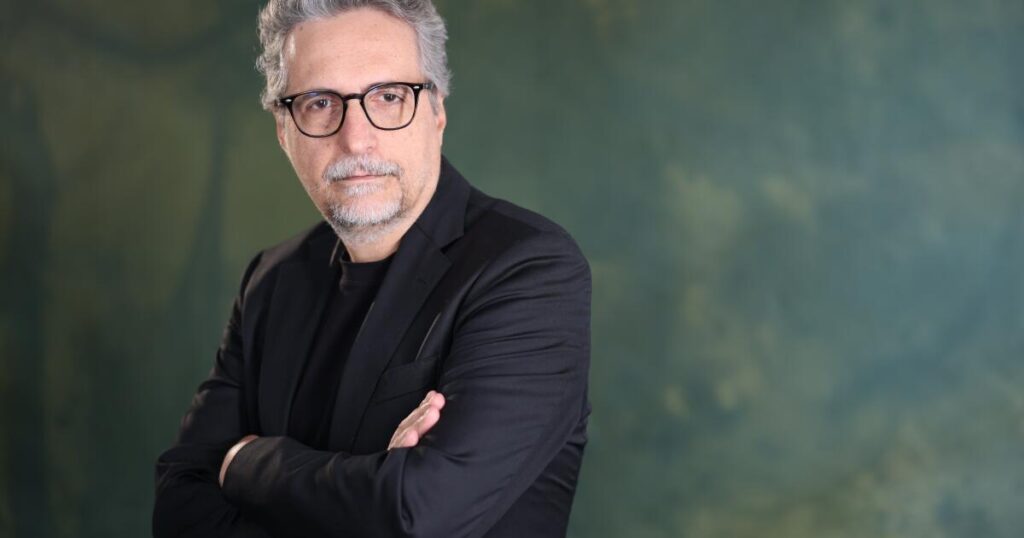
Brazilian filmmaker and die-hard cineaste Kleber Mendonça Filho relies on a certain creative method. “I will go wherever my thoughts are taking me,” he said recently over coffee at a West Hollywood hotel. “And hopefully it will make sense to you,” he adds with a laugh. But he’s serious. “It’s really the pleasure of adding ideas to other ideas, making free associations.”
That’s how the research for his previous film, the essay documentary “Pictures of Ghosts,” which centered on memories personal and cinematic of his eclectic hometown of Recife, led to “The Secret Agent,” his Cannes-awarded thriller starring Wagner Moura. Set in 1977, during Brazil’s dictatorship, and against the backdrop of the country’s riotous Carnival, it rests on a classic narrative in which Moura’s widowed researcher Marcelo hides from hired killers while conducting his own private inquiry. But at heart it’s a sinuous expression of its writer-director’s notions about people, movies, places and the past.
A hero doesn’t need a weapon, just Wagner Moura playing him.
Mendonça Filho has seen nearly everything his accomplished countryman has made, but knew there was something still to be tapped. “Many of his roles are proactive,” he says. “I wanted a classic hero in a different way. Not carrying a gun. Weighing his options. Able to love. Able to show hatred. It made me think of Roger Thornhill in ‘North by Northwest.’ He doesn’t know what is going on, but he’s compelling and easy to identify with. So I needed Wagner’s command of the screen, how the camera loves him, to see him thinking and emoting not in an overt way. It was a challenge, and when we make films, we are looking for challenges.”
A refugee house in 1977 can mirror the recent past.
Mendonça Filho had long heard of houses like the one in which Marcelo hides out, unassuming sanctuaries that shielded people from the dictatorship’s reach. But he was also inspired by how people came together during COVID-19. “With a government that was uncooperative, unresponsive, and people worrying to death, we found ourselves getting together with people we loved, drinking, talking, sometimes doing tests together, and it felt good,” he says. “So that was the emotional basis to go with the historic basis. Then, in this wonderful coincidence, the building we used was a halfway house in the 1960s for people about to leave the country with fake papers. Recife has an interesting political vibe. It’s always been called the commie city of Brazil.”
Movie theaters were always safe spaces too.
A key clandestine meeting in “The Secret Agent” happens at the São Luiz, a beloved Recife movie house from Mendonça Filho’s childhood. The location was intentional. “The movie theater is an intimate place,” he says. “It can be a thousand seats, but you and a date are close together. I have also met friends in movie theaters to talk about a problem they’re having, almost like two spies meeting to exchange information in the back of a cinema.” But his screenplay’s private encounter between Marcelo and a resistance figure named Elza (Maria Fernanda Cândido) happens not with the paying customers, but in a ’50s-era furnished apartment behind the São Luiz’s projection booth, a lair that Mendonça Filho first saw on a tour of the theater in 1989. “It was set up for technicians from Rio who worked in the cinema, and it felt like a secret place. I never forgot it. And it has one of the city’s best views, which is in the film.”
Because a movie suffers without a sense of place.
“I find it impossible to dissociate a conversation I’m having from the place we’re having it,” says Mendonça Filho, who can turn the rudimentary action of characters getting into a car and driving away into an epic-seeming shot. “It’s what makes a good story. If you’re on a New York street, even if it’s brief, you should know where you are. Give it context.” On a period film like “The Secret Agent,” that might mean extra work shutting down a block, getting the right cars, dressing extras, but for Mendonça Filho, it’s worth it. “It’s a challenge, and if there are modern elements, you’ll be deleting them in postproduction. It’s why people do [title cards] like ‘Los Angeles, 1974.’ But you should see the street the way in my mind you should see it. Show me!”
Cinema is a timekeeper.
Mendonça Filho’s awareness of the military regime as a child is that of a young cinephile’s: What was he kept from seeing? “I remember marching every Friday in school like little soldiers, but it was a lot of talk of films and censorship. ‘A Clockwork Orange’ was banned by the military, and finally released in 1977 in Brazil, but with little black dots following the actors’ genitalia. So my connection with the military was through cinema.” And since “The Omen” was released during Carnival in 1977 — something the director noticed poring through old newspapers — that horror classic is what’s showing at the São Luiz. The audience’s screams even make their way onto the tape Elza records of Marcelo in that apartment, which is then heard again in a flash-forward scene by a young female historian: a movie moment reaching across the generations. “I liked the idea that the girl in the future reacts to the screaming [from the theater]. I just have this connection with time and cinema. Film is my timeline.”
The post The 5 rules that guided the making of ‘The Secret Agent,’ according to its director appeared first on Los Angeles Times.