We Want So Much to Be Ourselves
by Stephen O’Connor
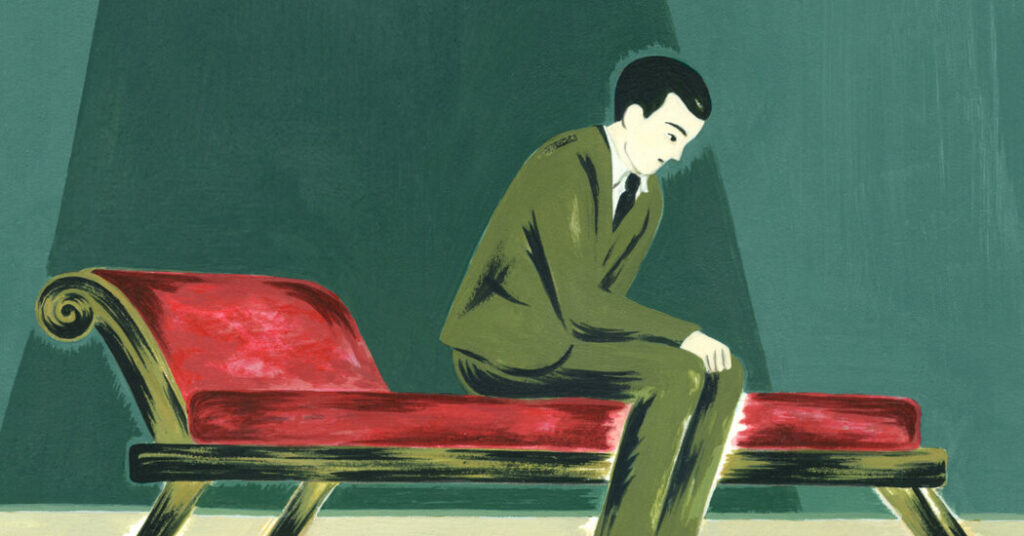
If psychoanalysis, “at its most basic level, might be defined as a way to help people to stop lying to themselves,” what happens when it’s practiced in a nation built on lies? That’s just one of the provocative questions raised in WE WANT SO MUCH TO BE OURSELVES (Bellevue Literary Press, 495 pp., paperback, $18.99), in which a protégé of Sigmund Freud finds himself toiling at the Berlin Psychoanalytic Institute as the Nazis consolidate their hold over Germany. Günter Zeitz, a scholarly Gentile proponent of “the Jewish science,” watches its principles being steadily eroded, turned into “soul medicine” for Aryans. And then he’s asked to treat a self-destructive young soldier who happens to be Hermann Göring’s nephew.
Well before he reaches this professional crisis, Günter must cope with the personal trauma inflicted by his increasingly unstable wife, whose violent compulsions are almost as perilous as her inability to acknowledge the danger she faces as a Jew in an ever more hostile country. When she runs away, taking their daughter with her, he’s unable to protect them — unable, sometimes, even to know where they are.
Deftly setting Günter’s ordeal against the pathological ethos of the society around him, O’Connor explores our notions of sacrifice, decency and complicity, ending with a painful postwar reckoning. Those who survive are, of course, irrevocably changed, and even for those who only learn of the Reich’s horrors secondhand, its reality “is like a corpse that won’t stay buried.”
The Daffodil Days
by Helen Bain
Bain’s wonderfully accomplished novel, THE DAFFODIL DAYS (Scribner, 286 pp., $28), takes place mostly in a small Devonshire village, mostly in 1962, and mostly from the perspective of local people observing two newly arrived “incomers.” The couple in question? Ted Hughes and Sylvia Plath. At the time, Hughes may have been the literary lion, but it’s Plath who’s the focus here. “North Tawton won’t know what to make of this pair,” observes the land agent who sells them a picturesque thatched house. “Particularly her.”
Inevitably, Plath’s suicide a year later casts its shadow over the observations of her charwoman, the town doctor and a riding instructor. Fascinating details appear in chapters about Plath shopping for a dress, dropping in on a banker’s New Year’s Eve party, and bantering with bell-ringers at the church next door. Interludes devoted to stays by her mother and brother are spliced among others featuring members of her London circle, during and after awkward rural drop-ins. There’s even a section devoted to the man who shows Plath how to use her fancy new washing machine, much commented upon by the locals.
What emerges is a kaleidoscopic yet nuanced portrait of an insecure, ambitious perfectionist, a writer whose hypersensitivity is both the source of her talent and her fatal flaw.
Daughters of the Sun and Moon
by Lisa See
In 1870, San Francisco is a bustling metropolis, linked by rail with New York, but Los Angeles is “just a little pueblo of 5,000 inhabitants,” including a small population of Chinese immigrants. It’s not too small, though, to be the site of one of the largest mass lynchings in American history, as depicted in See’s latest novel, DAUGHTERS OF THE SUN AND MOON (Scribner, 363 pp., $29). She presents this gruesome historical event through the experiences of three Chinese women whose lives will be changed — and intertwined — by the violence that descends on their community.
Dove is a teenager who’s been shipped across the Pacific to become the second wife of a wealthy merchant, “a prize on display,” with her lovely face and tiny bound feet. Moon is the clever, knowledgeable wife of a practitioner of traditional Chinese medicine, a helpmeet who bridges the gulf between her world and that of the Anglos around them. Petal, sold off by her impoverished family, is a prostitute in a Chinese gangster’s “bawdy house.” Can they survive what comes to be known as the Night of Horrors? That will depend on the strength of their unlikely friendship — and a certain amount of good luck.
Cages
by Chantel Acevedo
The title of Acevedo’s CAGES (Europa, 253 pp., $26) has many meanings: the sense of confinement within a marriage, the stigma imposed by certain social norms, the stifled emotions that can isolate a father from his children. Felix is a veterinarian whom we see through the eyes of those he has loved and lost. Central to all their reminiscences is the homosexuality that defined and endangered him.
Cuba in the early 1960s is a place where people like Felix can be imprisoned, sent away to labor camps — or worse. But even after he and his wife, Anabél, escape to London it’s difficult to maintain a sense of equilibrium; although less vicious, British strictures pose their own hazards. Felix and Anabél’s sense of isolation is also deeply rooted in their Cuban identity, in what we’re gradually shown of their lives before and after Castro’s revolution. These expats can’t help being scarred by a time when “cruelty had settled into the island’s bones.”
The post Vibrant New Historical Fiction appeared first on New York Times.