Oil prices briefly topped $100 a barrel. Mortgage rates hit their highest level in nearly a year. The president introduced new tariffs, raising the specter of higher prices on some goods. And cracks appeared in the artificial intelligence boom.
It wasn’t a good week.
Renewed combat operations in the Persian Gulf, coupled with a spate of trade policy announcements, rattled investors and raised questions about the outlook for the U.S. economy, with pivotal congressional elections a little over three months away.
Still, there is little sign of a recession, economists said. First-time unemployment claims stand at their lowest level since 1969. Technology companies continue to pour epic amounts of money into building the infrastructure needed for the AI revolution, which means growing sales for makers of server racks and computer chips, plus blue-collar jobs for the workers who put it all together.
Despite everything, consumer spending, which accounts for 70 percent of the economy, remains solid. But as gasoline prices and borrowing costs rise, and the impact of this year’s abnormally large tax refunds wears off, the ability of the American consumer to keep spending freely will be tested.
“I don’t see growth as being gangbusters. There’s more risk of the economy growing below [its] potential going forward because consumer spending won’t be as strong as it was,” said Neil Dutta, head of economics for Renaissance Macro Research. “We’re sort of at the high-water mark for consumption right around now.”
On Friday, economists from Goldman Sachs joined those expecting the economy to downshift, saying second-half growth is likely to be “softer” than its 2.25 percent estimate for the first six months.
Slower economic growth is the last thing President Donald Trump needs as he tries to help Republicans retain control of Congress. Voters are already in a sour mood. Just 33 percent of Americans approve of the president’s handling of economic policy, according to a Washington Post-Ipsos poll.
The Trump administration scoffs at the doomsayers.
On Wednesday, Treasury Secretary Scott Bessent revved up a crowd in Marietta, Georgia, by boasting about private-sector hiring and the economy’s performance over the past year.
Trump’s trade, energy and tax policies have been “transformative” for the economy, Bessent said at the rally, where the president touted his new eponymous investment accounts for children.
“Our economy has now averaged over 100,000 good-paying private-sector jobs per month for the last four months, and real GDP growth has increased at a rate of 2.7 percent over the past four quarters,” Bessent said.
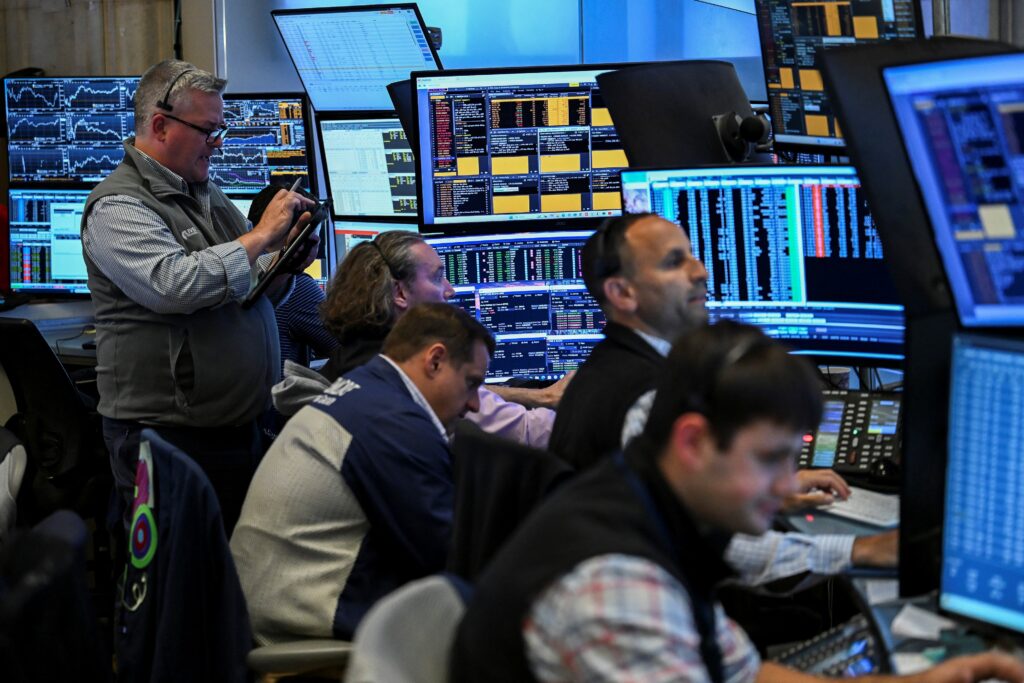
Financial markets, however, have been giving off troubled signs. The S&P 500 index has dipped by more than 2 percent since mid-July, amid renewed volatility in U.S. trade policy. On Friday, Trump threatened new tariffs on European goods in response to the $1 billion fine the European Union imposed on Google for allegedly using its search-engine dominance to undermine competition in other markets.
That was just the latest in a number of recent Trump trade moves, including the imposition one day earlier of new tariffs on 60 economies.
The yield on the 10-year Treasury note, which moves opposite bond prices, reached 4.71 percent Thursday before easing to 4.68 percent Friday, remaining near its highest level since January 2025. The higher yield indicates that investors are demanding a greater return before lending money to the U.S. government.
Bond investors are suddenly sensitive about the enormous amount of borrowing by corporations and the federal government. On Wednesday, when Google parent Alphabet raised its high-end estimate of AI-related investment this year to more than $200 billion, investors knocked 7 percent off the company’s shares in less than 24 hours.
The federal budget deficit of $1.4 trillion through the first nine months of the current fiscal year is also running slightly above that of the same period last year. The added red ink has driven the publicly held national debt to $32 trillion, requiring greater U.S. Treasury borrowing.
“We’re starting to hear about how much this war has cost and how much it’s continuing to cost. Well, where is that going to come from? We’re probably going to have to borrow more. So a national debt that continues to expand,” said Liz Thomas, chief market strategist for SoFi, an online bank.
Adding to the bond market sell-off is investors’ growing belief that the Federal Reserve will raise interest rates to bring inflation under control. As of Friday afternoon, futures traders saw roughly a one-third chance of a hike at the Fed’s July 28-29 meeting and about an 80 percent chance of at least one increase by the conclusion of its Sept. 16 meeting, according to CME FedWatch.
The resumption of daily U.S. bombing runs in Iran, which have caused oil prices to jump, only intensifies the inflation concerns that could prompt the Fed to cool off the economy by raising borrowing costs.
For the Fed, and its new chairman, Kevin Warsh, the problem is that its chief anti-inflation weapon cannot directly address the inflation the country is experiencing. Higher interest rates cannot reverse the effects of Trump’s tariffs or calm the fighting in Iran, which this week sent prices at the pump back above $4 per gallon.
Higher interest rates can cool off an overheating economy. But with employers adding a paltry 57,000 jobs in June, about half of what forecasters expected, there isn’t much sign that the United States overall is actually running hot.
Still, some members of the Fed’s rate-setting committee look at the frenzied AI build-out, which has driven up prices for electronic components, electricity and software, and see a problem that higher rates could remedy. As data centers have proliferated around the nation, prices for some popular applications made by Microsoft and Adobe, for example, have risen by 30 percent to 50 percent, according to a Goldman Sachs analysis released in May.
The Fed’s “hawks” also worry that, judging by the central bank’s preferred metric, inflation is moving in the wrong direction. Excluding volatile food and energy costs, prices are rising at an annual 3.4 percent pace, well above the Fed’s 2 percent target, and up four-tenths of a percentage point since December, Lorie Logan, president of the Federal Reserve Bank of Dallas, said in a speech last week.
Fed policymakers are split. Logan said she wants modestly higher rates now instead of “severe restriction later.” New York Fed President John Williams thinks inflation may have peaked. Warsh refuses to telegraph the Fed’s next move.
The prospect of even greater military escalation in the Persian Gulf is the wild card in any forecast of the economy’s course between now and November.
The president’s inability to bring the nearly five-month war to a close is rattling energy markets, which are responding to the conflict in a more worrisome way than before. The work-arounds that producers, shippers and governments have used to mitigate disruptions are no longer sufficient to avoid dramatic price spikes.
Oil traders who assumed for months that Trump would find a quick end to a conflict that is pushing up gas prices at home are no longer so confident. The physical oil market has been depleted by months of stranded tankers, damaged production facilities and inventory drawdowns.
“Inventories are well below what they would normally be at this point in the summer. It is a little bit scary,” said Denton Cinquegrana, chief oil analyst at Dow Jones Energy.
The U.S.-Iran ceasefire in April delivered consumers some relief at the pump. But that’s over now. After dropping below $4 per gallon, gas prices on Friday averaged $4.10 and could test their 2026 high of $4.55, he said.
Crude prices pushed past $100 per barrel this week, as Yemen’s Iranian-backed Houthi rebels joined the fight by attacking tankers in the Red Sea. Diesel prices were already soaring after war knocked refineries offline in both the Middle East and in Russia, where Ukrainian drones disabled key production facilities. Global markets also lack adequate gasoline refining capacity.
Americans were already struggling to cope with the war’s economic fallout before recent battlefield developments threatened to make it worse. Farmers, for example, spent $1.4 billion more on diesel fuel during this year’s planting season than they did last year, according to a report this week from congressional Democrats.
“If disruptions continue, oil prices are more likely to rise than they were earlier in the conflict,” warned a market update from Rystad Energy on Thursday. “Much of the world’s spare production capacity has already been used, while strategic and commercial inventories are lower than when the war began, leaving the market with fewer buffers against a prolonged supply disruption.”
Andrew Ackerman contributed to this report.
The post Iran war, tariffs raise new risks for a resilient U.S. economy appeared first on Washington Post.