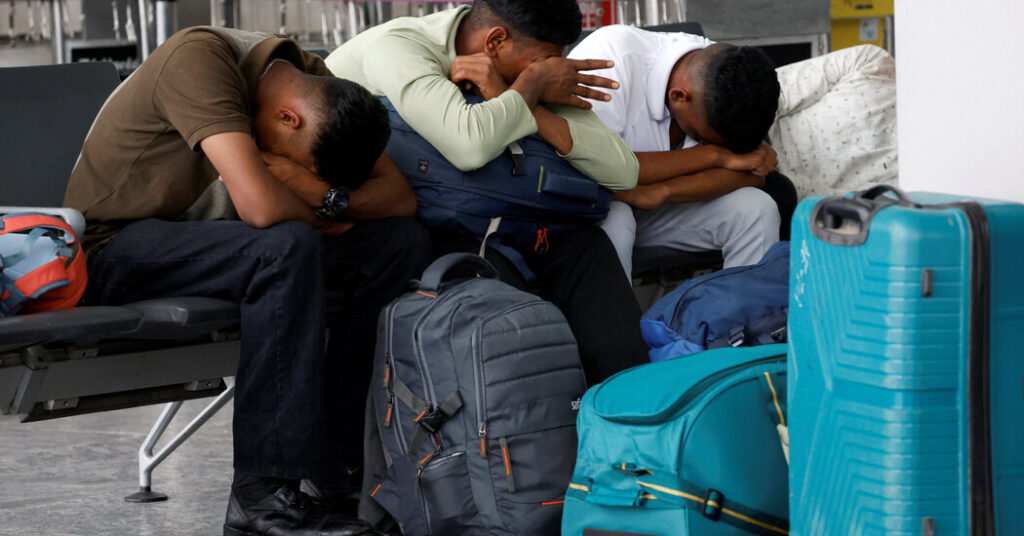
Air traffic across India was thrown off course on Friday after IndiGo, the country’s dominant carrier, canceled hundreds of flights. Thousands of passengers were stranded at airports, unable to make their journeys and struggling to understand what was to blame.
Starting on Tuesday, IndiGo began canceling flights at an unusual rate, citing a lack of crew members. Then on Friday, at midday, it canceled every departure from New Delhi Airport, India’s busiest. About 235 flights were canceled, according to a spokesman for the airport’s owner, with hundreds more cut elsewhere. Industry watchers counted at least 1,000 flight cancellations by the end of the working week.
IndiGo has an undisputed position as India’s biggest airline. It operates around 2,300 flights a day, racking up about 118 million passenger arrivals last year.
On Friday, would-be passengers posted footage of crowds chanting “IndiGo! Shame, shame!” at airports. Mountains of unclaimed luggage were photographed around airports serving New Delhi and other big cities.
Aveen Balakrishnan, a business development manager, was waiting at Ahmedabad’s airport, in western India, for about 20 hours after his scheduled flight home to Bengaluru, in the south, was delayed. He said that he had thought about booking on a competitor, Akasa Air, but noted that doing so would have cost more than taking an international flight.
“Is there no value for our time?” he said in an interview. “Every hour I wait here is an hour of misery.”
Mr. Balakrishnan was eventually seated on the plane but was still waiting on the tarmac two hours later, he noted in a text message.
IndiGo apologized multiple times and released a statement saying that “a multitude of unforeseen operational challenges” were responsible for the disruption, including weather and technological glitches. The airline noted also that new rules requiring more rest time for pilots and flight crew were behind a lot of the trouble.
The Federation of Indian Pilots said that those rules, which were announced almost two years ago and went into effect last month, were not to blame. “All other airlines have provisioned pilots adequately and remain largely unaffected,” the union said in a statement. Instead, it added, the cancellations were “the direct consequence of IndiGo’s prolonged and unorthodox lean manpower strategy.”
The airline and the pilots’ union agree on one thing: There are too few trained personnel to safely fly the vast number of flights that IndiGo operates. Its network has been growing at a frantic pace, running ahead of its ability to hire. The current snarl will persist for a few more days, the company said, but operations could be affected until February.
IndiGo’s stock price was down roughly 9 percent this week.
India’s government, which welcomed the Russian president, Vladimir V. Putin, at New Delhi’s airport on Thursday, was moved to take action. The aviation authority circulated a memo on Friday that withdrew one of the pilots’ rest requirements “in view of the ongoing operational disruptions.”
Calling the move “wrong,” the president of the pilots’ union, C.S. Randhawa, said, “You cannot compromise safety for commercial interest.” The government released a statement later in the afternoon, saying that the decision had been made for those “who rely on timely air travel for essential needs” and denying that the move would jeopardize safety.
India’s aviation sector has been growing by leaps and bounds in recent years, making it a standard-bearer of Prime Minister Narendra Modi’s push to upgrade the country’s infrastructure. The number of airports roughly doubled, from 74 to 157, during his first 10 years in office, according to government figures, and is projected to exceed 200 by 2030.
IndiGo, a scrappy upstart when it was formed in 2006, had captured roughly two-thirds of the booming market as of August, adding 58 aircraft in 2024 alone. Its initial appeal was its sleek but practical style. It cut costs, like other low-cost carriers, while staying focused on punctuality and reliability.
Air India, the country’s flagship carrier, has about a quarter of the local market. It was privatized by the Tata Group, one of India’s most prominent conglomerates, in 2022, and merged with two newer airlines soon after. Its turnaround has been slowed by a number of challenges, including the still unexplained crash in June of a jumbo jet bound for London.
Alex Travelli is a correspondent based in New Delhi, writing about business and economic developments in India and the rest of South Asia.
The post India’s Biggest Airline Falls Into Chaos, Canceling About 1,000 Flights appeared first on New York Times.