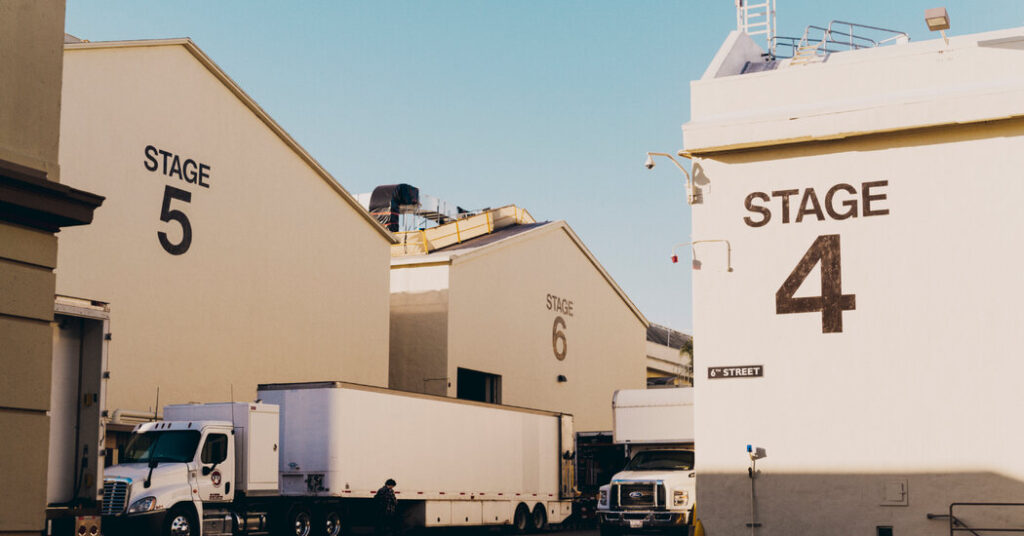
Paramount said on Friday that it had agreed to halt its merger with Warner Bros. Discovery until next June at the latest while a judge considers a lawsuit from state attorneys general who sued to block the deal. The delay is the latest curveball in a deal that would remake Hollywood.
In a legal filing, Paramount and the state attorneys general said that they had reached an agreement to freeze the $111 billion merger while the case works its way through court, extending a shorter pause imposed this week by a federal judge in California. The merger agreement expires on June 4, 2027, if the deal has not closed by that date.
The delay could be costly for Paramount. The company, run by the tech scion David Ellison, has agreed to pay Warner Bros. Discovery shareholders a fee of $650 million for every quarter that the deal does not close, beginning in October.
But Paramount framed the agreement as a “significant win” that would help it close the deal. The company said the move would speed up the legal process by pushing the case to a trial sooner. It will also help avoid prolonged back-and-forth over some legal issues, like the merits of a court-ordered delay.
The proposed delay does not take effect until it is approved by Judge Araceli Martínez-Olguín, who is overseeing the case in the U.S. District Court for the Northern District of California.
“This is the fastest and clearest way to prove that this transaction is good for competition, good for consumers, and good for creators,” a Paramount spokeswoman said in a statement.
The coalition of 12 states led by California includes New York, Connecticut, Oregon and Arizona. California Attorney General Rob Bonta, who led the states, said in a statement that the delay was “great news for audiences.” Letitia James, the New York attorney general, called the freeze “a crucial victory” in a statement.
The deal would unite under one roof two major movie studios, the streaming services HBO Max and Paramount+ and networks including CBS and CNN. Mr. Ellison has aggressively pushed to acquire Warner Bros., ultimately outbidding Netflix after proposing a handful of escalating offers.
The deal was already a big bet for David Ellison, his partners at RedBird Capital and his father, Larry Ellison, who personally guaranteed the acquisition. The combined company is expected to carry about $80 billion in debt, a daunting burden for the younger Mr. Ellison. Now, with the delay potentially triggering hundreds of millions of dollars in additional fees, the deal could become even less attractive.
The lawsuit from the state attorneys general argues that combining with Warner Bros. would give Paramount too much leverage over the release of feature films and, in particular, the tent-pole blockbusters that are the backbone of studio revenues. It also claims Paramount would be too dominant in the market for basic cable channels.
The Writers Guild of America has filed its own lawsuit against the deal, arguing it would financially harm screenwriters. The Friday filing proposing a delay to the deal’s closing also covers the union’s case.
Paramount has argued that the deal will give the combined company enough heft to serve as a counterweight to streaming powerhouses like YouTube and Netflix. It has also argued that the states are too narrowly defining the market for basic cable and films, particularly by excluding players like streamers.
The merger raised similar alarms in Hollywood among creative professionals who feared that bringing two major studios into the same conglomerate would lead to fewer productions and less investment in show business.
Norm Eisen, a lawyer who led opposition against the deal in Hollywood through his organization Democracy Defenders Fund, applauded the delay in a statement, saying that the merger was “anti-competitive, anti-consumer and anti-creator.”
The delay comes after a week of wrangling over how the lawsuits challenging the deal would proceed. Judge Martínez-Olguín was preparing to hear arguments on an injunction that would freeze the deal for an indefinite period of time while the lawsuits moved forward. Friday’s proposal is likely to render that kind of injunction unnecessary.
Seamus Hughes contributed research.
The post Paramount Agrees to Delay Warner Bros. Merger for Months appeared first on New York Times.