This article is part of Overlooked, a series of obituaries about remarkable people whose deaths, beginning in 1851, went unreported in The Times.
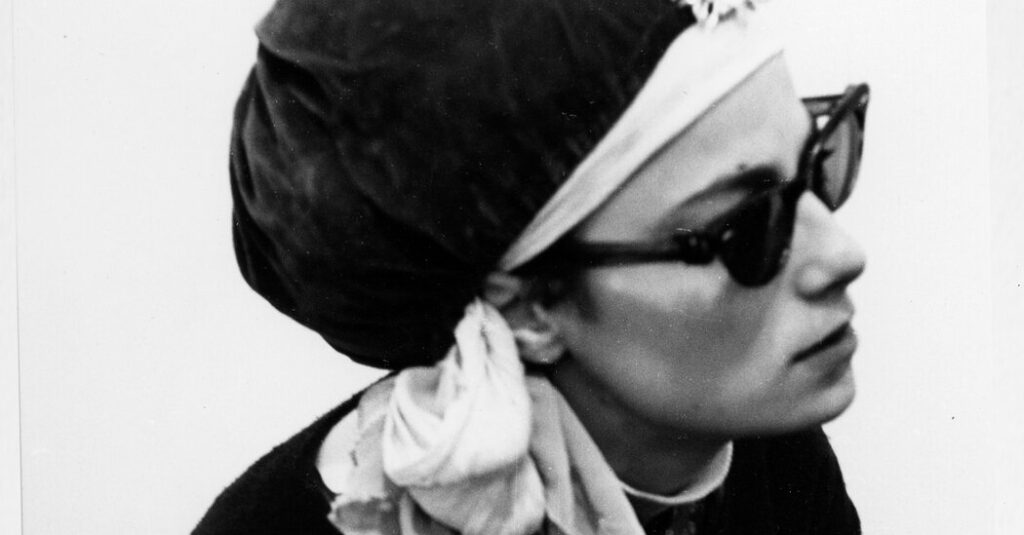
For a few years in the 1960s, a teenage filmmaker from Queens named Barbara Rubin helped jolt Manhattan’s underground art scene by pulling poets, painters, rock bands and experimental filmmakers into the same rooms.
She had just turned 18 when she joined the filmmaker and critic Jonas Mekas in championing experimental movies. She also made one of her own, “Christmas on Earth,” a roughly 30-minute, black-and-white, 16-millimeter collage of naked bodies and overlapping images that became a touchstone of the New York avant-garde.
She met the Beat poet Allen Ginsberg and, by his account, seduced him. And she brought both Ginsberg and Bob Dylan to Andy Warhol’s studio, the Factory, the new epicenter of a burgeoning art-world subculture.
Rubin may not have introduced the underground to sex and drugs, but as the movement’s resident baby boomer she added a measure of rock ’n’ roll.
She turned solemn poetry readings at the East Village café Le Metro, a hangout for young writers, into impromptu dance parties at a dive bar around the corner, and she prodded two regulars, Ed Sanders and Tuli Kupferberg, to channel that spirit into a satirical rock band called the Fugs. She also escorted Warhol and his entourage into the tourist trap Café Bizarre, and introduced them to a raw young band, the Velvet Underground.
She filmed the scenes she helped create. Her best known and only surviving film, shot intermittently between 1963 and 1965, began with an unprintable working title before she borrowed its name from a line in the poet Arthur Rimbaud’s “A Season in Hell”: “Christmas on Earth.”
The film could be clinically described as an exercise in gynecological exploration. Essentially performative, it was first shown at the Film-Makers’ Cinematheque, on a double bill with Warhol’s “Outer and Inner Space,” with two reels projected side-by-side.
More often, her film was shown with one image superimposed on the other. Occasionally she showed the reels sequentially or ran them backward and upside down. She continued to edit as well, cutting one print into four-frame shards and resplicing them at random. In every case, the content — an alternately obscure and bleached-out but always in-your-face entanglement of naked bodies — was impossible to ignore.
Writing in Artforum in 2022, the critic Amy Taubin called “Christmas on Earth” “the most transgressive and transcendent” of American underground movies.
Barbara Rubin was born on June 8, 1945, the second child of Lester Rubin, a businessman, and Pauline (Katz) Rubin, who managed the home. She grew up in a two-family house in Cambria Heights, a suburban neighborhood in southeastern Queens.
Relatives interviewed in Chuck Smith’s 2019 documentary, “Barbara Rubin & the Exploding NY Underground,” describe her parents as permissive and Barbara as willful. An addiction to diet pills while she was in high school landed her in Silver Hill Hospital, a sanitarium in New Canaan, Conn.
Rubin was discharged in June 1963, shortly after turning 18. Her uncle William Rubin, who was managing the Off Broadway Gramercy Arts Playhouse, found her a job working as an assistant to Mekas, an evangelist for independently made movies, at the Film-Makers’ Cooperative, which had been set up to distribute underground films.
“A week out of nine months of mental hospital indoctrination and I meet Jonas Mekas and he gives me a camera and film, love and trust,” she wrote in the Film-Makers’ Cooperative catalog by way of introducing her films.
Her arrival had coincided with the first screenings of Jack Smith’s scandalous “Flaming Creatures,” which quickly became a test case for obscenity laws.
In December 1963, Mekas intended to present his magazine Film Culture’s annual award by screening “Flaming Creatures” at the Tivoli Theater, a seedy Times Square movie house. When the theater abruptly canceled the show, Rubin led an occupation until the police cleared the building.
Later that month, she and Mekas smuggled “Flaming Creatures” into an international avant-garde film festival in Belgium, forced their way into a projection booth and managed to show part of it before the organizers cut the power, helping touch off a near riot that made the front page of Variety.
According to Mekas, those battles transformed Rubin from an apparently shy teenager into a rebel, “bursting and burning with hallucinations, shooting her first movie, with the excitement of a holy nun,” he wrote of his protégée in his weekly Village Voice film column.
When “Christmas on Earth” was shown in 1965, Mekas was moved to poetry: “As the film goes, image after image, the most private territories of the body are laid open for us. The first shock changes into silence, then is transposed into amazement.”
He proposed a syllogism: “Barbara Rubin has no shame; angels have no shame; Barbara Rubin is an angel.”
She solicited support from Walt Disney for a sequel, “Christmas on Earth Continued,” that would feature the Beatles and Dylan with Hollywood stars like Elizabeth Taylor alongside cartoon characters like Tinker Bell, Dumbo, and the Seven Dwarfs. Her request was ignored.
While on a flight to London with Ginsberg, she slipped a copy of her script to Dylan, who was also on the plane, to give to the Beatles. In London, Rubin was an organizer of the International Poetry Incarnation at Royal Albert Hall in June 1965. The event drew 7,000 people, including Mick Jagger, Marianne Faithfull and Indira Gandhi.
She moved forward on other projects, including collaborating with Warhol and his associates on the “Exploding Plastic Inevitable,” an immersive, multimedia art event staged on St. Marks Place in April 1966.
In 1967 she pulled together a three-week mixed media extravaganza called “Caterpillar Changes” at the Film-Makers’ Cinematheque. A kaleidoscopic presentation of multiscreen projections accompanied by live music, including performances by the Argentine saxophonist Gato Barbieri, the program was described on fliers as “New York’s First United Acidheadspeed Relief Fun Ball and Glitter Parade.”
Rubin was a fixture at major countercultural events like the Easter 1967 Central Park Be-In and the October 1967 antiwar March on the Pentagon, which she participated in with the filmmaker Shirley Clarke.
She and Clarke wanted to collaborate on an anti-Vietnam movie with a working title of “The Fugs Go to Saigon” and with a supporting cast that included the writers William S. Burroughs and LeRoi Jones (who later changed his name to Amiri Baraka), but they were unable to secure funding.
Rubin’s last major project was creating East Hill Farm, a bohemian commune in upstate New York that was funded by Ginsberg and populated by his friends. Rubin envisioned it as a place where she could settle down and have a child with Ginsberg; he did not share her interest.
Rubin was heartbroken, said the photographer Gordon Ball, a farm resident, and took refuge in a nearby Orthodox Jewish orphanage.
She studied with the charismatic rabbi Shlomo Freifeld at his yeshiva in Far Rockaway, Queens, and in 1971 married a fellow student, Mordechai Levy, at a traditional Orthodox wedding attended by Ginsberg and Dylan.
Rubin made one last movie, “Emunah” (the Hebrew word for faith), which she described to Mekas as “a film dealing with the concentration camp experience.” It has since been lost.
Rubin and Levy divorced, and she married the French-born painter Israel Isaac Besancon, and, in 1973, they moved to Aix-les-Bains a town in eastern France renowned as a post-Holocaust sanctuary for Jewish rebirth.
She died on Sept. 17, 1980, of a postnatal infection after giving birth to her fifth child. She was 35.
Two years later, Mekas arranged for a screening of “Christmas on Earth.” He also archived their plentiful correspondence, rescued her work from obscurity and created a short film, “To Barbara Rubin With Love” (2006).
In 2013, Anthology Film Archives and the Boo-Hooray gallery showed her films and exhibited her notes and letters and relevant photographic material. The next year, the film scholar Ara Osterweil’s book “Flesh Cinema: The Corporeal Turn in American Avant-Garde Film” placed Rubin in the context of the radical feminist artists Carolee Schneemann and Yoko Ono.
The final issue of Film Culture, published in 2018, was devoted to “The Legend of Barbara Rubin.” Smith’s “Barbara Rubin & the Exploding New York Underground” followed in 2019, and Todd Haynes’s 2021 documentary, “The Velvet Underground,” confirmed Rubin’s centrality to the downtown avant-garde scene.
Utterly otherworldly, Rubin moved through the 1960s as a kind of human switchboard, connecting poets, filmmakers and rock musicians long before social networks existed.
Her path traced an improbable trajectory from Cambria Heights through the downtown underground to the exaltation of Hasidic mysticism. The films, records and memories she left behind are fragmentary, but they suggest that the connections she forged and the life that grew out of them were her enduring achievement and ultimate mystery.
The post Overlooked No More: Barbara Rubin, Teenage Filmmaker at the Heart of New York’s Underground appeared first on New York Times.