To the Editor:
Re “U.S. Eases Rules in Nuclear Deal for Saudi Arabia” (front page, July 23) and “Trump Demands Saudis Establish Ties With Israel; Nuclear Deal Caveat” (front page, July 24):
Of all the ill-advised moves that President Trump has made in the Middle East since the Iran war began five months ago, his decision to give Saudi Arabia a potential pathway to nuclear enrichment — now subject to his new demand that the Saudis establish diplomatic relations with Israel — ranks among the most self-defeating.
Over the course of the conflict, Mr. Trump has repeatedly proclaimed that one of his main objectives is to prevent Iran from ever acquiring a nuclear weapon and therefore denying it the ability to enrich uranium for this purpose.
If that is the case, why is he handing the potential ability for such enrichment to Saudi Arabia, Iran’s chief antagonist in the region after Israel? Is he so clueless as to fail to recognize the incentive that this gives the Islamic Revolutionary Guard Corps and the country’s hard-liners to dig in their heels in demanding the right to retain such capability themselves? Apparently, he is.
By giving Saudi Arabia the potential for nuclear enrichment while demanding that Iran abandon such capability as a condition for peace, Mr. Trump is guaranteeing that the prospect for resolving the conflict remains ever more elusive.
Michael Silk Laguna Woods, Calif.
To the Editor:
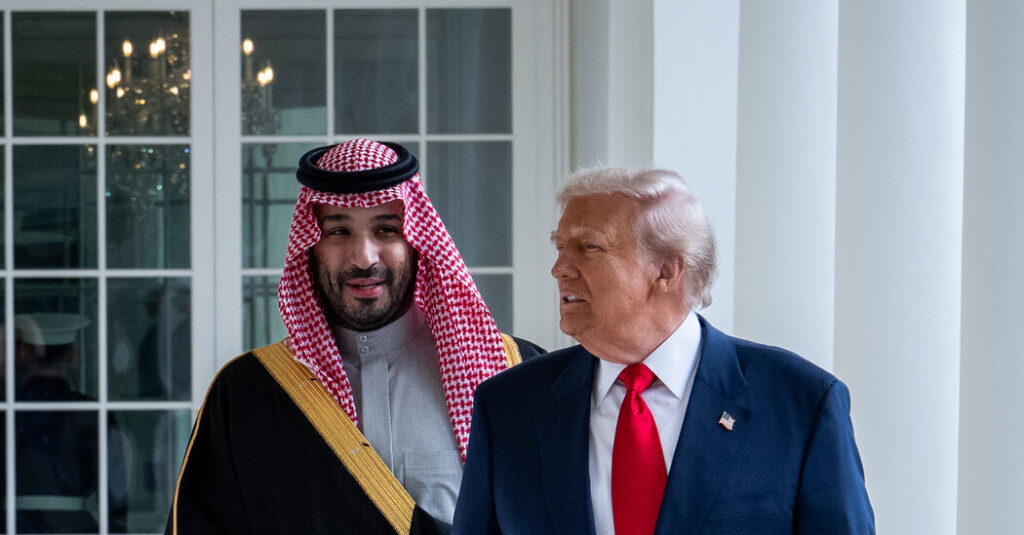
The deal the Trump administration struck with Crown Prince Mohammed bin Salman of Saudi Arabia to provide the kingdom with long-sought American nuclear technology constitutes a reckless abandonment of U.S. efforts to deter Saudi development of nuclear weapons.
Coming in the midst of a war in the Middle East and a struggle to block Iran from developing nuclear weapons, a Saudi deal, though intended for peaceful development, would inevitably raise the risk of nuclear rivalry in a perpetually volatile region.
President Trump’s deal with the Saudis, if approved by Congress, would represent a stunning departure from decades of American policy to stem proliferation. It’s bound to strengthen Iran’s resolve to develop nuclear weapons, upending the president’s continuously stated goal of containing Iran’s nuclear ambitions.
The deal with the crown prince is consistent with the president’s efforts to establish close personal financial ties with the Saudi kingdom that have dubious benefits for the United States. An agreement to help build a Saudi nuclear program from the ground up would be a huge windfall for certain U.S. companies, at the expense of long-term Middle East stability.
Roger Hirschberg South Burlington, Vt.
To the Editor:
History has an inconvenient habit of repeating itself. The United States backed the shah of Iran until the 1979 Islamic Revolution, then spent nearly half a century confronting the regime that followed. Along the way, agreements were reached in hopes of reducing future dangers, yet mistrust endured.
Now Washington is preparing to assist Saudi Arabia in developing a civilian nuclear program. We are assured, once again, that today’s ally will remain tomorrow’s ally. History suggests a little more humility. Governments change, alliances shift and today’s carefully negotiated safeguards may look very different 30 or 50 years from now.
Perhaps history does not repeat itself exactly — but it has an uncanny sense of irony.
Juan Carden St. Louis
To the Editor:
The Trump administration’s willingness to provide nuclear technology to Saudi Arabia without rigorous restrictions on enrichment of uranium or inspections moves us further on the path to nuclear war.
The Saudi government has been guilty of human rights violations, including the murder of the Saudi journalist and dissident Jamal Khashoggi. Individuals and organizations in Saudi Arabia have also supported organizations hostile to the United States. Those are reasons to be more cautious — not less — regarding sharing nuclear technology.
As noted in the article, the supposed peaceful use of nuclear power can easily shift to making bombs. The existence of more countries with nuclear weapons, particularly during turbulent times, increases the likelihood that weapons will be used. What is needed is a robust plan for nuclear disarmament by all countries — not proliferation of nuclear technology without safeguards.
Jeff Atkinson Wilmette, Ill.
A Flawed Idea About the Strait of Hormuz
To the Editor:
Re “Could the Gulf States Share the Strait of Hormuz?” (news article, July 20):
The proposal to turn the Persian Gulf into a jointly administered “regional commons” modeled on the European Coal and Steel Community mistakes the lesson of history. The E.C.S.C. did not create peace by giving a coercive state greater influence over strategic resources. It became possible only after France, West Germany and their partners reconciled, renounced territorial revisionism and committed to a common legal order underwritten by the United States.
None of those preconditions exist in the Gulf. Iran has repeatedly threatened to close the Strait of Hormuz as leverage over the world. Giving Iran a formal role in administering the waterway it has endangered would signal that coercion is rewarded while entrusting a critical artery of global commerce to the world’s leading state sponsor of terrorism — with dire consequences for regional stability, energy markets and freedom of navigation.
The problem in the Gulf is not the absence of rules but Iran’s willingness to violate them. The answer is to deter and punish Iranian coercion, not renegotiate the rules every time they are breached.
Mark D. Wallace New York The writer is the chief executive of United Against Nuclear Iran.
Blame Policy for the Five-Day Workweek
To the Editor:
Re “The Elusive Promise of the Four-Day Workweek,” by Joanne Lipman (Opinion guest essay, July 7):
Ms. Lipman is right that we shouldn’t look to corporations to lead society to a four-day workweek and that the mere existence of A.I. will not produce it. However, she misses the mark when she blames a culture of workaholism and the performance of busyness, as though those couldn’t possibly be driven by corporate practices and the soaring cost of living.
The deeper reason we haven’t seen the shift is policy: The 40-hour workweek was codified in federal law in the 1940s, and no serious effort has changed it since. It’s no surprise the workweek has stayed frozen while companies demand more and more from their employees.
Ms. Lipman also understates the movement’s recent momentum. Hundreds of companies, including both of ours, have shifted to four-day weeks in just the past few years, seeing better work-life balance alongside real growth. That surge, when combined with how working families experience unprecedented time poverty and burnout, is exactly why local, state and federal legislation is more possible than ever.
Legislation, not voluntary corporate policy alone, is the only way to ensure that a shorter week reaches all workers equitably, not just those lucky enough to work somewhere untethered to today’s corporate norms.
Jennifer Njuguna Vishal Reddy Ms. Njuguna is a chief executive of Common Future, and Mr. Reddy is the executive director of WorkFour.
The post Concerns About the U.S.-Saudi Nuclear Deal appeared first on New York Times.