In an Instagram revolt of the young, India’s “WhatsApp Uncles” are at a loss.
Prime Minister Narendra Modi, who for more than a decade has used social media to project an image of nearly divine infallibility, is facing perhaps his most formidable challenge in years in the form of a Gen Z-driven protest that has seized the digital narrative with videos, memes and authentic outrage.
As the demonstrators vent their anger at India’s economic failings and a lack of accountability, the signs and slogans in New Delhi at the main site of the protests — which spread this week to several other Indian cities — are aiming directly at Mr. Modi. Usually criticized only in whispers, the strongman leader has suddenly found himself the subject of jokes and taunts, with protesters defacing him on billboards and mocking him in verse, sharing the images online to an audience of millions.
One widely viewed video shows a group chanting about the prime minister as a “56-inch monkey,” a reference to his boasting of a 56-inch chest. Others are pointedly more profane.
The Indian state, its vast authority increasingly built around Mr. Modi’s image, has struggled to match the protesters’ creativity and tenacity. Anurag Minus Varma, the author of a book about how social media algorithms are transforming India, said the massive mobilization on the streets had broken a sense of fear and offered a release for pent-up anger.
“Because of the comfort of the crowd, now people can voice out their opinion,” Mr. Varma said. “And when they are voicing out their opinions, it is almost an outburst because every safety valve of democracy was closed by this particular regime.”
The protest movement was not really about Mr. Modi at the beginning.
It started as a sit-in in New Delhi demanding the resignation of the education minister, under whom several college exam cheating scandals have affected millions of young people worried about their career prospects in India’s super-competitive job market. Last weekend, police officers in plain clothes fought their way through supporters of a prominent activist who had gone on a hunger strike, dragged him to a hospital and began forcibly clearing the protest camp.
In the days that followed, Mr. Modi was largely silent. And his government’s dismissive response — with the education minister, Dharmendra Pradhan, calling the protesters a “B-team of terror groups” — exposed a generational gap.
It was the kind of condescension that the protesters call “WhatsApp Uncle”-speak — a lecturing, one-way discourse that has taken over India’s public space as Mr. Modi’s Bharatiya Janata Party dominates the social messaging platform to promote its agenda with texts that are duly forwarded by supporters.
That was the tone in which many young Indians heard India’s chief justice, in mid-May, compare the country’s unemployed young people to parasites and “cockroaches.” In response, a graduate student created the satirical Cockroach Janata Party online. The group quickly blew up on Instagram, where it has nearly 26 million followers.
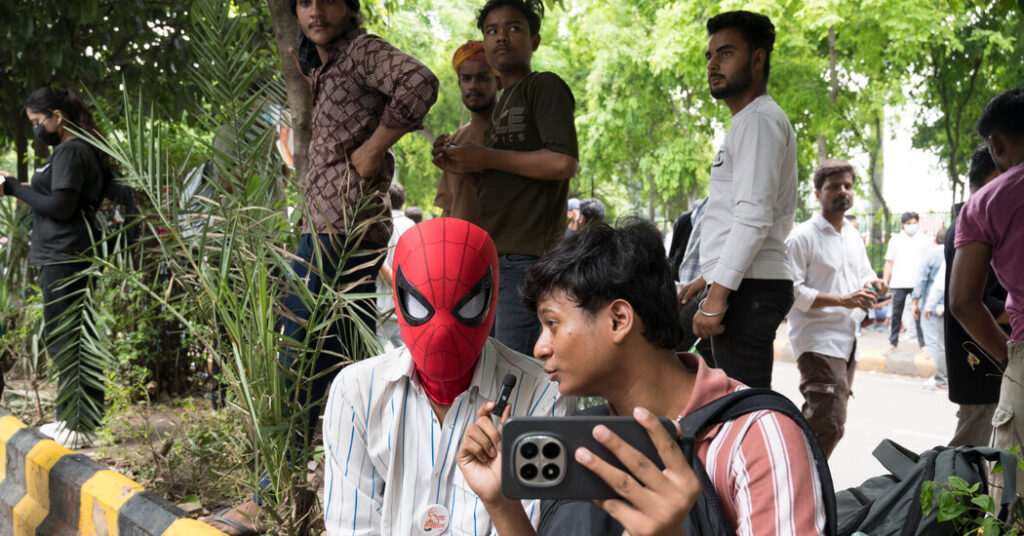
India’s mainstream news media, much of it co-opted by Mr. Modi and his party, hardly covered the sit-in as it began at Jantar Mantar, in the heart of the capital. It spread thanks to YouTubers and small digital news outlets such as Peek TV, which collected over 200 million views of its short videos from the protest site across Instagram and YouTube in one week. Another YouTube account, Unfiltered by Samdish, captured video from behind the police lines on Monday as officers tried to break up the sit-in with batons and tear gas. The episode received more than two million views in two days.
Protesters have documented the police response in ways that have made officials look plodding and out of touch.
When security forces rushed at them with batons, young protesters filmed over their shoulders as they outran the middle-aged officers. Others pushed their cellphones in the faces of the police as they were attacked, some sneeringly asking for more punishment.
In one video, a group of protesters films from the back seat of a police van as the officer riding shotgun raises the possibility that they could be slapped with bogus drug charges. The young man holding the cellphone flips the camera to himself, his hand over his mouth in a look of astonishment familiar from countless internet memes.
Joyojeet Pal, a University of Michigan professor who studies political communication in India, said the protests have demonstrated that the centralized control of the information space that Mr. Modi enjoyed for the past decade may no longer be working. The government’s top-down messaging style is ill suited for social media algorithms that now prioritize authenticity, he said.
“It is no longer, ‘Look what the police did,’ and it is more, ‘This is how today felt,’” Mr. Pal said.
The protests have focused on real economic concerns, but they have also been a gold mine of content creation.
There were “get ready with me” videos, including one by a young protester who puts foam pads inside his trousers to protect his behind from police batons. Some tongue-in-cheek “fit checks” focused on what people were wearing at the protest site. A protester who was being driven away to detention with a large group posted, “Thanks to the world’s largest democracy, got a window seat in police bus.”
Another filmed police picking up their gear after breaking for a meal and said to the officers, “Did you eat, uncle ji? Stomach is full? Now going to war? Best of luck!”
It remains to be seen how Mr. Modi, 75, will try to placate the protesters, whose demands have expanded from the education minister’s resignation to include amnesty for peaceful demonstrators and greater accountability from the government over the exam leak.
Before the last national elections, in 2024, he brought influencers and podcasters to his side, an acknowledgment that the Indian social media space was changing. His party remains dominant in Parliament and has been on a winning streak in state elections, the political opposition is in disarray, and no one comes close in India to Mr. Modi’s political power or fund-raising prowess.
Late Thursday night, Mr. Modi addressed the protests on video for the first time. Gone was the slick, often multicamera production that Indians are used to seeing him in. The camera was right in his face, as if filmed selfie-style on mobile.
“Friends,” he began, in English, before promising strict action against anyone found to have played a role in the exam leaks. He made no mention of the demand for the minister’s resignation.
The video was released just as mobile internet service had been blocked around the main protest site in New Delhi.
“Internet has been blocked in Jantar Mantar,” one social media user wrote in a comment on Mr. Modi’s video. “How will those people watch it, sir?”
The post Phones in Hand, India’s Young Protesters Blast Through Modi’s Media Control appeared first on New York Times.