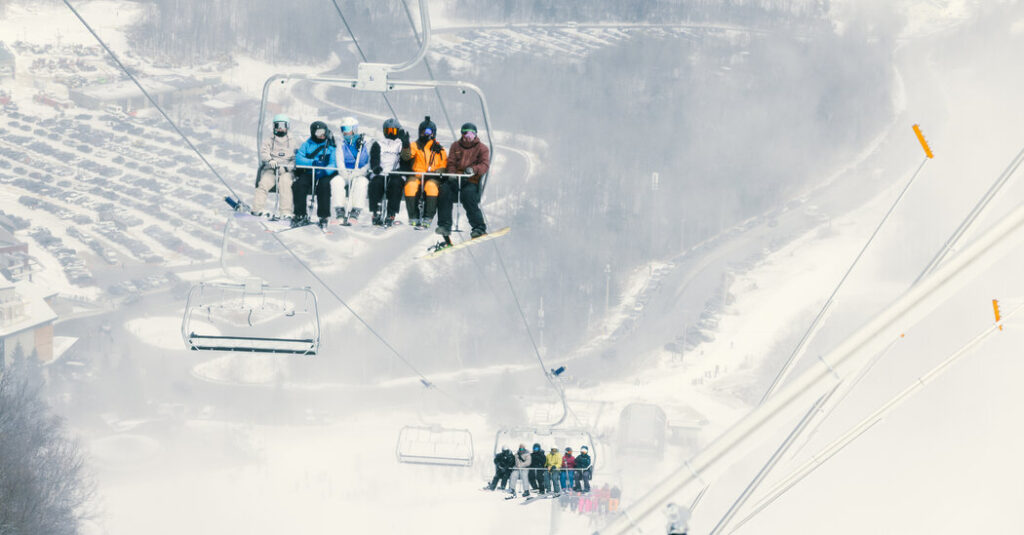
Killington, the sprawling ski resort in central Vermont, has many claims to fame: Its 4,229-foot main peak is Vermont’s second highest mountain; it has 73 miles of ski trails and a vertical drop of over 3,000 feet; about 800,000 people ski there every year.
But it has never been known for a fancy base area.
Great Gulf, a Toronto-based real estate developer, wants to change that. It is planning to invest $3 billion to build a new base village at the mountain over the next 25 years. Its renderings of the development show clusters of luxury homes, two public squares, a large open area called a “ski beach,” a fitness grove, forest spa, skating path, panoramic pool, and more than 100,000 square feet of retail and dining space along a pedestrian promenade. It is being designed by the architect Moshe Safdie, whose work includes the Marina Bay Sands resort in Singapore, featured in the film “Crazy Rich Asians.”
Killington is entering a luxury arms race that is sweeping the ski industry. Deer Valley is in the midst of an expansion that has doubled the Utah resort’s skiable terrain and will add a $5 billion base village complete with $9 million town homes. Powder Mountain, the Utah ski resort acquired in 2023 by the Netflix co-founder Reed Hastings, is setting aside 2,700 of its 8,000 skiable acres for exclusive use by residents of a new development called Powder Haven, where building lots average $4 million, plus an annual membership fee of between $30,000 and $100,000.
And at Stowe Mountain Resort, in northern Vermont, developers invested $500 million over two decades to create a high-end village in the Spruce Peak base area that includes five restaurants, a hotel, a members-only club and golf course, a 10,000-square-foot outdoor ice rink, and 450 residences that range in price from $200,000 to $15 million.
But in its scale, the Killington project dwarfs anything at a ski area in the Eastern United States. Kevin Chu, the executive director of the Vermont Futures Project, notes that Vermont has not had a project of this size since at least 1970. “It is certainly at a scale that may feel a bit out of context for what Vermonters know and feel about the state.”
For decades, Vermont effectively fended off large scale developments. In 1970, the state enacted Act 250, a landmark land use law that restricts large scale development by requiring time-consuming and costly reviews of potential impacts on water, air, traffic and aesthetics. That process stymied Killington’s previous development efforts, culminating in a pitched battle in the mid-1980s that blocked a plan for the ski area to expand into 1,000-acre area known as Parker’s Gore, which was deemed to be prime bear habitat.
Last year, the Vermont legislature passed Act 181, which made sweeping reforms to the development law, and which Great Gulf hopes will “ensure a more expeditious process,” according to Michael Sneyd, who is overseeing the Killington project for Great Gulf.
But in what may be a sign of things to come, the developers recently canceled plans for what they were calling the Crystal, a gleaming glass-walled base lodge the size of a football field, that was to be the centerpiece of the project. Mr. Sneyd said that “our goal is to still have an icon with the lodge,” but a new design has not yet been announced.
Mike Solimano, Killington’s president and general manager, told a community meeting in October that a new lodge would be “not as palace-y.”
A new village in the mountains
The bottom of Killington is a mishmash of old, new and tacky. You reach the ski resort after a 3.5-mile drive along an access road, with no defined town center. The Ramshead and Snowshed base lodges, which date to the early 1960s, now stand as symbols of faded glory. The base area is dominated by a sprawl of large parking lots.
The idea for a resort village has been around since Killington was founded in 1958. Mr. Solimano recalled that when he began working at the resort 23 years ago as its vice president for finance, he was told that he would be working on building a $1 billion village within a year.
“It’s now a quarter century later and triple the price,” he said over lunch at the Killington Grand Hotel, the lone slopeside hotel at the ski area.
The current plan dates to 2023, when Great Gulf acquired 1,100 acres at the base of Killington for $43 million and announced plans to completely reconfigure it. The ski area and base village were separated in the early 2000s, when Killington’s previous owner, the now-defunct American Skiing Company, began selling off parts of the resort to raise cash. The base area was sold to a private developer, and the mountain was sold to Utah-based Powdr Corporation.
In September 2024, Powdr sold the resort to a group of Killington skiers and homeowners led by the hedge fund founder Phill Gross and Michael Ferri, who owns carwashes and oil change franchises. Great Gulf is a minority investor in the group.
Killington’s new owners have said they plan to reinvest all profits back into the mountain. They have already committed $60 million to fund high efficiency snow-making systems and new lifts.
Under Great Gulf’s plan, the old Snowshed and Ramshead base lodges will be torn down and replaced by the new development, where visitors will shop, dine and stay after a day on the slopes.
The idea is “to create a resort community that is appealing both to skiers and to those who perhaps don’t ski as much,” said Mr. Sneyd. He said that the goal for the new Killington is to rival “the most impressive ski resorts in North America, like Vail or Aspen.”
The plan would require the town of Killington, which has about 1,400 residents, to move the ski area access road to allow for a more pedestrian-friendly design. So far, the town has committed more than $80 million in public road and water infrastructure improvements, which include extending a municipal water line. This will help address PFAS contamination of local water sources that has forced some businesses to truck in water. The improvements will be paid for, in part, by a tax increment financing (TIF) bond, which borrows money based on anticipated increased property tax revenues.
Great Gulf originally hoped to break ground in the spring of 2025 but now anticipates that construction will start in the spring of 2027, with completion of the first housing units within two years. Mr. Sneyd estimates the mountainside units will cost between $2 million and more than $6 million apiece.
The development is being built with the expectation that climate change may result in shorter ski seasons. Great Gulf is “building a destination that can thrive year-round without being winter-dependent,” he said.
A mogul field of challenges
A key challenge confronting the Great Gulf project is Vermont’s housing crisis and worker shortage. Many workers simply can’t find affordable housing. Vermont’s vacancy rate of 3 percent is among the lowest in the country, which has contributed to the nation’s second highest rate of homelessness, according to the Vermont Housing Finance Agency. Vermont’s unemployment rate of 2.5 percent is the second lowest in the country, reflecting its tight labor market.
Great Gulf estimates that the project will employ around 3,000 construction workers and create more than 1,500 permanent hospitality jobs. The development will increase the number of housing units in the town of Killington by more than 70 percent.
“It’s tough to find workers, but if you treat the workers well, if you pay them well, and if you offer them good full-time employment, then they will come,” insisted Mr. Sneyd.
Which raises the question: Where will they live?
The ski resort and Great Gulf donated a combined $700,000 to the town of Killington to purchase land to build 300 to 400 units of affordable employee housing, but construction will not begin until the municipal water line is completed, which is a few years away. The ski resort currently provides 400 units of employee housing. Killington employs about 1,750 people during its peak winter season.
Great Gulf is also considering building employee housing in nearby Rutland, Vermont’s fifth largest city, which is 20 minutes from the ski area. The city, once a thriving center of the marble and rail industries, is a working class community and was the epicenter of a heroin epidemic over the past 15 years that made national news. It is currently experiencing something of a renaissance that has attracted new residents and, with them, “negative vacancy rates,” said Michael Doenges, Rutland’s mayor. He noted that a recent study determined that Rutland County, which includes Killington and Rutland, will need 9,000 new units of housing in the next decade to keep up with demand. “The only thing that’s holding us up now is we just don’t have enough places,” he said.
Still, “you’re less likely to find critics than cynics here in Killington,” said Polly Lynn Mikula, the editor and co-publisher of The Mountain Times, a weekly community newspaper, who noted that some people were skeptical because “a village has been planned and abandoned many times.”
Environmental groups that thwarted Killington’s past expansion efforts have been notably mum about the Great Gulf project, which was announced a month after the bond vote.
Doug Hoffer, the Vermont state auditor, said that paying for the development with a TIF draws money away from the state education fund, which means “every other town in the state will pay for this project.” He said of the Killington project: “In terms of job creation, it’s not great,” noting that many jobs would be temporary and “they’re comparatively low wage.”
The biggest wild card is a familiar one for developers in Vermont: how long it will take for Great Gulf’s revised plans to be approved by development-shy state and local officials. This may not become clear until sometime in 2026.
Mr. Sneyd is bullish on the development. He said that Vermont has an opportunity to “take advantage of 68 million people that live within a five to six hour driving distance. This is the future of places like Vermont, to be able to utilize their natural resources, their beauty, their mountains, in the way that our forefathers used marble and trees to fund their economic engines.”
Follow New York Times Travel on Instagram and sign up for our Travel Dispatch newsletter to get expert tips on traveling smarter and inspiration for your next vacation. Dreaming up a future getaway or just armchair traveling? Check out our 52 Places to Go in 2025.
The post Can a $3 Billion Upgrade Make Killington the ‘Aspen of the East’? appeared first on New York Times.